
Multiple-ownership index falls to lowest since Sept. 2018
Ownership index hits record 28.57, up 0.71 percentage points in a year
Tax reform drives multi-property sales; non-owners rush to buy
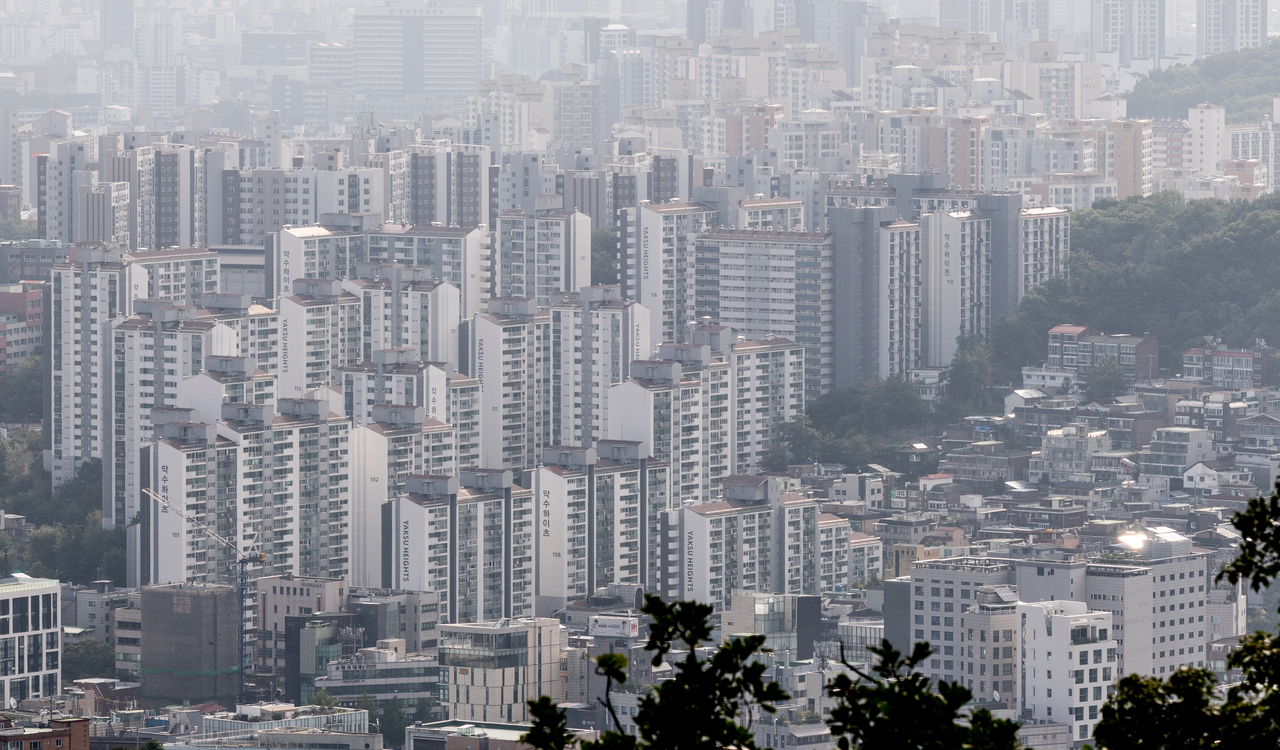
The share of people owning two or more collective residential properties — apartments, townhouses and officetels — has fallen to its lowest level in more than eight years, while the proportion of the overall population that owns at least one such property has hit an all-time high. The divergence reflects a broader restructuring of South Korea's real estate market toward single, owner-occupied homes amid the government's tightening stance on multi-property ownership.
According to the Court Registry Information Plaza, the multiple-ownership index for collective residential properties stood at 15.918 last month, the lowest reading since September 2018 (15.882). The index measures the share of collective-property owners who hold two or more units — meaning roughly 15.9 out of every 100 such owners currently hold at least two properties. The decline was particularly pronounced among owners holding between two and seven units.
The index climbed from 16.469 in May last year to a peak of 16.475 in June before turning downward in July and falling steadily through October this year — a slide that began almost immediately after the current government took office with a policy platform centered on curbing multi-property ownership. Compared with last June's peak, the index was down 0.557 percentage points last month.
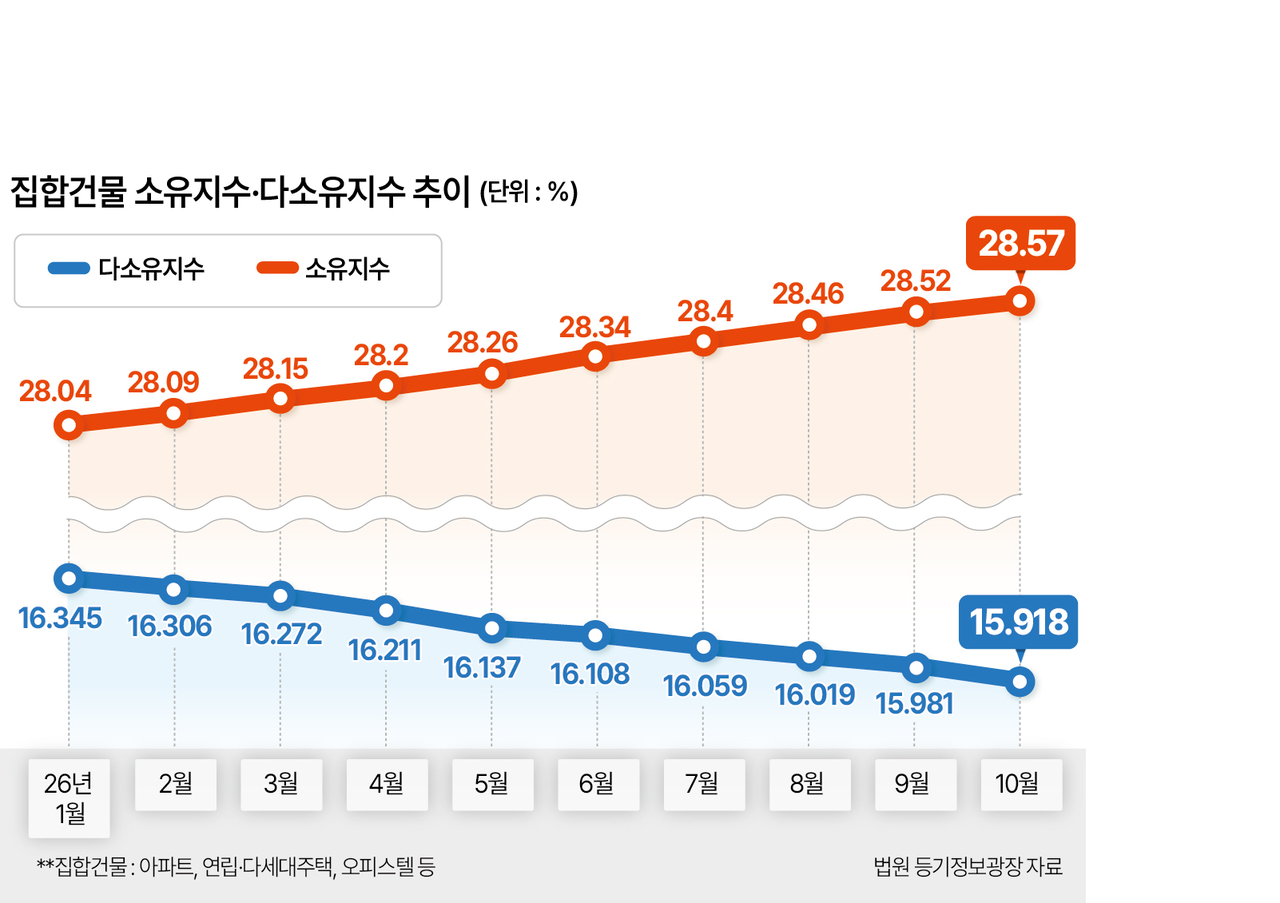
The overall ownership index, by contrast, set a new all-time high. The index — which tracks the share of the total population that owns at least one collective residential property — reached 28.57 last month, the highest level since records began in January 2010. That is up 0.71 percentage points from the same month last year (27.86). The index has risen without interruption this year, moving from 28.04 in January to 28.15 in March, 28.34 in June and 28.52 in September — a cumulative gain of 0.53 percentage points over ten months.
The current reading is roughly 5 percentage points above the 23–24 range recorded during the 2020–2021 real estate boom, when demand for both homeownership and investment was at its height.
Analysts say the two indices are moving in opposite directions because multi-property owners are offloading units that end-users without homes are snapping up, reshaping the ownership structure. Sales by multi-property holders and first-time purchases by non-owners are happening simultaneously, pushing the multiple-ownership index down while lifting the overall ownership index.
The sell-off by multi-property owners is largely a response to the government's Aug. 3 tax reform package, which signaled a clear intent to raise holding taxes and capital gains taxes on multi-property owners, non-resident landlords and owners of high-value homes. As awareness spread that the tax burden of holding multiple properties would increase, owners have been moving to shed lower-yielding units and consolidate around a single prime property in a key location.
At the same time, non-owners have been actively moving to buy. Persistent price increases in major Greater Seoul areas — driven in part by supply shortage concerns — have fueled anxiety that waiting any longer will price buyers out, translating that fear into purchases. Worsening jeonse and monthly rent conditions, with fewer listings and rising rents, have also pushed more end-users toward what has been called "survival buying": choosing to purchase rather than absorb ever-higher housing costs.
The National Assembly's fiscal and economic planning committee began reviewing the real estate tax reform bill in its tax subcommittee this week. While some details may be adjusted during deliberations, most observers expect the core tightening of the tax burden on multi-property owners to remain intact — meaning the wave of disposals is likely to continue for some time.
Ko Joon-seok, a professor at Yonsei University's Sangnam School of Management, said the trend reflects both the announced tightening of taxation and the rush by multi-property owners to sell or transfer properties ahead of the outcome of the regular National Assembly session in December. "The direction of raising both holding taxes and transaction taxes simultaneously has already been set, so multi-property owners have been scrambling to dispose of or gift their properties," Ko said. "In the current market, holding housing for investment purposes is in effect impossible, so the structure has shifted to an end-user-driven market where real demand absorbs multi-property listings."
Ilda
hwshin@heraldcorp.com




