
ETRI develops autonomous research AI 'YouRA,' outperforming Japanese and Singaporean rivals
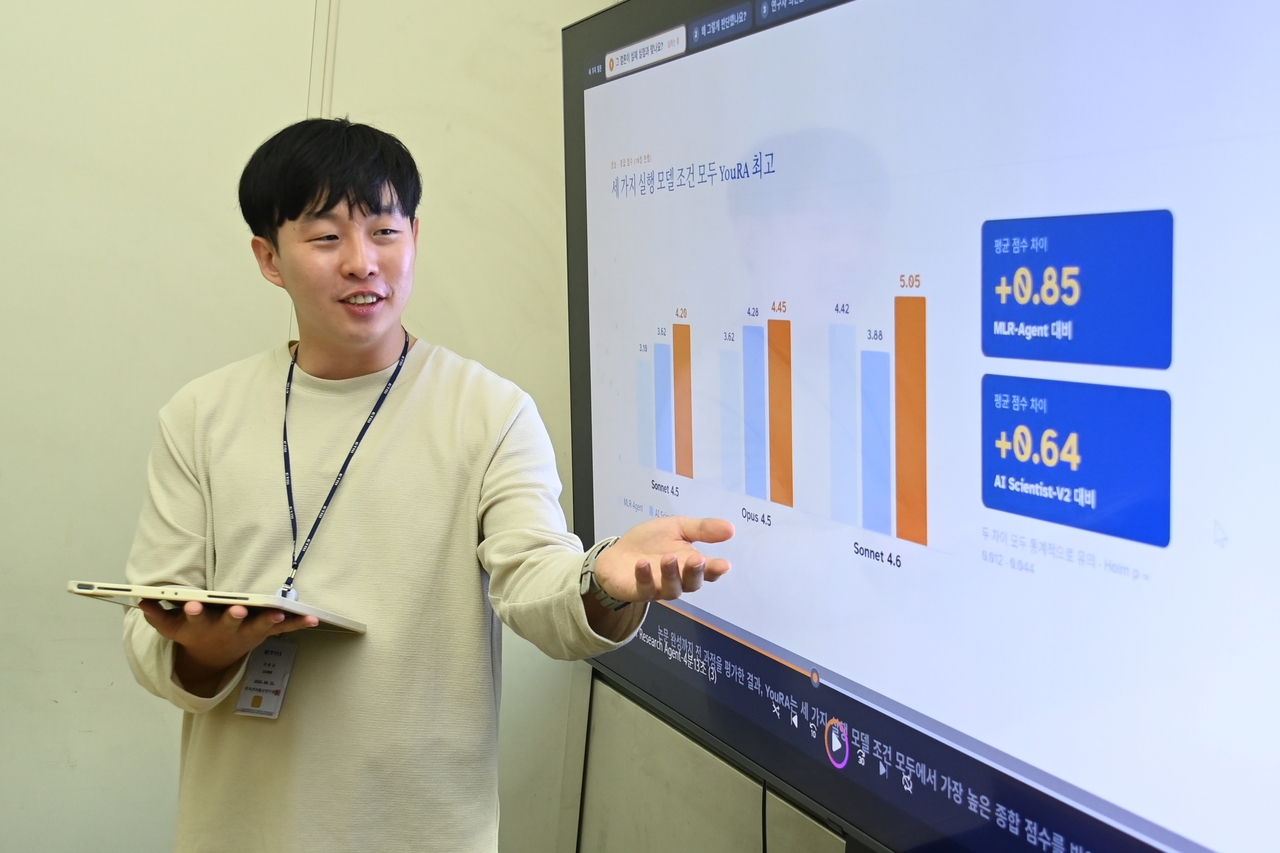
An "AI scientist" capable of independently setting research topics, forming hypotheses, running experiments, verifying results and writing papers has arrived.
The Electronics and Telecommunications Research Institute (ETRI) announced Thursday that it has developed an autonomous AI agent called YouRA that can carry out the entire research process on its own.
Given only a call for papers from an international AI conference, YouRA sets its own research direction and topic. It then forms hypotheses through debate and review among multiple AI agents, analyzes prior research, gathers experimental data, verifies hypotheses and produces a finished paper.
Earlier autonomous research AI systems had notable limitations: relying on conversation logs meant that records of failed hypotheses or experiments were often lost, and the claims in a paper sometimes did not match the actual experimental results.
To address this, ETRI researchers developed technology that logs every stage of the research process as structured data and improves reliability through step-by-step verification and analysis of failure causes.
The team also separated the AI that conducts research from the AI that judges whether each research stage is complete, reducing the risk of wrapping up a study prematurely. The system can incorporate mid-course changes to the research scope or evaluation criteria and continue accordingly.
YouRA's competitiveness was confirmed in performance evaluations using MLR-Bench, an internationally recognized open benchmark.
In the paper-completion evaluation, YouRA scored an average of 0.64 points higher than Sakana AI's AI Scientist-V2 from Japan and 0.85 points higher than the National University of Singapore's MLR-Agent.
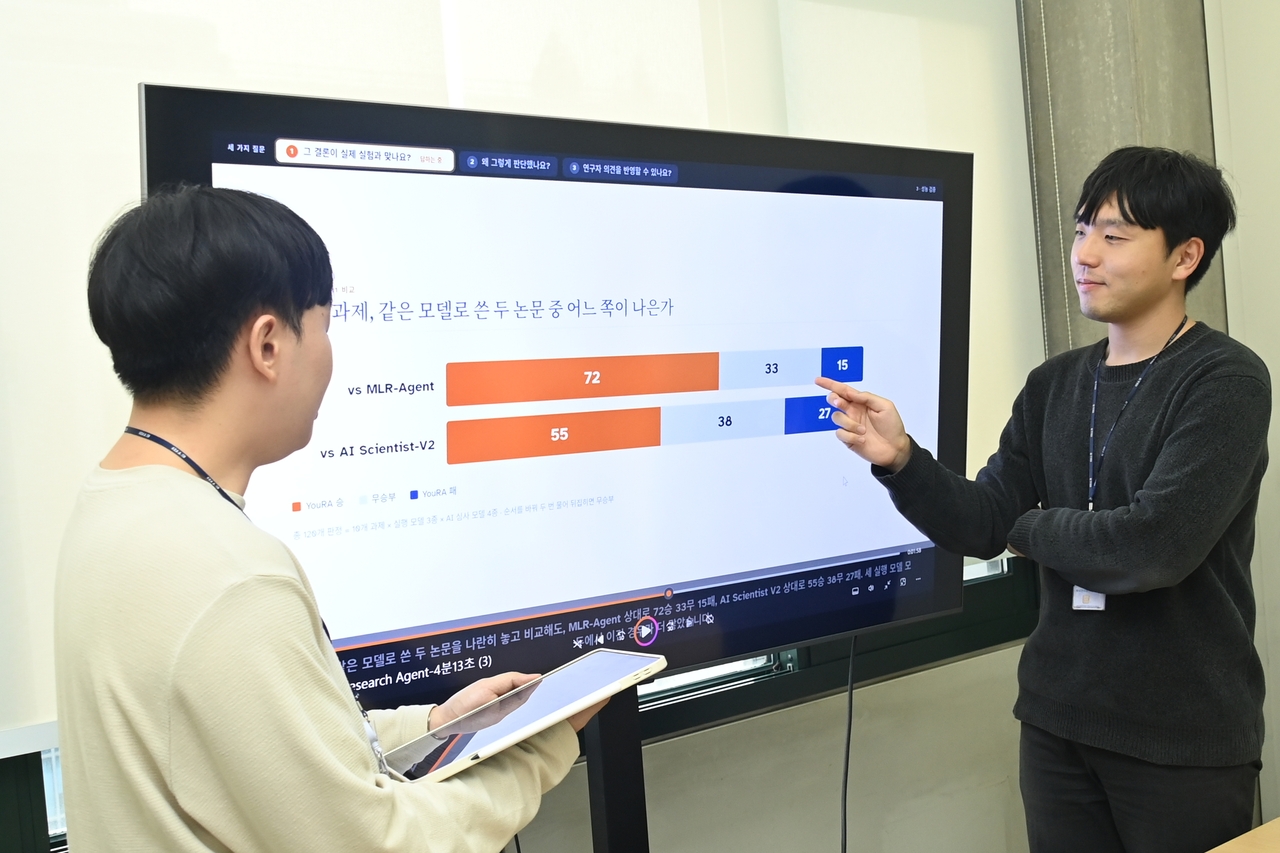
In head-to-head paper comparisons, YouRA also came out ahead, posting a record of 72 wins, 33 draws and 15 losses against MLR-Agent, and 55 wins, 38 draws and 27 losses against AI Scientist-V2.
YouRA also led in its ability to conduct experiments using real data. Of 30 papers evaluated, both analytical tools judged 27 produced by YouRA to have used real data-based experiments — far exceeding AI Scientist-V2 with 17 and MLR-Agent with 11.
However, overall scores in the paper-completion evaluation remained in the 4-to-5 range out of 10, and YouRA showed no clear advantage over rivals in some hallucination-error assessments, indicating that further technical refinement is needed.
ETRI plans to expand the technology beyond autonomous research in fields such as new materials to broader AI agent applications where tracking task history and verifying evidence are critical.
"It is important for AI to conduct research on its own, but it must also be trustworthy in its process and results before it can truly develop into an AI scientist," said Lim Su-jong, head of ETRI's Language Intelligence Research Laboratory. "We will continue to advance the technology so that AI can grow into a key research partner that accelerates scientific discovery."
nbgkoo@heraldcorp.com




