
Men more likely than women to want marriage and children
1 in 10 married women has no children
Non-family childcare surpasses family care for first time in 10 years
For the first time, more than half of Koreans in their 30s were unmarried last year, with 6 in 10 men and more than 4 in 10 women in that age group having never married.
The survey also found that women were less likely than men to want to marry or have children. In childcare, reliance on family has declined while the role of external facilities such as hagwon and daycare centers has grown.
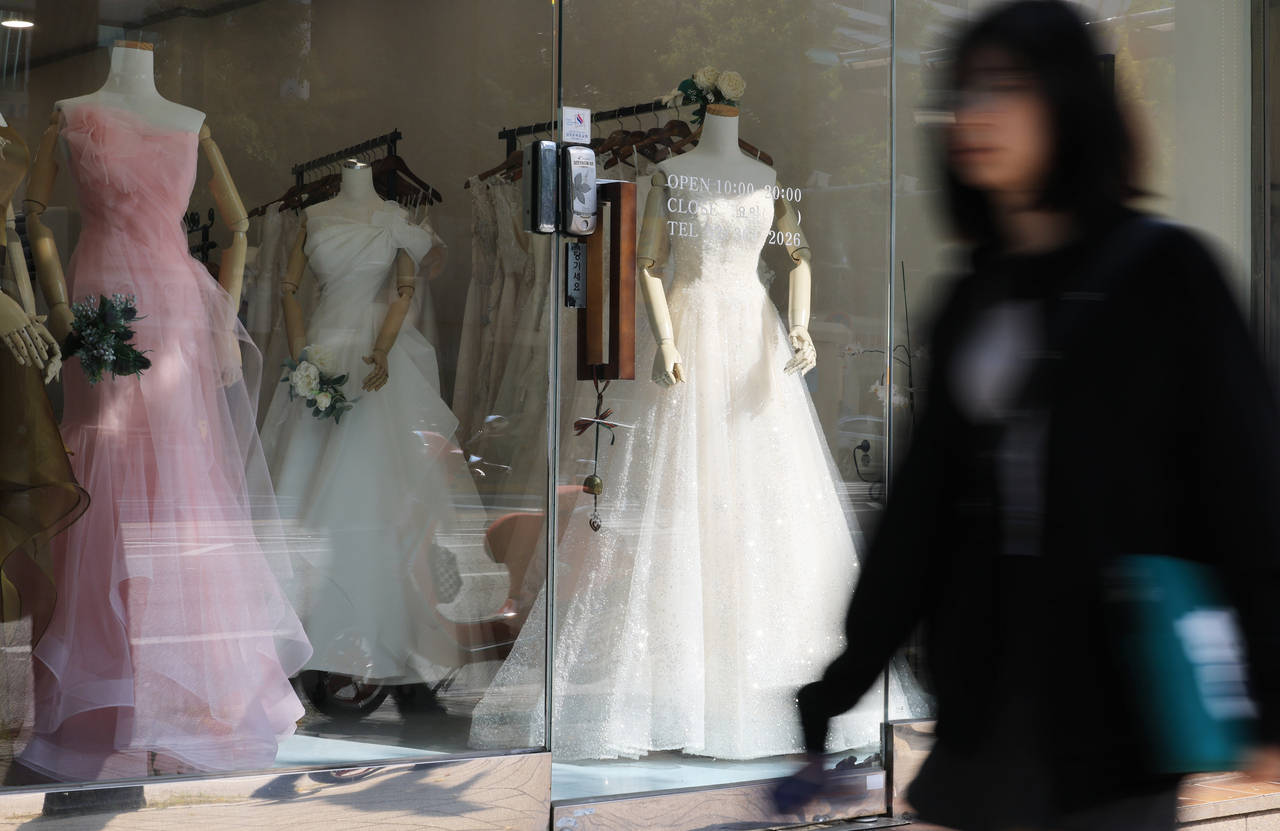
The Ministry of Statistics released the results of the 2025 Population and Housing Census — a sample survey — on Tuesday. The survey covered 20 percent of households nationwide, with Nov. 1 last year as the reference date.
The share of unmarried people in their 30s reached 53.1 percent last year, up 10.6 percentage points from 42.5 percent in 2020. Compared with 13.4 percent in 2000, the figure has nearly quadrupled over 25 years.
By gender, the unmarried rate among men in their 30s rose from 19.2 percent in 2000 to 61.1 percent last year. Over the same period, the rate among women in their 30s climbed sharply from 7.5 percent to 44.3 percent.
Among women, the share with a spouse (52.7 percent) surpassed the unmarried share starting in their 30s, but men did not reach that crossover point until their 40s, when the share with a spouse (66.7 percent) overtook the unmarried share (27.7 percent).
Of the total population aged 15 and older — about 44.577 million people — about 24.362 million (54.7 percent) had a spouse, including those in common-law marriages, down 1.3 percentage points from five years earlier. The unmarried population stood at about 13.881 million, accounting for 31.3 percent of the total, roughly unchanged from five years ago.
Gyeong Eun-suk, head of the population census division at the Ministry of Statistics, said the social trend of delaying marriage continues. "In the past, marriage was seen as a necessity, but we believe there has been a social shift toward viewing it as optional," Gyeong said.
This census also surveyed marriage intentions for the first time. Among the roughly 11.926 million unmarried people aged 19 and older, 57.8 percent said they intended to marry. Men were more inclined at 60.4 percent, compared with 54.4 percent for women — a gap of 6.0 percentage points.
By age group, those between 19 and 29 showed the highest intention to marry at 69.1 percent, followed by those in their 30s at 64.5 percent and those in their 40s at 40.1 percent. The ministry noted that marriage intentions reflect personal, subjective views and may differ from actual marital status.
Differences by gender and marital status also emerged on the question of having children. Among people aged 19 to 49, 35.4 percent said they intended or planned to have children — 39.8 percent of men versus 30.9 percent of women. The gap between unmarried (50.1 percent) and married (18.7 percent) respondents was 31.4 percentage points.
"It appears that women — and married women in particular, who are actually the ones who give birth — tend to weigh the decision more carefully," Gyeong said. "This suggests that policy should be directed toward them."
Among married women aged 15 and older, 10.0 percent had no children last year, 2.5 times the 4.0 percent recorded in 2010. The average number of children born also fell to 2.0, down 0.1 from five years earlier.
For married women aged 19 to 49, the expected number of children — combining the average number already born (1.38) with the number they planned to have in the future (0.23) — stood at 1.61.
Childcare patterns have also shifted. The share of children aged 12 and under cared for by someone other than a family member, or at an external facility, during daytime hours rose to 63.9 percent, up 13.3 percentage points from five years earlier. The share cared for by family fell from 78.2 percent in 2020 to 61.4 percent last year.
Non-family care has not exceeded family care since 2015 — a decade ago. The ministry attributed the shift to a rebound in facility-based childcare, which had contracted in the wake of the COVID-19 pandemic.
Even as the population of children aged 12 and under shrank by 20.7 percent over five years, the number receiving care through after-school programs and hagwon rose by 63.8 percent and 16.5 percent, respectively. By specific care type, however, direct parental care remained the most common at 50.3 percent, followed by hagwon at 23.1 percent and daycare centers at 16.6 percent.
Among married women aged 20 and older who had worked before marriage, 80.6 percent had left a job at some point due to marriage, pregnancy, childbirth or childcare — down 1.6 percentage points from five years ago.
Marriage was the most commonly cited reason for leaving work at 46.8 percent, followed by pregnancy and childbirth at 29.7 percent. However, among women in their 30s and 40s, pregnancy and childbirth accounted for 42.4 percent and 42.5 percent, respectively — higher than marriage in both age groups.
Meanwhile, the number of people who had graduated from university or above reached about 19.948 million last year, up 14.9 percent from five years earlier. Among those aged 30 and older, men had a higher university graduation rate (50.9 percent) than women (42.8 percent), but in the 30s and 40s age groups, women outpaced men.
y2k@heraldcorp.com




