
Seoul's homeownership rate hits 42%, lowest nationwide
Share of households staying less than a year at one address rises to top
Non-family households up more than 77% in five years
Last year, 26 percent of all households in South Korea lived in monthly-rent arrangements, according to new census data. As jeonse — the lump-sum deposit rental system — continues to lose ground to monthly rent, the average length of time people stay at one address is also shrinking. Non-family households, where people live with friends, romantic partners or others outside blood or marital ties, surged more than 77 percent over five years.
The Ministry of Statistics released the findings Tuesday in its 2025 Population and Housing Census (sample survey). The survey, conducted every five years, used Nov. 1 last year as its reference date.
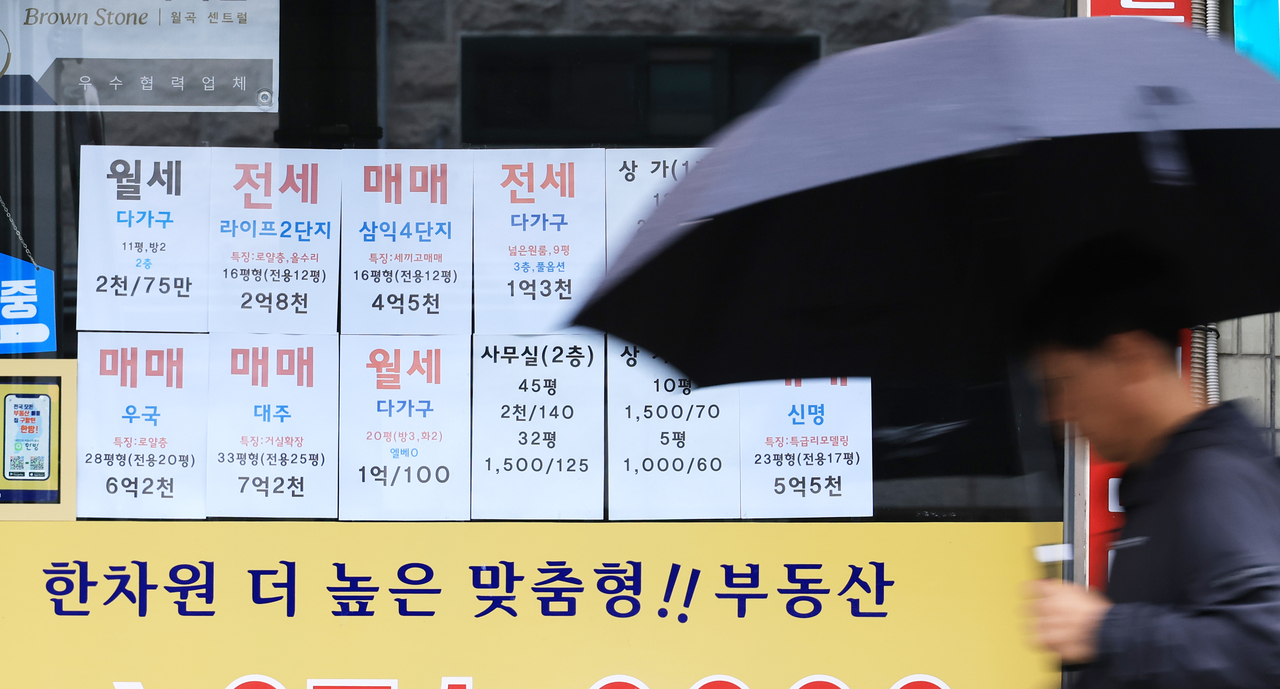
Of the approximately 22.495 million households counted last year, about 12.816 million, or 57 percent, owned their homes. Households paying monthly rent with a deposit numbered about 5.426 million, accounting for 24.1 percent of the total, while those paying monthly rent without a deposit came to 423,000, or 1.9 percent. Jeonse households stood at about 2.998 million — 13.3 percent — roughly half the number of monthly-rent households.
The share of deposit-backed monthly-rent arrangements has risen steadily, while the jeonse share has trended downward.
"Since 2015, the monthly-rent share has been overtaking jeonse," said Gyeong Eun-suk, head of the population census division at the Ministry of Statistics. "The deposit burden, combined with jeonse deposit fraud becoming a serious social problem, and the growth of single-person households — which tend to rent monthly — appear to have had a significant impact."
Among housing types, apartments had the highest homeownership rate at 66.9 percent, followed by row houses at 62.9 percent and multi-unit houses at 53.7 percent. By contrast, in non-residential dwelling types such as officetels, monthly rent accounted for 52.2 percent of arrangements, while owner-occupancy stood at just 24.4 percent.
Seoul stood out for its high proportion of rental households. The capital's jeonse and monthly-rent shares were 21.7 percent and 33.7 percent, respectively — the highest of any region nationwide. Its homeownership rate of 42 percent was the only one among all cities and provinces to fall below 50 percent, reflecting the high property prices that make buying a home difficult.
The average length of residence across all households was 8.5 years. Households that had lived at their current address for less than a year accounted for the largest share at 16.3 percent, displacing the 5-to-10-year group — which had topped the previous survey — to second place at 15.3 percent. The ministry attributed the shift to the growth of monthly-rent households, which tend to move more frequently.
Changes in household composition were also notable. Non-family households — those made up of people with no family relationship — numbered about 361,000 last year, accounting for 1.6 percent of all households. That represents a 77.2 percent increase from about 204,000, or 1 percent, in 2020.
The survey also measured the size of unmarried cohabiting households for the first time. Defined as households where people live together in a romantic relationship outside legal or common-law marriage, they reached about 174,000 — roughly 0.8 percent of all households and about half of all non-family households.
Family households numbered about 13.89 million, making up 61.7 percent of the total. By generational composition, two-generation households — typically parents and children — remained the most common type but fell 6 percent from five years earlier. One-generation households, such as couples living alone, rose 13.3 percent over the same period, while households of three or more generations declined 26.9 percent.
Single-person households reached about 8.244 million, accounting for 36.6 percent of all households.
Meanwhile, the survey counted about 1.722 million vacant homes. The most common reason given for vacancy was that the property was listed for sale, rent or in the process of being vacated, at 37.4 percent, followed by temporary use at 28.2 percent and unsold or unoccupied new units at 15.2 percent.
y2k@heraldcorp.com




