
'Growth for all' set as core goal for next year's economic policy
Three livelihood projects to cover housing, jobs and finance
Growth engine diversification, regional domestic demand in focus
The government has set "growth for all" — ensuring every citizen shares equally in the opportunities and fruits of economic expansion — as the core goal of next year's economic policy. It plans to develop a "national quality of life index" to monitor improvements in livelihoods and inequality, and to link the findings directly to budget allocations and policy decisions. Three major livelihood projects centered on jobs, housing and financial services for ordinary citizens will be unveiled next month, alongside efforts to strengthen the domestic demand base through regional consumption and neighborhood commercial districts.
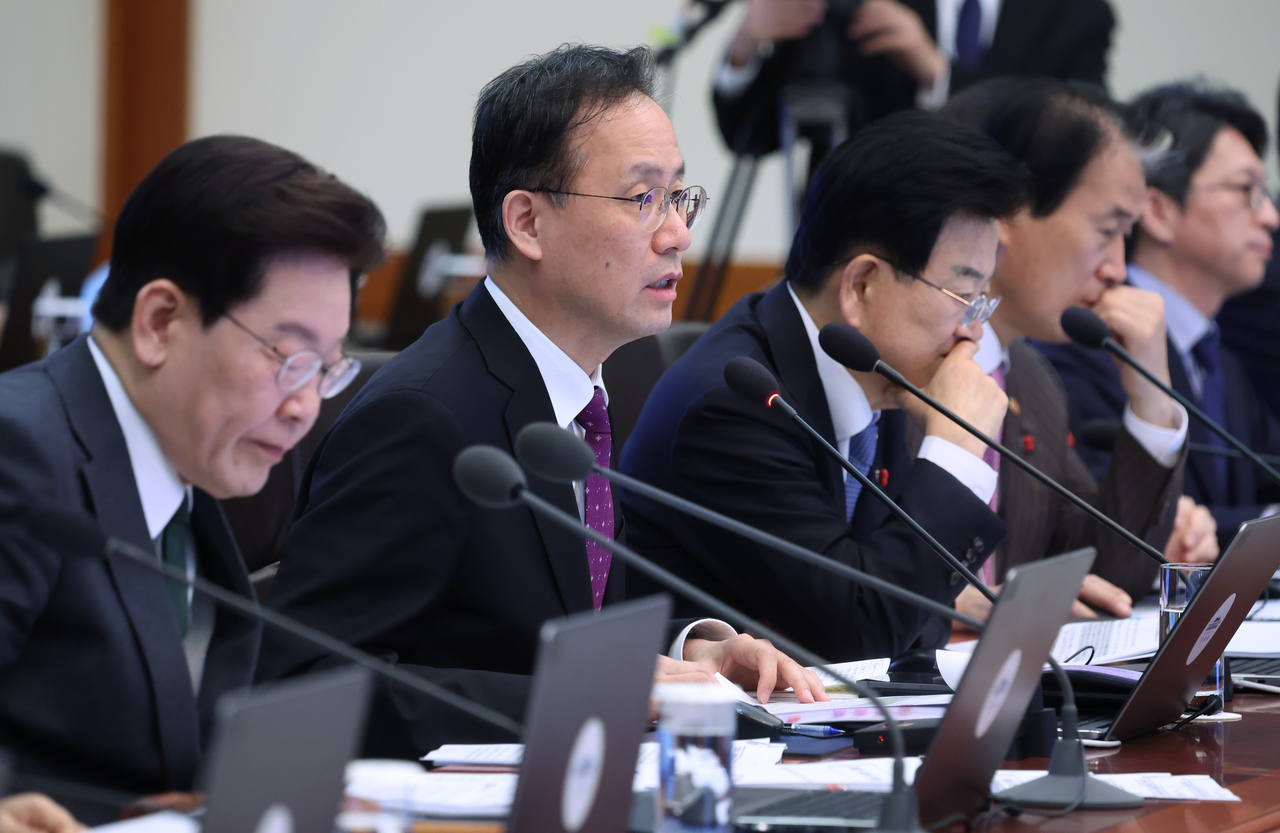
Deputy Prime Minister and Minister of Economy and Finance Lee Hyung-il presented the key framework of the "2027 Economic Policy Direction" to a Cabinet meeting on Tuesday.
The government assessed that this year's semiconductor boom has broadened export- and investment-led growth, but that the burden on ordinary citizens remains heavy due to uneven growth across sectors, persistently high prices and sluggish youth employment. While it expects the momentum from rising exports and investment to spill over into domestic demand next year, sustaining solid growth, it also sees a need to address structural challenges — including polarization, population decline and technological catch-up by emerging economies — and to prepare for the period after the semiconductor boom.
In response, the government has committed to directing its full efforts toward realizing "growth for all," in which every citizen shares equally in the opportunities and outcomes of economic expansion.
To that end, it will pursue stable macroeconomic management and strengthen risk management through integrated oversight of financial, foreign exchange and real estate markets. Policy resources will be concentrated on stabilizing livelihoods, expanding growth engines and enhancing global competitiveness to ease polarization and raise the potential growth rate. The government will also focus on strengthening the domestic demand base through livelihood and economic reform, as well as support for regional consumption and neighborhood commercial districts.
"We plan to develop a national quality of life index to monitor improvements in livelihoods and inequality, and to actively explore ways to link it to budget allocations and policy decisions," Lee said.
The government views the existing quality of life indicators published by the Ministry of Statistics as having too many components and, in some cases, excessively long publication lags, limiting their usefulness for policy. It is examining the development of new supplementary indicators, with specific plans to be announced alongside the economic policy direction release next month.
On livelihood stabilization, the government identified key tasks including easing the cost of living through petroleum price stabilization, discount support for agricultural, livestock and fishery products, and improvements to retail distribution structures, as well as reducing the burden of food and transportation costs and keeping public utility charges in check.
Three major livelihood projects — a national jobs project, a guarantee of residential rights for citizens, and financial services that reach ordinary people — will also be pushed forward as priorities. Set to be unveiled alongside the 2027 Economic Policy Direction in December, the projects include expanding employment across income groups, supplying 1.19 million units of public housing, boosting rental housing supply, expanding low-interest lending, and easing the burden on borrowers with strong repayment records.
Alongside this, the plan includes measures to improve the dual structure of the labor market — spreading cooperative agreements between prime contractors and subcontractors, strengthening protections for vulnerable workers, and shifting to income-based employment insurance. Lifetime income and asset support was also highlighted as a priority, covering the launch of the Child Independence Fund, stronger links between youth asset-building programs, and the promotion of fund-type retirement pension schemes.
To expand growth engines, the government will pursue three mega-projects and seven SEED projects, foster green industries, and support research and development investment and technology commercialization in advanced industries. It will also develop a strategy to nurture promising service industries, enact a basic law on service industry development, and provide sector-specific tailored support for key industries including automobiles, steel and petrochemicals.
The support system for small and medium-sized enterprises will be restructured away from a size-based approach toward one centered on business activities that drive growth, such as investment and innovation. The government will support promising startups in financing, technology and market access, and will also work to nurture neighborhood commercial districts, improve the Onnuri gift voucher program, expand the safety net for small business owners and ensure fair transactions on platforms.
To accelerate region-led growth, the government will cultivate regional economic engines through a five-hub, three-special-zone framework, ultra-wide special economic zones and a second round of public institution relocations. It plans to stimulate regional investment, consumption and employment through fiscal and tax preferences for regions and by promoting domestic travel. Corporate investment and innovation support, rationalization of administrative and economic penalties, improvements to industrial and technology regulation, stronger strategic management of national wealth, and reform of public institution functions were also included as key tasks.
On global competitiveness, the government will focus on improving the quality of capital markets through measures to promote long-term investment, strengthen shareholder protections and reform the Kosdaq regime. It will pursue inclusion in advanced-economy indices, internationalization of the won and legislation on digital assets, and will also develop a framework for institutionalizing cross-border stablecoin transactions.
The government will expand economic cooperation with major partners including the United States, China and Japan, diversify export markets and trade networks, and strengthen economic security through supply chain stabilization and tougher prevention and punishment of technology leaks. It plans to activate a strategic export finance fund and an overseas construction new strategy fund to support overseas project orders, and to formally launch a Korean-style development finance initiative.
y2k@heraldcorp.com




