Seoul filed for compulsory acquisition review in April; result expected in February
125 billion won budgeted for compensation as demolition plans face repeated delays
Walkway built under former Mayor Park at a cost of 110.9 billion won now slated for removal
Oh Se-hoon's green-city strategy calls for razing arcades and creating a downtown park
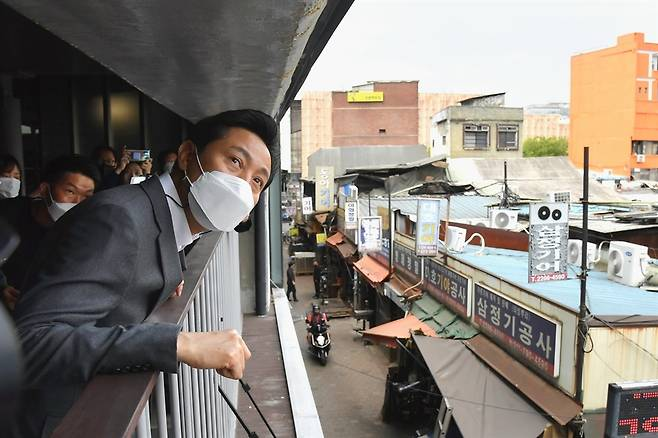
Negotiations with residents over converting the Sampung Arcade in Seoul's Sewoon district — located in front of Jongmyo — into a park have collapsed, and compulsory acquisition proceedings are now underway through the Central Land Expropriation Committee under the Ministry of Land, Infrastructure and Transport. The Seoul Metropolitan Government expects the committee's ruling in February next year, after which it plans to complete the compensation process and begin demolishing the arcade in the first half of 2028. The elevated walkway stretching from the Sampung Arcade to PJ Hotel is also set to be torn down.
Seoul filed an application with the committee in April for a compulsory acquisition ruling on the Sampung Arcade and is awaiting the outcome. "The committee's ruling on the compulsory acquisition is scheduled for February next year," a Seoul city official said. The site targeted for acquisition is the area around 310-68 Euljiro 4-ga, Jung-gu, Seoul, where the Sampung Arcade stands.
The city announced an implementation plan in July last year for the first phase of the Sewoon District Downtown Park project, which centers on converting roughly 5,670 square meters around the Sampung Arcade into a park. Under the process, the city must first attempt to reach a compensation agreement with residents before resorting to compulsory acquisition through the committee if talks fail. After receiving a public-interest endorsement from the committee in December last year, Seoul entered compensation talks with the arcade's landowners, building owners and tenants — but the two sides ultimately could not bridge their differences.
The project is a centerpiece of the "Seoul Green Ecological Downtown Recreation Strategy" announced by the city in 2022. The plan calls for the phased demolition of the Sewoon Arcade complex and the creation of a large downtown park of roughly 50,000 square meters in its place, completing a green corridor through the city center linking Bugaksan, Jongmyo and Namsan. The contentious redevelopment of Sewoon District 4 in front of Jongmyo is also part of the green-city initiative.
The city had originally planned to begin demolishing the Sampung Arcade and the elevated walkway in May this year. The project was delayed, however, after the city decided last year to switch the funding source for compensation from the budget to municipal bond issuance — a change that triggered a mandatory review by the Central Investment Review Committee, which oversees local government investment projects financed by bond issuance.
Under the current city administration, Seoul reversed course again, shifting the funding back to the city budget and pledging to accelerate the project. The budget proposal submitted to the city council on Oct. 30 included 125 billion won ($93.9 million) in total compensation funds.
The delays to the Sampung Arcade demolition have pushed back the linked project to remove the elevated walkway. The walkway is a 1-kilometer elevated bridge connecting the Sewoon, Cheongye, Daelim and Sampung arcades and PJ Hotel. It was built as an urban regeneration project under former Seoul Mayor Park Won-soon, who chose to preserve the Sewoon Arcade area, and the full route opened in July 2022 at a cost of 110.9 billion won drawn entirely from the city budget.
Yet in April of that same year — before the walkway had even fully opened — Seoul Mayor Oh Se-hoon visited the Sewoon Arcade and unveiled his green ecological downtown strategy, which calls for demolishing the arcades, pursuing high-density redevelopment and creating green space. At the time, Oh said of the walkway: "The elevated walkway has barely been completed and is about to come into use, but it is destined to be torn down. To realize this plan, the walkway is an obstacle that cannot remain — and that obstacle must be removed."
According to the Board of Audit and Inspection, the city had projected an average of 10,000 pedestrians a day when the walkway was built. As of October 2023, however, daily foot traffic stood at just 2,122 — roughly 20 percent of the projected figure.
The area around 174-4 Jongno 3-ga-dong, Jongno-gu, Seoul, was designated a redevelopment promotion zone in 2006, and the city drew up an integrated redevelopment plan for the Sewoon Arcade complex in 2009. Former Mayor Park halted that effort in 2014 when he pivoted to urban regeneration and preservation. Mayor Oh reversed course again in 2022, reviving the demolition-and-redevelopment approach the city is now pursuing.
cook@heraldcorp.com