Seoul conducts traffic impact study in October through outside firm
Average morning speed on Seosomun-ro: 19 km/h
Little change from May last year, before demolition work began
City weighing at-grade intersection instead of rebuilding overpass
New overpass construction excluded from next year's budget
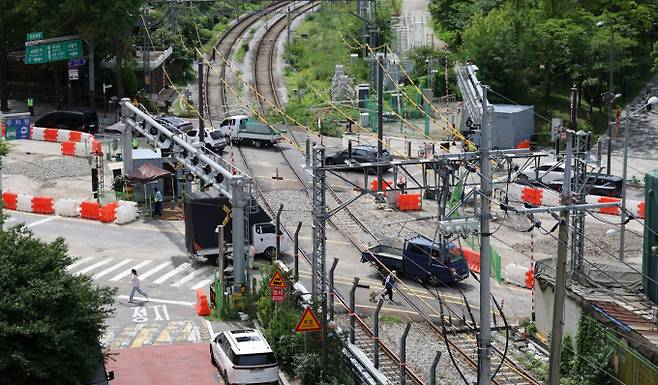
A traffic impact study commissioned by the Seoul Metropolitan Government following the demolition of the Seosomun overpass has concluded that traffic in the area is flowing smoothly, with conditions last month showing little difference from before the structure came down. The city has also quietly dropped funding for a replacement overpass from next year's budget — a new development confirming that plans to rebuild have stalled. Seoul had originally intended to demolish the old overpass and construct a new one in its place, but calls for a review have prompted the city to also consider converting the site into an at-grade intersection instead.
The Seoul Metropolitan Government's Urban Infrastructure Headquarters hired an outside traffic research firm last month to assess the impact of the demolition. After a month-long study, the firm concluded in its report that "traffic conditions around the Seosomun overpass area have stabilized considerably and the flow of traffic is no worse than before the demolition."
The Seosomun overpass was a 493-meter, four-lane road connecting Jungnim-dong and Sunhwa-dong in Jung-gu, which opened in 1966. It served as a key link between central Seoul and the western districts of Sinchon and Mapo, handling an average of about 38,000 vehicles a day. Over time, however, the aging structure became a recurring safety concern. In March 2019, a concrete slab measuring 1.8 meters wide, 1.6 meters tall and 6 centimeters thick fell from the overpass. A detailed safety inspection conducted immediately afterward gave the structure a D rating — the second-lowest on a scale of A to E — indicating a condition requiring urgent repair work.
Ultimately, the Seoul Metropolitan Government began a phased lane closure on Aug. 17 last year, marking the start of demolition work on the overpass. The project was completed on July 5 this year. Later that month, on July 10, the city announced in a press release that full-scale construction of a new overpass would begin Aug. 1, targeting a March 2029 opening. The planned replacement was to span 570 meters in total — comprising a 335-meter bridge section and a 235-meter retaining wall — with four lanes of traffic.
The project was put on hold after a mayoral staff meeting in early August raised the need to reconsider whether a new overpass was necessary. Data from Seoul's Transport Operation and Information Service showed that the average morning travel speed on Seosomun-ro last month was 19 kilometers per hour — nearly identical to the 19.6 km/h recorded in May last year, before demolition began. The all-day average speed of 17.5 km/h also showed little change from the pre-demolition figure of 17.8 km/h.
With reconstruction on hold, a 33.7 billion won ($25.3 million) budget line for the new overpass has been excluded from next year's spending plan. "The new overpass funding had originally been scheduled for next year's budget, but since no decision has been made on whether to rebuild, it has been left out," a Seoul city official said. A separate 2 billion won earmarked for an at-grade conversion was also dropped from next year's main budget. The city plans to draw up a supplementary budget next year once a final decision is reached and proceed with whichever option is chosen.
Any decision on whether to rebuild or convert to an at-grade intersection must also account for the impact on rerouted bus services. Since demolition began, 31 bus routes have been diverted — 11 Seoul city routes and 20 regional routes serving Gyeonggi Province and Incheon — running instead along Tongil-ro, Sajik-ro, Saemunnan-ro and Sejong-daero. Should the city opt for an at-grade intersection rather than a new overpass, traffic volumes in the area could rise again.
"We plan to make a policy decision as quickly as possible after conducting a comprehensive review, including the impact of the rerouted bus lines and an analysis of future traffic conditions," a Seoul city official said.
cook@heraldcorp.com