Tokyo Forum 2026 opens at University of Tokyo with focus on AI, humanity and civilization
Chey proposes joint efforts in infrastructure and talent; university president stresses human judgment
SK Group Chairman Chey Tae-won described AI Friday as a transformative technology capable of reshaping the course of human civilization, calling on South Korea and Japan to deepen cooperation in AI infrastructure, energy, startup ecosystems and talent development. Chey also said the value created by AI must be shared broadly across society and that university education should shift toward building students' capacity to identify and solve new problems.
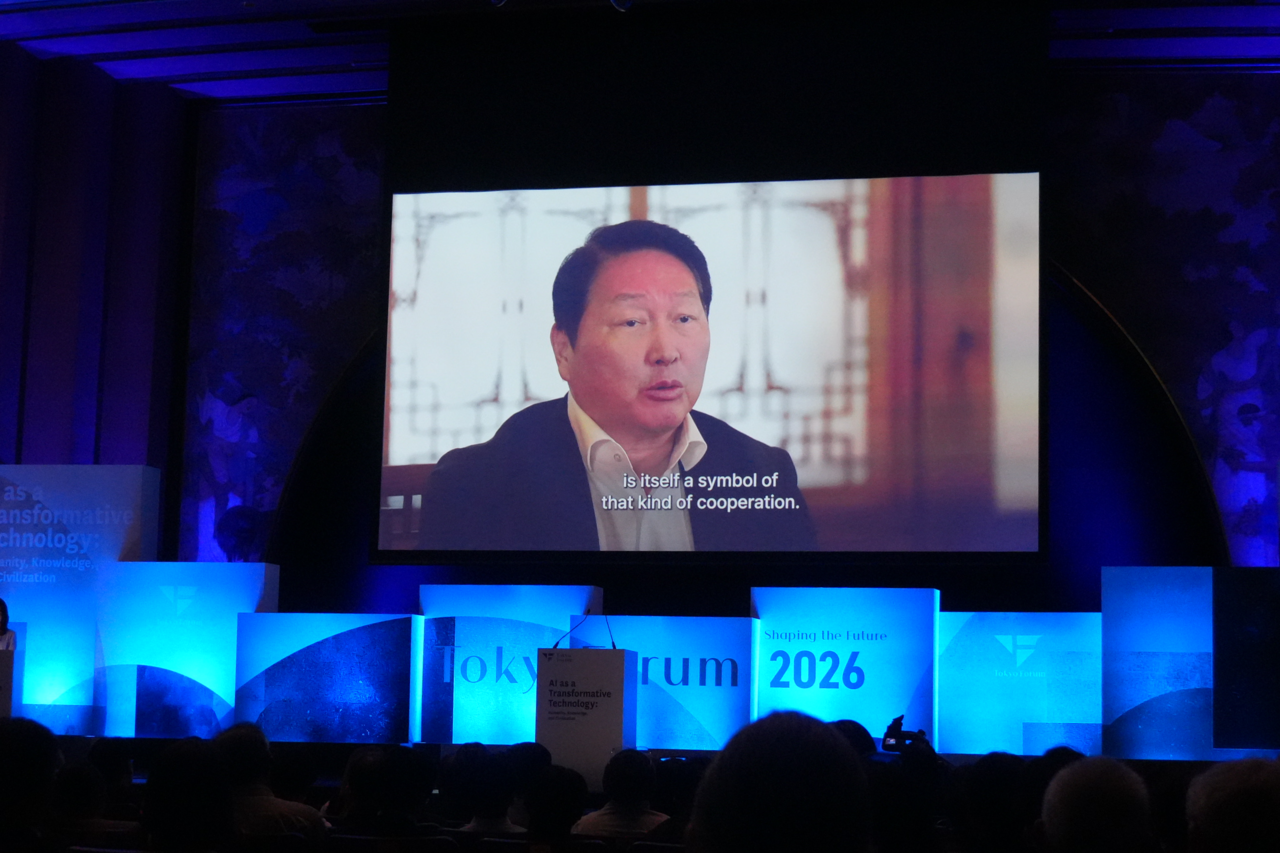
Chey sent a video message to Tokyo Forum 2026, which opened Friday at Yasuda Auditorium at the University of Tokyo. Co-hosted by the university and the Chey Jong-hyun Academy, the two-day forum runs through Saturday under the theme "AI as a Transformative Technology: Humanity, Knowledge and Civilization."
In the English-language video message, Chey said AI is driving a civilizational shift that goes beyond simple productivity gains, fundamentally changing how people live and how societies are structured.
Chey said that just as factories once combined labor, capital and energy to produce goods, the AI era generates new value and solutions through data, computing power and electricity. The choices societies make about how to harness that change, he said, matter as much as the pace of technological progress itself.
Chey also said the gains from AI development must be shared widely, with the value AI creates channeled into solving social problems and generating new jobs.
Chey identified Korea-Japan cooperation as a central challenge in responding to these changes, saying no single country can alone bear the enormous resources — semiconductors, data centers, power and talent — that the AI era demands.
Chey said South Korea and Japan share common challenges such as aging populations and energy security while each possessing complementary strengths. Cooperation between the two countries in energy, AI, startup ecosystems and talent development would allow them not merely to follow new rules but to help shape them, he said.
Chey also called for changes in talent development and university education. He said students need more than knowledge acquisition — they need the ability to identify new problems, connect ideas across disciplines and create value through technology. Universities, he said, should reorient their education to help students build wisdom through challenge, problem-solving and hands-on experience.
University of Tokyo President Fujii Teruo, who took the podium earlier, stressed the role of universities in the AI era and the importance of human agency in decision-making. Citing Amari Shun-ichi, a University of Tokyo professor emeritus who contributed to the development of neural network theory from the 1960s, Fujii said basic and theoretical research remains vital and that universities must provide reliable knowledge to help society navigate technological change.
Fujii also raised concerns about over-reliance on AI in educational settings. He said the process by which children wrestle with difficult problems, try different approaches and work toward answers is itself valuable. Focusing too much on reaching answers quickly, he warned, risks depriving students of the opportunity to think deeply, generate their own ideas and experience the joy of creativity.
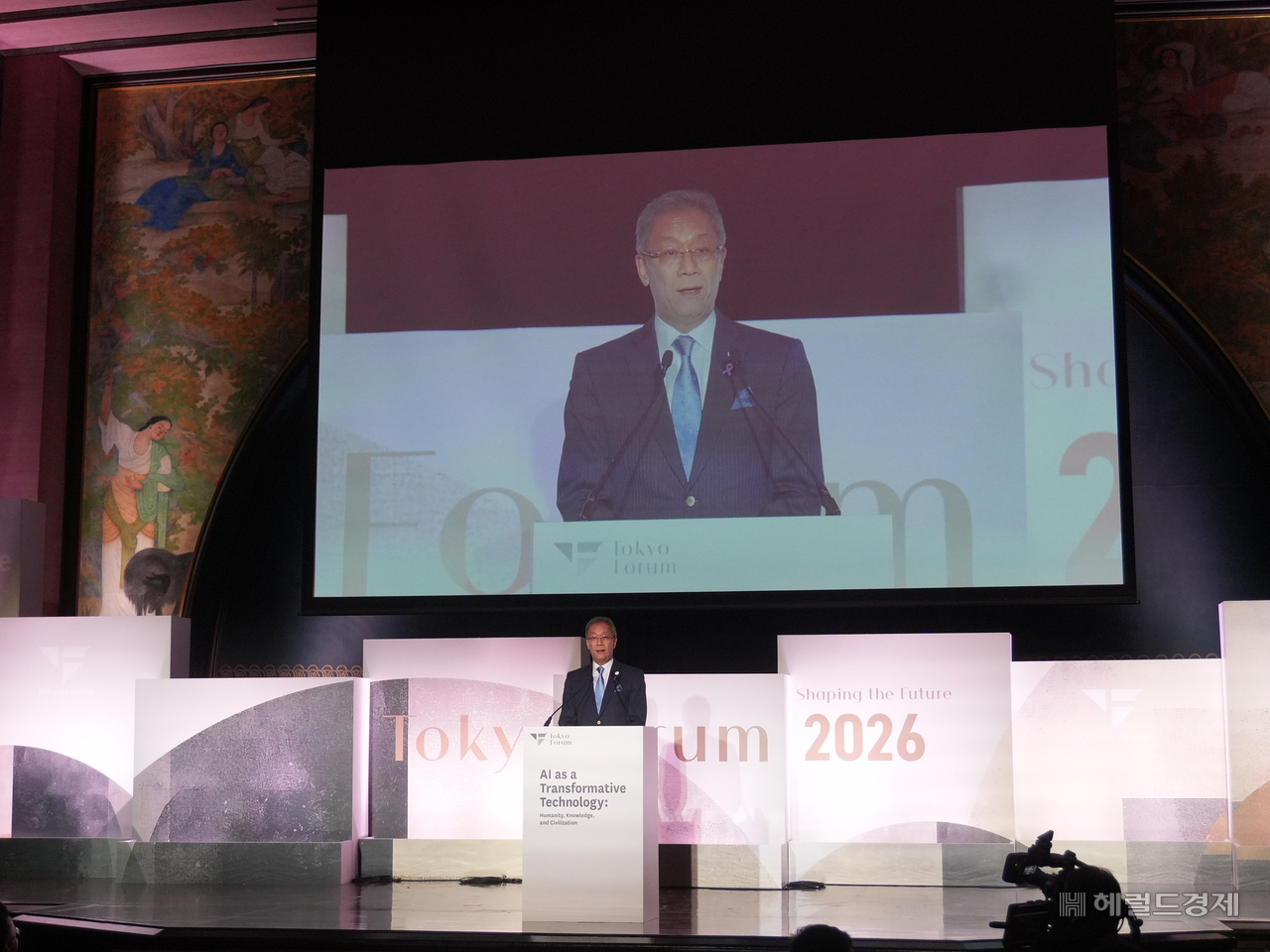
Fujii said people must actively choose when to use AI and when to rely on their own abilities. He proposed examining AI's effects on mental health, social inclusion, and the preservation and sharing of knowledge through perspectives drawn not only from science and engineering but also from education, philosophy and history.
Following the opening ceremony, the forum moved into keynote lectures, a plenary discussion and panel sessions. Keynote speakers included Anne Bouverot, France's presidential envoy for AI and chair of the board of the École Normale Supérieure in Paris; Ito Ren, co-founder and chief executive of Sakana AI; and Abe Masahiko, a professor in the Graduate School of Humanities and Sociology at the University of Tokyo.
The three keynote speakers then took part in a plenary discussion moderated by Son Ji-ae, a visiting professor at Ewha Womans University. The session examined the relationship between AI and human society from the perspectives of policy, industry and the humanities.
The first panel discussion focused on the theme "What Is AI: The Evolution of Technology as Seen from Human Society." It examined the contrasting perceptions of AI as both a source of wonder and a source of threat, and explored how views of civilization and the idea that technology drives social change shape our understanding of AI.
Panelists included Giovanna Tinetti, a professor of astrophysics at King's College London; Ahmed Kasim Bawa, a professor at the Graduate School of Business Administration at the University of Johannesburg; Otsuki Grant Jun, an associate professor in the Graduate School of Arts and Sciences at the University of Tokyo; and Zefan Schramek, a postdoctoral researcher at Tokyo College, University of Tokyo. Shimazu Naoko, a professor and vice dean of Tokyo College, moderated the session.
Key topics included the potential for AI to widen global inequalities as well as its potential to empower people facing economic hardship. Participants also discussed the role of universities in educating the next generation amid rapid change and ways to make public discourse on AI more inclusive and diverse.
On Saturday, the second day of the forum, Chey is scheduled to attend in person at Yasuda Auditorium for a "Business Leaders Session" running from 2 p.m. to 3 p.m., joining the on-site discussion after his opening-day video message. The session will be moderated by President Fujii and will include Chey, NTT Chairman Sawada Jun, Taejae University President Yeom Jae-ho and Sophia University President Sugimura Miki.
sjkim@heraldcorp.com