Doosan Yeollip levy halved after decade of litigation
Munjeong-dong faces 50.5 billion won vs. zero won gap — mass lawsuits feared
'Differing assessment standards reduce predictability,' expert warns
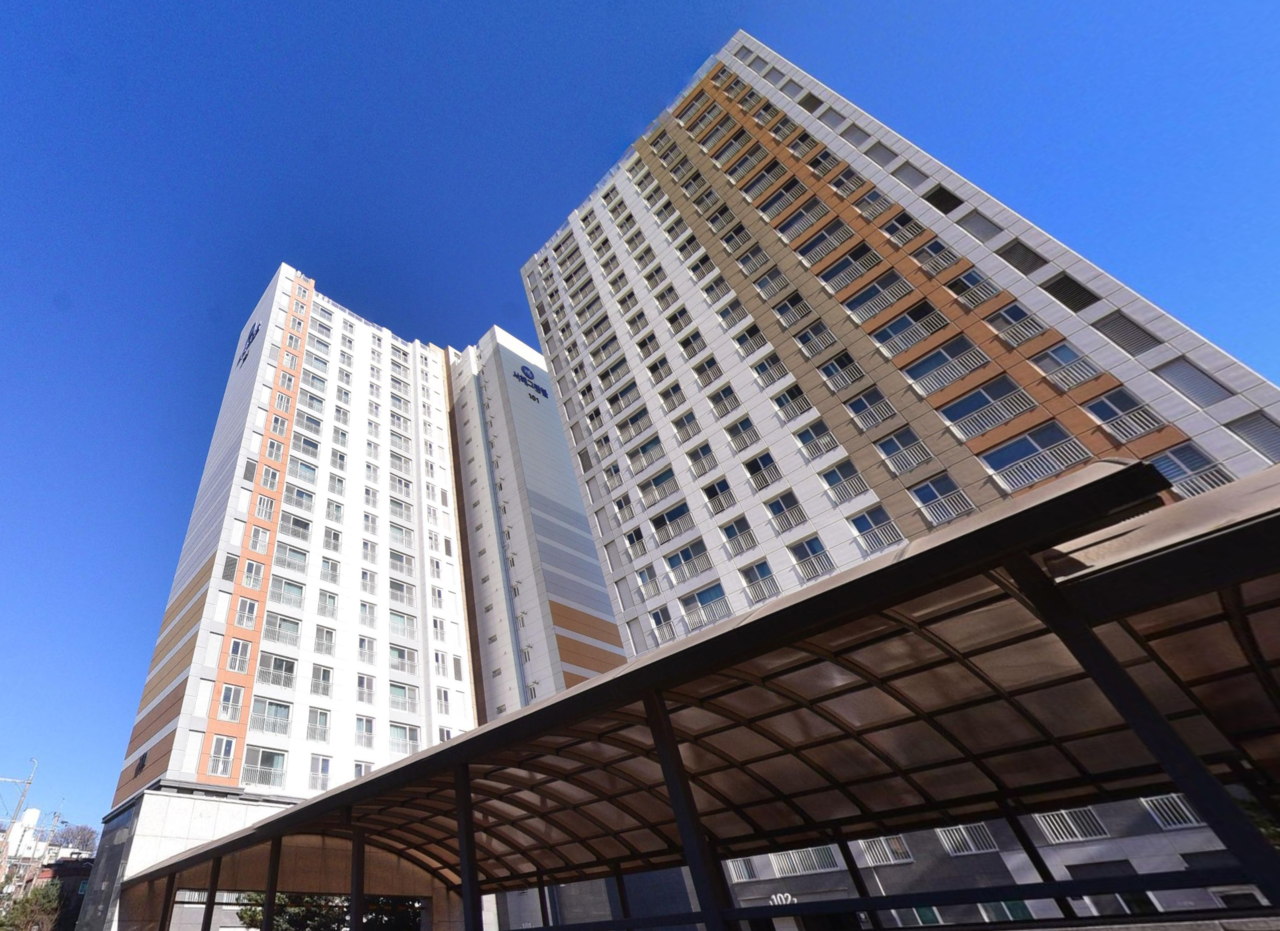
With the government ruling out any extension of the deadline for imposing reconstruction excess profit recapture levies, the fate of complexes that completed reconstruction around the same period now hinges on differences of just a month or two. There are also concerns that some complexes may have lost their levy imposition rights entirely after the government and local authorities delayed the process past the statutory deadline. Add to that cases where levies were imposed but went uncollected for years, or were slashed by more than half through litigation, and critics say the reconstruction excess profit recapture regime has effectively become a lottery.
According to the redevelopment industry on Friday, the Yeonhui Villa reconstruction project in Gusan-dong, Eunpyeong-gu, Seoul — now known as Eunpyeong Seohaegrangbl — received its completion approval on May 18, 2021. Under the legal interpretation the Ministry of Land, Infrastructure and Transport announced Thursday, the five-year imposition exclusion period, calculated from five months after the completion approval date, is estimated to have expired on Oct. 18. Yeonhui Villa was notified by Eunpyeong-gu in July 2018 of a preliminary reconstruction levy totaling 560 million won ($421,000), or about 7.7 million won per member.
The Ministry of Land, Infrastructure and Transport concluded Thursday that the imposition exclusion period for reconstruction levies cannot be extended. The ministry determined that the special provisions of the revised Reconstruction Profit Recapture Act, which took effect in March 2024, merely set a deadline for processing levy imposition under the revised law — they did not extend or newly establish the exclusion period itself. The ruling makes clear that once five years have passed from five months after the completion approval date, no levy may be imposed.
During a national audit in October 2022, the Seoul Metropolitan Government disclosed that Eunpyeong-gu and Seocho-gu had each suspended levy imposition procedures — for Yeonhui Villa and Banpo Hyundai in Seocho-gu (now Banpo Centrevill Asterium), respectively — following requests from the associations to delay and after consultations with the Ministry of Land, Infrastructure and Transport. At the time, the Seoul Metropolitan Government said it planned to apply the ministry's announced reconstruction levy relief measures to both projects, and that it would support the district offices in carrying out levy imposition and collection once the assessment criteria were finalized after the legislative revision.
However, as the legislative revision and levy calculation dragged on, Yeonhui Villa's association completed dissolution and liquidation proceedings. According to the Seoul Metropolitan Government's redevelopment project information portal, the association completed its dissolution registration on Dec. 1, 2023, and its liquidation registration on June 16, 2024.
By contrast, Banpo Hyundai in Seocho-gu, which received its completion approval on July 30 of the same year, is now facing imminent levy imposition. Seocho-gu served the association with advance notice Thursday of a preliminary levy totaling 17.9 billion won. With 80 association members, that works out to an average of 223.75 million won per person. Under the ministry's legal interpretation, Seocho-gu must impose the final levy by Dec. 30.
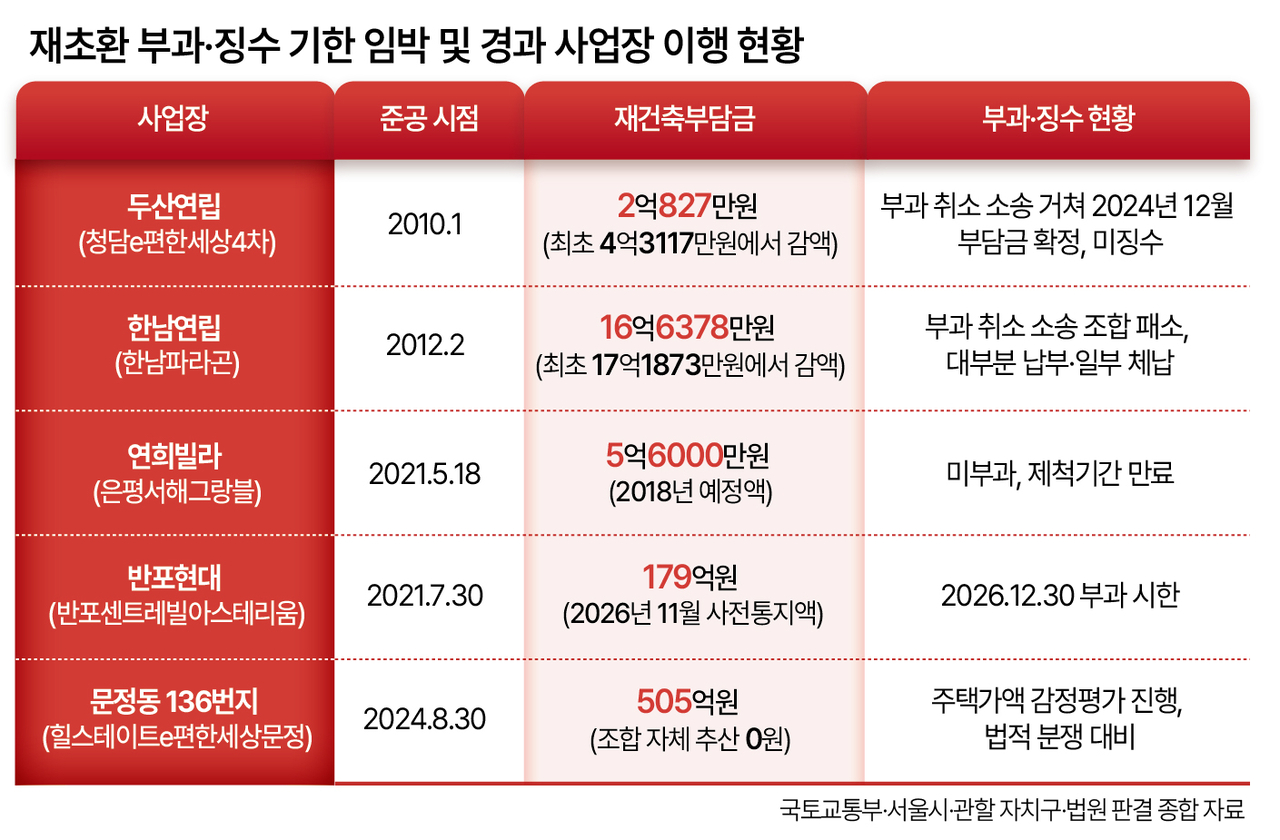
There are also cases where levies were imposed but collection was delayed by litigation or the amounts changed significantly. Doosan Yeollip in Cheongdam-dong, Gangnam-gu, Seoul — now Cheongdam Daelim e-Pyeonhansesang 4cha — was assessed a levy of 431.17 million won in December 2014, but after a decade of litigation the amount was reduced to 208.27 million won in December 2024. A key factor in the reduction was the court's recognition of approximately 1.6 billion won in land value for a pedestrian path on the complex's perimeter as a development cost — something that had not been accepted when the levy was originally calculated. The case illustrates how the same project can yield vastly different levy amounts depending on what development costs are recognized.
As reconstruction levies are imposed in earnest going forward, litigation-driven delays are likely to recur. The project at 136 Munjeong-dong, Songpa-gu — now Hillstate e-Pyeonhansesang Munjeong — is locked in a dispute with Songpa-gu over the levy calculation. The preliminary levy amount Songpa-gu notified the association of in 2018 was 50.5 billion won, but the association's own estimate last year came to zero won — a stark divergence.
The central dispute between the two sides is the assessed value of housing at the end of the reconstruction period. The association's own estimate puts the figure at around 870 billion won, while the Korea Real Estate Board's calculation stands at around 1.04 trillion won — a gap of roughly 170 billion won. The association has raised objections over the difference in public price realization rates between the original single-family homes and the newly built apartments, as well as whether the area of commercially liquidated retail units should be included in the calculation. The association has already retained legal counsel and says it will pursue administrative litigation if its demands are not met.
A Ministry of Land, Infrastructure and Transport official, asked about projects where levies have been imposed but not collected, said, "There are complexes with ongoing litigation," adding, "Because the actual amount collected can vary depending on the outcome of the lawsuits, we have to wait until the litigation concludes."
Seo Jin-hyung, a professor in the real estate law department at Kwangwoon University, said that if levy amounts can vary by hundreds of millions of won for identical reconstruction projects depending on the assessment method and the judgment of administrative agencies, guaranteeing fairness in the system becomes very difficult. "A system where people cannot predict how much they will owe or when a levy will be imposed will struggle to earn public trust," he said. He added that without clear and consistent assessment standards from the government, lawsuits will repeat every time a levy is imposed, and the resulting social costs will snowball.
quq@heraldcorp.com