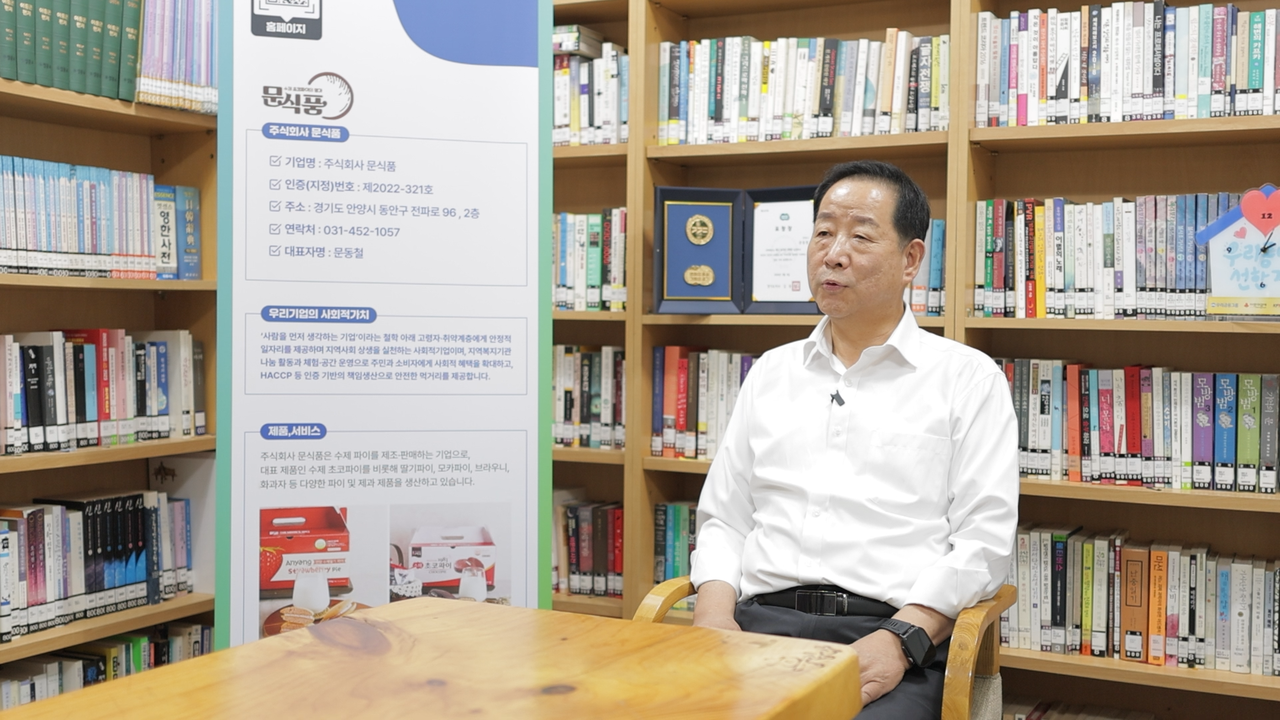
Choco pie maker Moon Dong-cheol sings the praises of employment insurance
Government covers 50–80% of premiums for up to 5 years; local governments add more
Involuntary closure triggers monthly unemployment benefits of up to 2.02 million won
Until just two years ago, Moon Dong-cheol, CEO of Moon Food — a social enterprise in Anyang, Gyeonggi Province, that makes handmade choco pies — assumed employment insurance had nothing to do with him. He knew that salaried workers could collect unemployment benefits if they lost their jobs, but had no idea that business owners like himself were also eligible. That changed in January last year, when the Ministry of SMEs and Startups and the Small Enterprise and Market Service guided him through the enrollment process.
Moon pays a monthly employment insurance premium of 76,050 won ($57), half of which — 38,025 won — is reimbursed by the government. For less than 40,000 won a month, he now has a financial cushion against an unexpected closure. Over five years of government premium support, the reimbursements alone add up to 2.28 million won.
"I used to think unemployment benefits had absolutely nothing to do with business owners, but knowing the state is there as a safety net for me is a real relief," Moon said. He described the self-employed employment insurance scheme as "a safety asset for myself."
Unlike salaried employees, self-employed workers must apply for employment insurance on their own and pay the full premium themselves. To ease that burden, the Ministry of SMEs and Startups and the Small Enterprise and Market Service have run a premium support program for small business owners since 2018. Depending on the reference wage tier — levels one through seven — the program covers 50 to 80 percent of premiums paid for up to five years. When combined with local government support programs, business owners in some regions can have their entire premium reimbursed.
Enrollment has grown consistently since the premium support program launched. According to the Ministry of SMEs and Startups and the Small Enterprise and Market Service, the number of self-employed people enrolled in employment insurance rose nearly fourfold — from 17,500 at the end of 2017 to 68,278 as of September this year. The number of beneficiaries under the government's premium support program surged from 2,489 in 2018 to 46,767 as of October this year, a nearly 19-fold increase.
The biggest benefit of self-employed employment insurance is the income it provides after a business closes. Those who shut down involuntarily due to falling sales or similar hardship can receive monthly unemployment benefits of between 1.09 million won and 2.02 million won for 120 to 210 days, depending on the reference wage tier chosen at enrollment. Eligibility requires that premiums be paid for at least one year out of the 24 months before closure, among other conditions.
Benefits are also available while a business is still operating. Through the Tomorrow Learning Card program, enrollees can receive between 3 million won and 5 million won in vocational training support over five years, covering courses in marketing, SNS use and commercial district analysis. Additional perks include a 0.1 percentage point reduction on interest rates for small business policy loans and bonus points in the document screening stage of the Hope Return Package business-revival support program.
The government is also working to ease the eligibility requirements for unemployment benefits. One key proposal would shorten the qualifying period of consecutive monthly deficits from six months to four, reducing the burden on small business owners who feel compelled to keep operating — even as losses mount — just to meet the current threshold.
The premium support program is open to small business owners with fewer than five full-time employees who meet sector-specific sales thresholds; those in mining, manufacturing, construction and transportation may qualify with up to nine employees. Enrollment and premium support applications can be submitted simultaneously through the Korea Workers' Compensation and Welfare Service's employment and industrial accident insurance total service portal. Existing enrollees can apply for premium support separately through the Soho24 portal. Applications for this year's premium support have closed; the next intake opens Jan. 1.
"Having the state as a shield behind me has been a great source of strength," Moon said.
In Tae-yeon, chairman of the Small Enterprise and Market Service, said the organization would work to bring more small business owners under the protection of employment insurance through premium support. "Employment insurance is the most fundamental safety net that lets small business owners focus on running their businesses with peace of mind," he said.
hong@heraldcorp.com