Five cement makers see Q3 sales fall 2.3%, operating profit plunge 51.8%
Price war erodes margins as factory utilization drops to 50% range
Domestic demand seen falling below 40 million tons next year as construction slump drags on
South Korea's major cement companies saw their third-quarter operating profit shrink by roughly half compared with a year earlier, as a prolonged construction downturn triggered a price war that squeezed margins. The outlook for next year is equally grim: the Korea Cement Association projects domestic demand will fall below 40 million tons, and most industry watchers expect the earnings slump to continue for the foreseeable future.
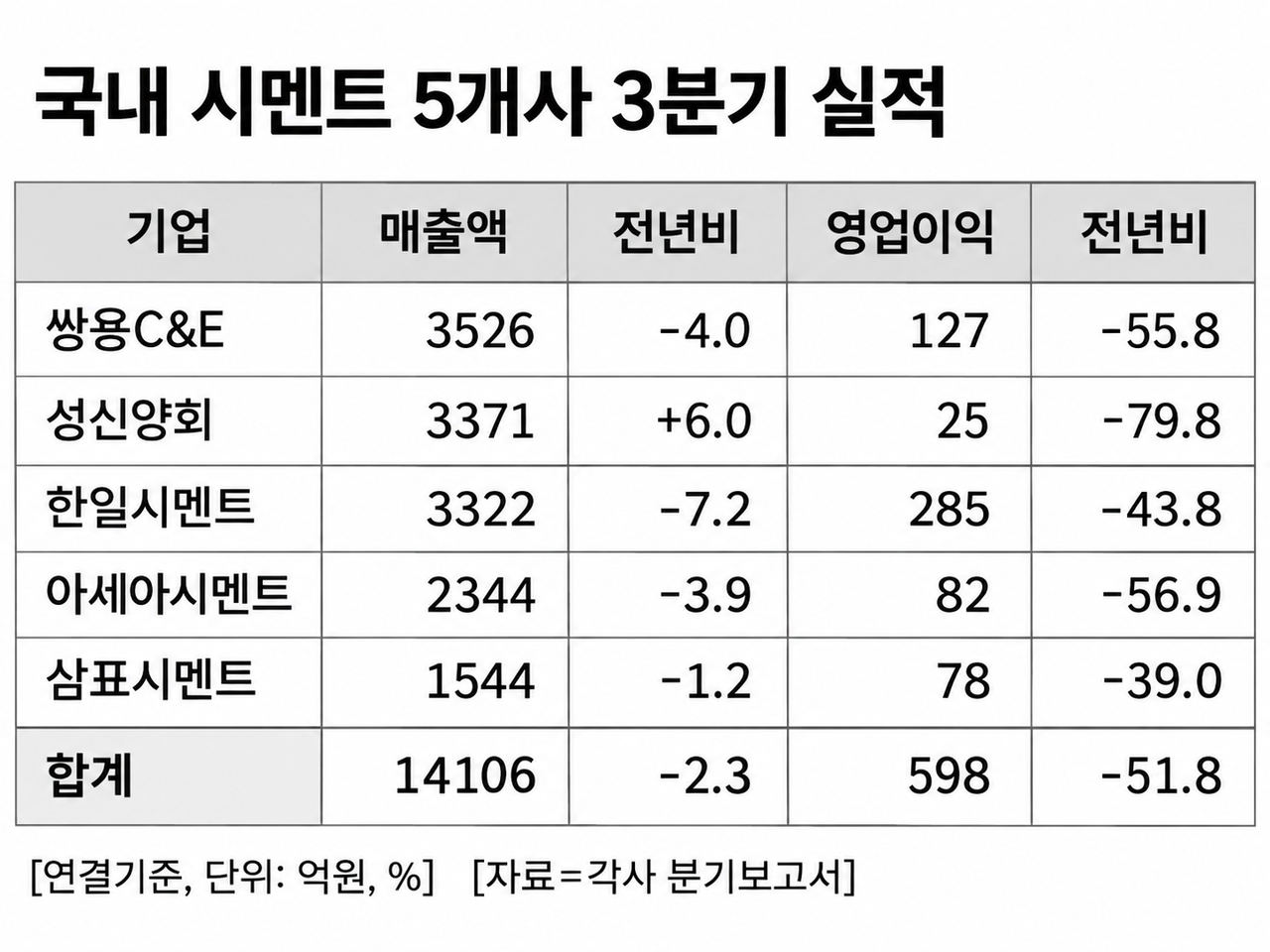
An analysis of third-quarter filings from Hanil Cement, KGM C&E, Asia Cement, Sampyo Cement and Sungshin Cement shows combined consolidated sales of 1.41 trillion won ($1.06 billion) in the third quarter of this year, down 2.3 percent from the same period last year. Operating profit fell 51.8 percent, from 124 billion won in the third quarter of last year to 59.8 billion won this year. The combined operating profit margin for the five companies dropped from 8.6 percent to 4.2 percent over the same period.
Sungshin Cement recorded the steepest decline in operating profit. Its third-quarter sales rose 6.0 percent year-on-year to 337.1 billion won, but operating profit fell 79.8 percent, from 12.6 billion won to 2.5 billion won, as its trading business boosted revenue without improving profitability. Asia Cement and KGM C&E also saw operating profit fall 56.9 percent and 55.8 percent, respectively, while Hanil Cement and Sampyo Cement posted declines of 43.8 percent and 39.0 percent.
While sales held roughly steady compared with the third quarter of last year, the sharp deterioration in profitability is largely attributed to falling unit selling prices. Sampyo Cement's average domestic selling price for Portland cement stood at 98,957 won per ton in 2024, slipped to 97,304 won per ton last year, and fell further to 95,813 won per ton in the January–September period this year. Sungshin Cement's average cement selling price dropped from 96,761 won per ton to 92,471 won per ton over the same period. Asia Cement and KGM C&E have also been on a downward pricing trend since 2024.
Most cement industry transactions are business-to-business deals with ready-mix concrete producers and construction companies. During construction booms, buyers focus on securing adequate supply; during downturns, cement makers must fight to hold on to customers. "If existing clients are poached by rivals when demand is already weak, factory utilization rates could fall even further," an industry official said. "It may be better to accept lower margins in order to protect sales volumes."
Factory utilization rates have also fallen sharply. Sampyo Cement had a production capacity of 8.19 million tons in the January–September period this year, but actual output was limited to 4.16 million tons, leaving utilization at just 50.8 percent. Hanil Cement's utilization rate for cement and slag powder production facilities stood at 57.3 percent, while Sungshin Cement's clinker production utilization stood at 51.1 percent. Because cement manufacturing is a capital-intensive industry with high fixed costs, lower output drives up per-unit costs and causes operating profit to deteriorate rapidly.
The domestic cement market has now shrunk below its post-Asian financial crisis low. According to the Korea Cement Association, domestic cement demand stood at 61.75 million tons in 1997, then plunged to 44.62 million tons in 1998 in the immediate aftermath of the crisis. Demand recovered over the following years, reaching 50.24 million tons in 2023, but has since shed more than 10 million tons in just two years, falling below 40 million tons annually.
The Korea Cement Association projected in a recent report that domestic cement demand will reach only around 39.65 million tons next year, and that a recovery above 40 million tons will not come until 2029 at the earliest — with 2030 demand forecast at only around 41.9 million tons. "Cement is bulky, heavy and vulnerable to moisture, making exports virtually impossible," an industry official said. "A recovery in domestic demand is critical, but there are no signs of that happening yet."
hong@heraldcorp.com