Korea Institute of Public Administration analyzes 226 municipal governments nationwide; fiscal self-reliance drives disparity
Report calls for shared AI use and differentiated national subsidy rates to close the gap

Local governments with stronger fiscal self-reliance are pursuing up to four times as many AI-related disaster management projects as their financially weaker counterparts, a new report has found, prompting calls for a shared technology framework that would extend access to regions lacking funds and trained personnel.
The finding comes from an issue paper released Thursday by the Korea Institute of Public Administration, titled "Strategies for Introducing Locally Tailored AX Deployment and SaaS-Based Platforms to Bridge the Disaster Safety Technology Gap." The report found that local governments with limited fiscal capacity and specialist staff face structural barriers to independently building and operating such systems.
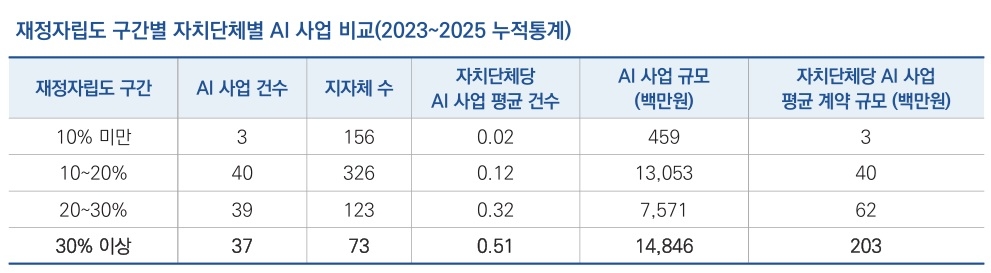
Researchers cross-referenced fiscal self-reliance ratios with disaster-safety AI procurement data from all 226 basic municipal governments nationwide between 2023 and 2025. Municipalities with a fiscal self-reliance ratio of 30 percent or higher averaged 0.51 AI-related projects, roughly four times the 0.12 average recorded by those with ratios between 10 and 20 percent.
The disparity is particularly acute in the 89 population-decline areas designated as of the end of 2025, where aging populations and vulnerable residents face growing evacuation challenges. Yet those same areas lack the fiscal resources and specialist personnel needed to independently build AI-based disaster management systems, the report said.
The national average fiscal self-reliance ratio stood at 48.6 percent as of 2024, while county-level governments — which make up the bulk of population-decline areas — recorded ratios of only 10 to 20 percent. Central government AI investment in disaster safety has been concentrated in large cities and metropolitan areas, leaving fiscally weak municipalities with little room to allocate separate budgets for AI disaster preparedness.
To address the shortfall, the report said building a "technological safety net" — using AI for continuous disaster monitoring and risk prediction — is essential to compensate for gaps in local disaster management capacity.
Rather than having each local government build its own AI systems, the report proposed a shared cloud-based software-as-a-service (SaaS) model.
SaaS allows governments to use software operated by a provider on demand, without setting up dedicated servers. Under such a model, local governments could reduce the burden of building and maintaining systems while accessing AI-driven disaster management functions such as risk prediction, automated alerts and evacuation route guidance.
The report said the central government should supply common technology and analytical capabilities, while local governments customize their use according to regional characteristics such as terrain, population and road networks.
However, for cases involving sensitive disaster information, the report also suggested that only select functions be migrated to the cloud, or that existing systems be upgraded with security requirements in mind.
The report further proposed that the central government provide service vouchers to help fiscally weaker local governments adopt the platform first, and that differentiated national subsidy rates be applied based on each region's fiscal conditions.
Alongside this, the report called for establishing joint operational support organizations centered on metropolitan governments to provide integrated assistance to basic municipal governments — covering system operations, incident response, civil servant education and information security — and for rolling out the platform nationwide in stages, starting with population-decline areas.
thlee@heraldcorp.com