Narasallim Research Institute report on 2025 local government fiscal autonomy
Fiscal autonomy ratio falls to 57.27%, lowest since current accounting method began in 2016
Even as the government promotes decentralization as a national policy priority, local finances have in fact grown more dependent on the central government than ever, according to a new analysis.
The fiscal autonomy ratio of local governments nationwide tumbled 6.17 percentage points — from 63.44 percent to 57.27 percent — on a 2025 settlement basis, according to a report on nationwide local government fiscal autonomy released Thursday by the Narasallim Research Institute.
That marks the lowest level since the current settlement-based accounting method was introduced in 2016, falling even below the 58.57 percent recorded in 2020 during the COVID-19 crisis. Over the same period, the fiscal self-reliance ratio also dropped 4.10 percentage points, from 41.62 percent to 37.52 percent.
The fiscal autonomy ratio measures what share of total revenue local governments can allocate and spend at their own discretion. The fiscal self-reliance ratio indicates how much of a local government's total budget it can cover through its own revenue sources.
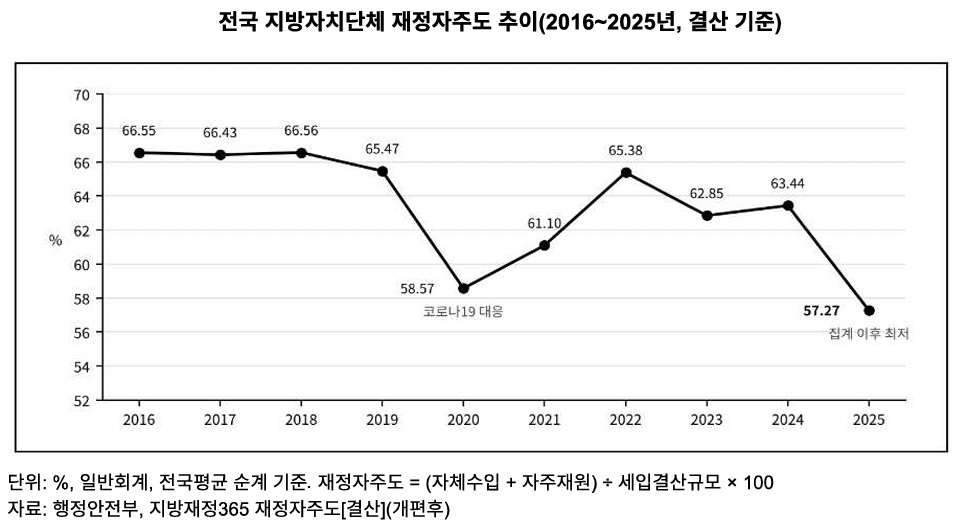
The primary driver of the decline is that locally controlled revenue has stagnated while central government subsidies — earmarked funds whose use is dictated from above — have surged.
Local allocation tax in 2025 came to 66.32 trillion won ($49.5 billion), up just 2.37 trillion won, or 3.7 percent, from the previous year. National treasury subsidies, by contrast, jumped 32.5 trillion won, or 42.4 percent, to 109.22 trillion won — surpassing even the 25.62 trillion won increase recorded in 2020, when COVID-19 emergency relief payments were disbursed.
As a result, national treasury subsidies accounted for 28.6 percent of total revenue settlements and 62.2 percent of all central government transfers — both figures exceeding the 2020 levels of 26.0 percent and 61.1 percent, respectively, and reaching their highest points since 2018.
A breakdown by individual project makes the nature of the subsidy surge even clearer.
Of the 36.46 trillion won total increase in national funding, 24.94 trillion won — or 68.4 percent — was concentrated in cash-based consumer stimulus programs, chiefly the livelihood recovery consumption coupon program at 22.89 trillion won and a regional currency issuance support program at 940 billion won.
On top of that, mandatory welfare programs that grow structurally each year — including the basic pension and national basic livelihood security benefits — added another 6.29 trillion won in national funding. The large-scale deployment of cash-based programs, whose beneficiaries and payment amounts the central government determines unilaterally, as a routine economic stimulus tool has squeezed local governments' room to manage their own finances.
Compounding the problem is that national treasury subsidies require matching contributions from local governments.
Local matching funds in 2025 rose 3.32 trillion won from the previous year, of which 91.3 percent — 3.03 trillion won — went toward matching consumer stimulus programs. In total, 38.0 percent of the 8.74 trillion won increase in local revenue over the year was absorbed by matching obligations for national subsidy projects — nearly double the usual share of 21.0 percent.
With resources tied up in matching national subsidies, the real growth rate of locally initiated project spending — independent of national funding — was effectively flat at 0.2 percent after accounting for inflation of 2.1 percent.
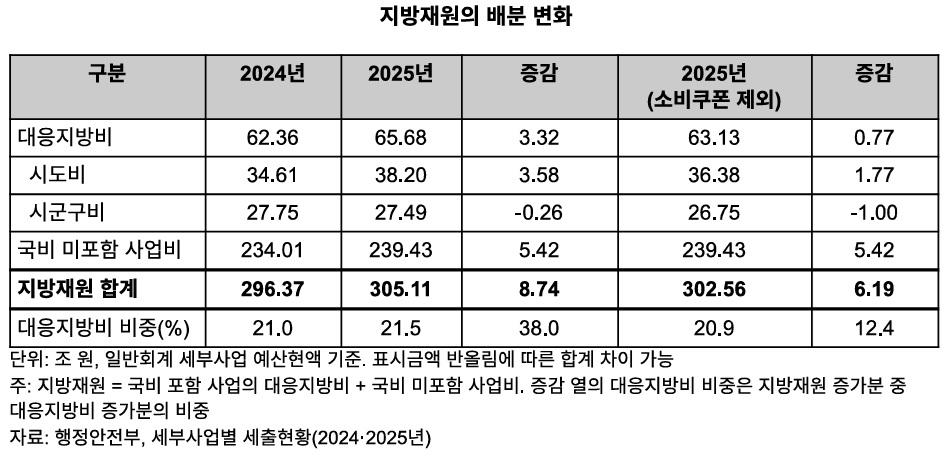
Consequently, projects involving national funding accounted for 51.6 percent of total expenditure budget appropriations — surpassing, for the first time in history, the 48.4 percent share held by projects funded entirely by local governments. While the overall scale of local finances has grown, the portion that local governments can actually decide for themselves has shrunk. The subsidy-heavy fiscal support structure is expected to continue in the 2027 government budget proposal, which includes increased national funding for regional gift vouchers and project spending allocations under a newly established future response fund.
"Contrary to the national policy agenda's pledges to improve the national-to-local tax ratio and raise the local allocation tax rate, the actual direction of fiscal decentralization is moving backward," the report said. It called for an urgent overhaul of how the central government funds nationwide cash support programs, urging that economic stimulus resources be transferred through local allocation taxes or block grants, and that institutional reforms be introduced to secure the stability of local allocation taxes.
thlee@heraldcorp.com