Toxic octopuses, sea snakes among species moving north; East Sea hazardous species triple in a decade
Jellyfish sting incidents jump more than fivefold in a year to 4,224 cases
KIOST calls for AI-based early detection and warning system centered on Jeju
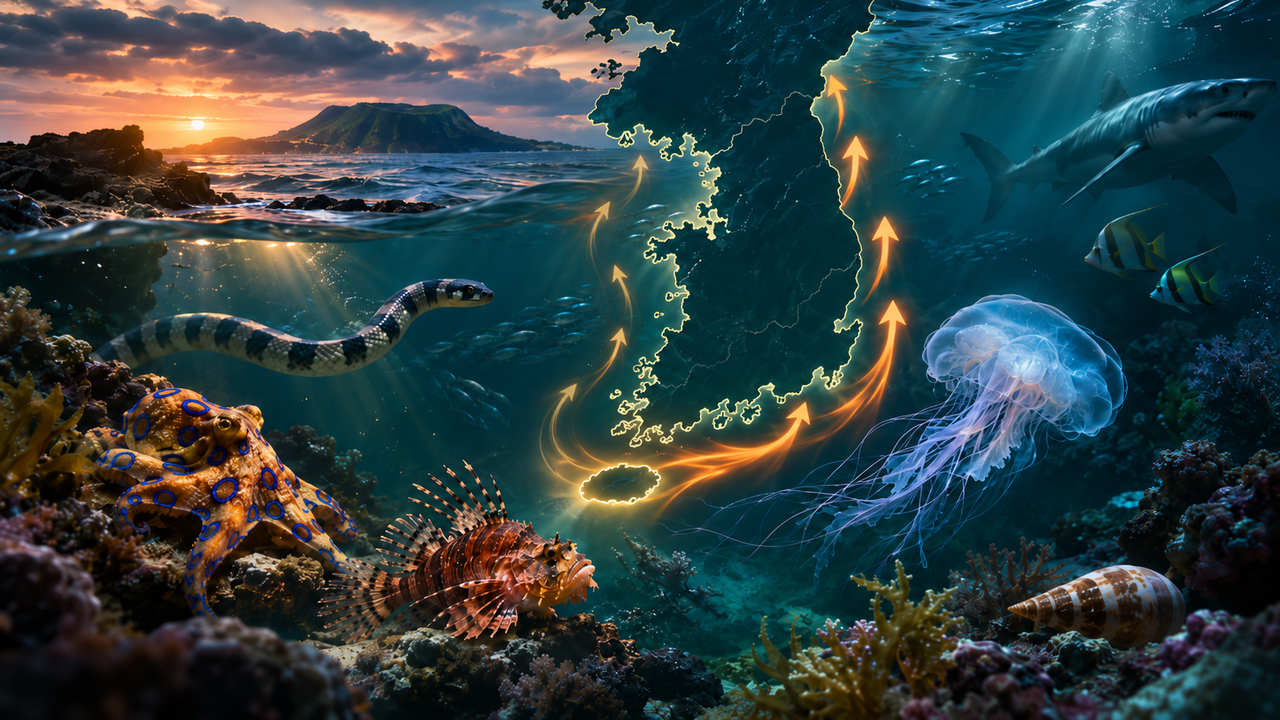
Venomous marine creatures — including toxic octopuses and sea snakes — once largely confined to the waters around Jeju Island are spreading into the South and East seas. The number of hazardous marine species recorded in the East Sea over the past decade has more than tripled compared with the previous decade, rising to 16 species. Researchers say the subtropical transformation of Korean waters, driven by rising sea temperatures and the expansion of warm currents, is pushing dangerous marine life steadily northward.
An analysis by the Korea Institute of Ocean Science and Technology (KIOST), released Thursday, examined domestic sighting records for 36 hazardous marine species registered in the Global Biodiversity Information Facility (GBIF) and the Ocean Biodiversity Information System (OBIS). The number of species confirmed in the East Sea climbed from five in 2006–2015 to 16 in 2016–2025. Over the same period, species counts in the South Sea doubled from 10 to 20. Jeju rose from 13 to 15 species, and the West Sea from 11 to 12.
The density of hazardous species sightings — measured per 1,000 total marine animal records — also increased. In the East Sea, the rate rose roughly 2.9-fold, from 2.8 to 8.1 sightings per 1,000 records, while the South Sea nearly doubled from 4.2 to 8.2. The West Sea went from 1.3 to 3.3, and Jeju from 4.6 to 6.2. However, the researchers cautioned that the increases partly reflect historically sparse survey and observation records, making it difficult to conclude that rising documented sightings directly correspond to rising population numbers.
The northward shift is also visible in specific sighting locations. Among seven representative tropical and subtropical marine species, five have been recorded farther north than ever before. The Indo-Pacific sergeant and the amberjack have been spotted as far north as the coast of Goseong in Gangwon Province, at latitude 38.5 degrees north.
The highly venomous broad-banded sea snake was first recorded in Jeju in 2015 and was subsequently confirmed in Tongyeong, South Gyeongsang Province, in 2017, indicating that this neurotoxic species has extended its range to the southern coast.
The blue-ringed octopus has similarly expanded from Jeju into the South and East seas. First recorded in Jeju in 2003, it was confirmed in the South Sea in 2019 and has since been sighted in Ulsan on the East Sea coast. The species carries a potent venom; in June 2015, a tourist was bitten near Hyeopjae Beach in Jeju and required emergency treatment.
The lionfish, which carries venomous spines, was recorded in Jeju in 2010, the South Sea in 2015 and the East Sea in 2022. The toxic Portuguese man-of-war has also been confirmed not only around Jeju but in the South and East seas as well.
The shifting distribution of hazardous marine life is already translating into real safety incidents. Jellyfish sting cases jumped roughly 5.7-fold, from 744 in 2023 to 4,224 in 2024. Large sharks caught as bycatch in the East Sea rose from one case in 2022 to 44 in 2024. As of a June 24 announcement this year, large shark sightings along the East Sea coast stood at 46 — about 3.8 times the 12 recorded during the same period the previous year.
Researchers identified Jeju as the key observation zone for tracking the northward advance of hazardous marine species. Jeju, which feels the influence of warm currents before other regions, has recorded a higher frequency of tropical and subtropical species than temperate species for three consecutive years since 2023.
Toxic fish, sea snakes and cone snails were observed in Jeju at rates far exceeding those in other waters. An analysis of 2016–2025 records found that the proportion of these species observed in Jeju was 3.4 to 4.2 times higher than in other sea areas. Of 16 domestic records for lionfish, 13 were from Jeju; of five records for the broad-banded sea snake, three were from Jeju.
The concern is that as the range of hazardous marine species widens, the baseline data needed to accurately identify species and communicate risks remains insufficient.
Domestic sighting records for the 36 hazardous marine species registered in international biodiversity databases were limited to 1,174 entries after duplicates and errors were removed. Seven of the 36 species had no domestic sighting records at all.
Misidentification in field reports has also been a persistent problem. Of 45 sea snake reports submitted with photos or video between 2013 and 2016, only 18 — just 40 percent — turned out to be actual sea snakes. Eighteen cases involved fish mistaken for sea snakes, and seven involved land snakes.
In jellyfish web reports collected by the National Institute of Fisheries Science from 2024 to 2026, 124 of 666 submissions — 18.6 percent — excluding Nomura's jellyfish and moon jellyfish could not be identified to species or turned out not to be jellyfish at all.
A shark that appeared in Busan's Bukhang port in September also took 18 days to identify. The shark, nicknamed "Bukangi" by local residents, proved difficult to classify as either a bull shark or a blacktip shark. It was ultimately identified as a blacktip shark on Oct. 6, based on distinguishing features captured in close-up footage.
KIOST proposed building an integrated AI-based monitoring and early-warning system to detect hazardous marine species as early as possible. The proposed system would use photos and videos submitted by the public to identify species, while AI-equipped underwater drones and unmanned observation devices would continuously monitor beaches, haenyeo diving zones and aquaculture farms.
By detecting hazardous species in Jeju first, local governments, fishers and beach operators along the South and East seas could receive timely alerts and gain critical response time, the researchers explained. They also called for linking environmental data such as sea temperature with species sighting records to assess risk levels, and for expanding the current jellyfish-focused special advisory system to cover other hazardous marine species.
"Because Jeju serves as a gateway through which dangerous species pass, detecting and reporting them there first gives the South and East seas time to respond," said Kim Tae-hun, a principal researcher at KIOST's Tropical and Subtropical Research Center. "We need an AI-driven transformation of integrated ocean management — one that connects the entire process from data collection and species classification to unmanned real-time monitoring, early warning and response."
adastra@heraldcorp.com