Research published in Royal Society of Chemistry journal
Lithium doping maximizes oxygen reactivity inside catalyst
Boosts hydrogen output while preventing structural breakdown
Green hydrogen is key feedstock for e-SAF
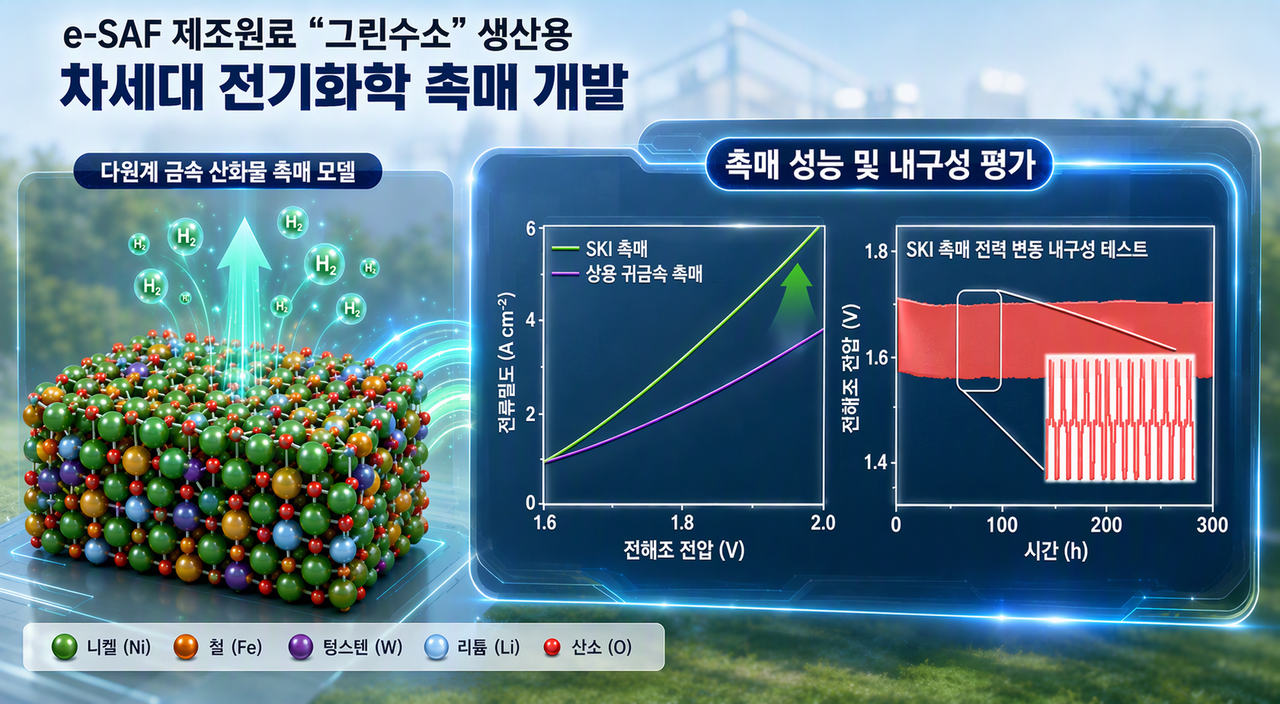
SK Innovation announced Wednesday that its newly developed high-efficiency water electrolysis catalyst technology has been published in the Journal of Materials Chemistry A, an internationally recognized academic journal issued by the Royal Society of Chemistry in the United Kingdom.
The journal ranks among the top quartile of publications worldwide in materials and energy research.
In water electrolysis — the process of splitting water with electricity to produce hydrogen — catalysts play a central role. A catalyst is a substance that accelerates the reaction breaking water into hydrogen and oxygen, reducing power consumption and improving hydrogen production efficiency.
Water electrolysis systems powered by renewable energy face a key drawback, however: because renewable generation varies with weather and time of day, the irregular power supply can degrade and ultimately destroy the catalyst's structure.
Researchers at SK Innovation's Environmental Science and Technology Institute addressed this problem by adding trace amounts of lithium to a nickel-iron-tungsten (Ni-Fe-W) catalyst through a process known as doping. The lithium maximizes oxygen reactivity within the catalyst, simultaneously increasing the rate of hydrogen production and preventing structural breakdown.
The green hydrogen produced using the new catalyst technology serves as a key feedstock for e-SAF, or next-generation sustainable aviation fuel. E-SAF is synthesized by combining green hydrogen — made from renewable energy — with carbon dioxide captured from industrial processes.
The achievement marks an expansion of the thermochemical catalyst expertise SK Innovation has built through its refining and chemical operations into electrochemical-based manufacturing of useful materials. The company now holds patent technology covering the entire e-SAF production chain, from water electrolysis catalysts and carbon dioxide electrolysis to synthetic crude production and e-SAF refining and conversion.
According to the International Air Transport Association, achieving carbon neutrality in the aviation industry by 2050 will require about 500 million tons of SAF annually. E-SAF is projected to account for more than 40 percent of global SAF production potential by that year.
"We will continue to leverage SK Innovation's core research and development capabilities in catalysts, processes and synthesis to secure future clean energy technologies and contribute to building the e-SAF ecosystem," said Kim Pil-seok, head of SK Innovation's Environmental Science and Technology Institute.
yeongdai@heraldcorp.com