Bank of Korea report on AI adoption and productivity effects
Two in three workers say they use AI on the job
Managers, professionals and office workers see biggest time savings
'Link to quality improvement remains limited'
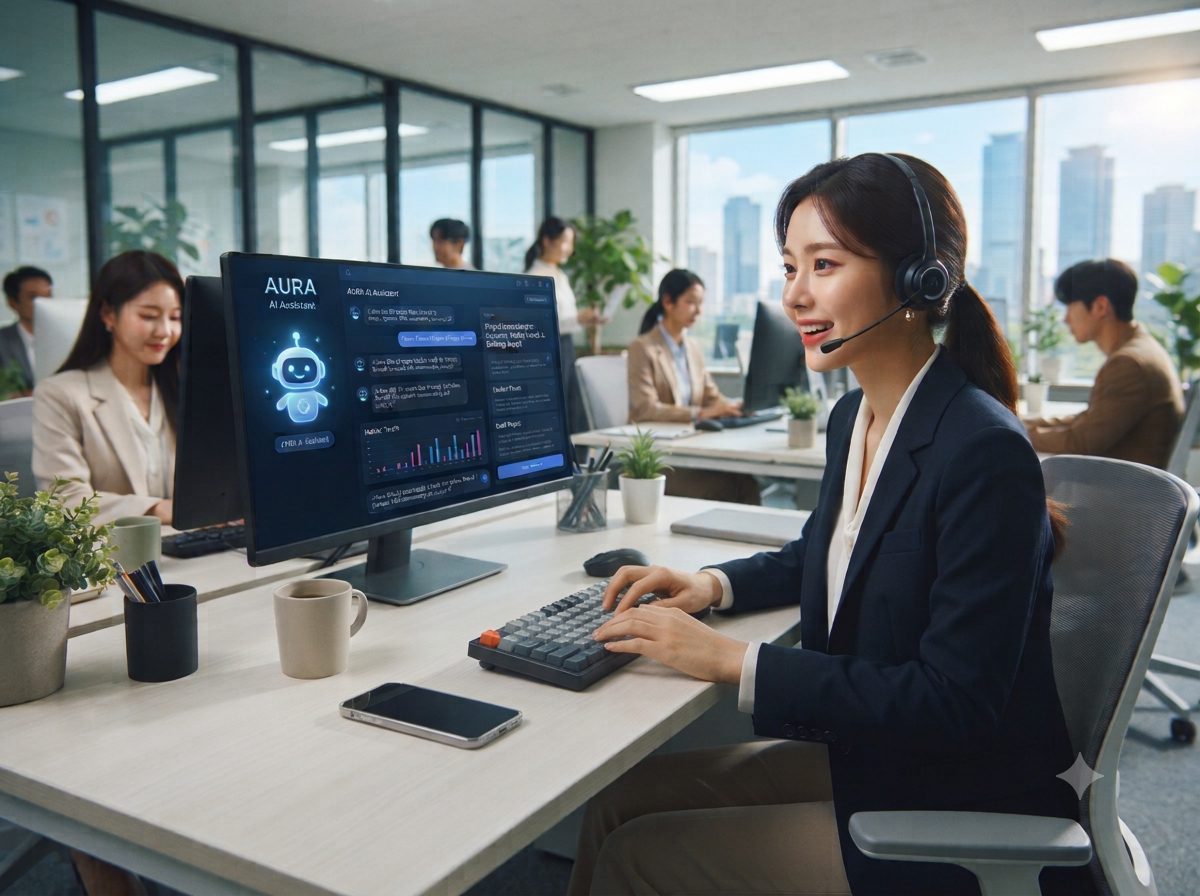
Two in three employed Koreans now use generative AI at work, according to a new survey, with the share of workers using AI on the job rising 14.7 percentage points in a year and the rate of working-hour savings growing 2.4 times over the same period.
The findings come from a Bank of Korea issue note on AI adoption and productivity effects, released Tuesday by Oh Sam-il, head of the bank's employment research team, and colleagues. The team surveyed 16,342 employed Koreans between the ages of 18 and 64 nationwide from August to September this year, finding that 66.5 percent reported using generative AI at work — up from 51.8 percent last year.
The share of workers who use AI regularly also rose, from 17.1 percent to 30.6 percent. South Korea's workplace AI adoption rate far exceeded those of the United States (43 percent) and the average of six European countries (33.7 percent).
Among those who use AI at work, average weekly usage climbed from 5.9 hours to 8 hours. The rate of working-hour savings expanded from 3.8 percent to 9.2 percent over the year — roughly a 2.4-fold increase.
For a worker on a standard 40-hour week, that translates to time savings growing from 1.5 hours to 3.7 hours per week.
"By next year, I would expect the average to come down by about a full day," Oh said. "The way people work looks set to change considerably."
Individual savings rates varied, however, depending on circumstances.
Users who bore no personal cost for AI tools saved an average of 8.3 percent of their working hours, while those paying out of pocket saved 11.4 percent and those whose employers covered the cost saved 11.6 percent.
By occupation, managers (11 percent), professionals (10.9 percent) and office workers (11 percent) posted the most notable reductions in working hours. Service workers (5.2 percent), sales workers (8.5 percent) and manual laborers (5.3 percent) saw comparatively smaller gains — a pattern the report attributes to AI being more readily applicable to cognitive tasks.
When asked how they used the time freed up by AI, the largest share of respondents — 33.8 percent — said they focused more on core tasks, while 29.3 percent said they took on additional work. In all, 63.1 percent said they redirected the saved time back into their jobs. Even so, the link between time savings and actual productivity gains remained unclear.
"What matters is how meaningfully people used the time they got back, but the effect on output or quality improvement is still limited," Oh said.
The correlation coefficient between working-hour savings and increases in workload — where a value closer to zero indicates a weaker relationship — edged up from 0.00 last year to 0.08 this year, but remains low. The correlation between time savings and improvements in work quality also stood at just 0.09.
The report called for policy attention to be directed at improving the quality of AI use rather than simply its spread, recommending that workers' ability to apply AI effectively be strengthened and that companies reform their work processes and organizational practices.
It added that rather than targeting higher adoption rates or longer usage hours, what matters is verifying whether actual work outcomes improve. The report also urged policymakers to consider benefits that are difficult to capture through short-term output metrics, such as quality improvements, the accumulation of skills and worker well-being.
kimstar@heraldcorp.com