Budget briefing held with six ministries including Ministry of Planning and Budget
Lee Gwang-jae calls mega special zones 'new engine of innovation economy'
Power sector seen needing 80 trillion won over next decade
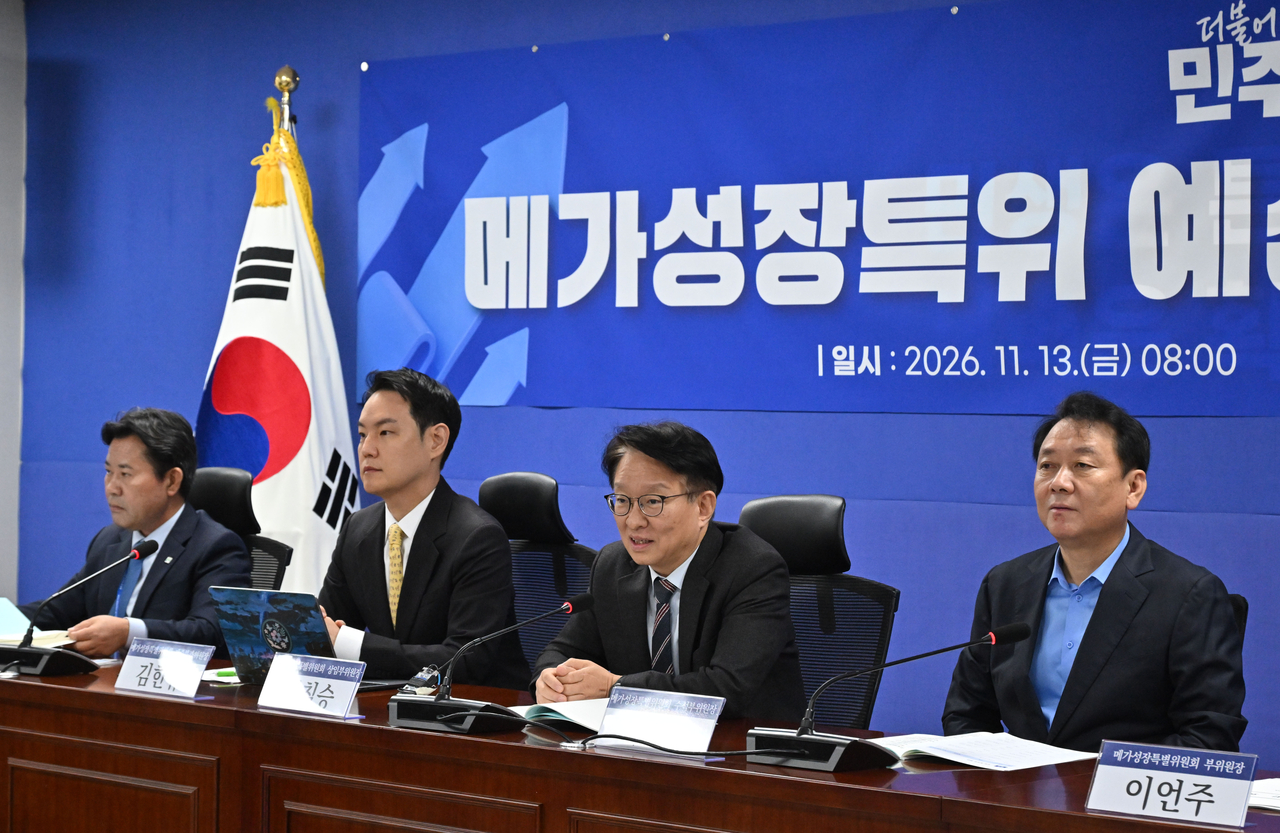
The Democratic Party of Korea's Special Committee on Mega Growth said Friday it would work to pass the super-wide-area special zone bill and its related budget through the National Assembly before the end of the year. With the power sector expected to require about 80 trillion won ($60 billion) over the next decade, the Democratic Party plans to continue discussions with the government focused on budget items to be reflected in next year's spending plan.
Lee Gwang-jae, the committee's senior vice chairman, said at a budget briefing held at the National Assembly Members' Office Building that day that "mega special zones are the engine of the new innovation economy South Korea needs," adding that the party would "make every effort to turn the two wheels of legislation and budget by year-end and move toward a new innovation economy."
Standing Vice Chairman Kwon Chil-seung said "the starting point for shared growth and the fruits of that growth is a meticulous and well-structured budget." Kwon added that "the results of the mega special zones will be a crucial test of the Lee Jae Myung administration's success or failure," urging the committee to "navigate the debates and controversies that will arise through year-end with wisdom and stand at the very forefront of building shared growth and an irreplaceable South Korea."
Six ministries attended the briefing — the Ministry of Planning and Budget, the Ministry of Trade, Industry and Resources, the Ministry of Science and ICT, the Ministry of Climate and Energy, the Ministry of Land, Infrastructure and Transport, and South Korea's Ministry of National Defense — to discuss projects that should be reflected in next year's budget related to the mega projects. Jang Cheol-min, the lawmaker who leads the Democratic Party's side on the committee, told reporters after a closed-door session that the meeting was "an occasion to discuss what the government is centering on and the areas the Democratic Party needs to push further."
Jang said that Park Jeong-hyeon, chairperson of the Presidential Committee on Balanced National Development, "offered various opinions so that mega project work can proceed in other regions beyond those already under way" — citing Gwangju, North Jeolla Province's Saemangeum, South Chungcheong Province's Asan, which is home to Samsung Electronics' Onyang campus, and Yongin in Gyeonggi Province.
The briefing also covered infrastructure budget discussions on power and water supply to underpin AI data centers and other facilities. Jang said that "as far as I understand, about 80 trillion won will be needed for the power sector over the next 10 years, with government funding of around 50 trillion won." Jang added that "there were opinions on the Ministry of Climate and Energy's plan to resolve power supply uncertainties by region."
However, discussions on labor special provisions — one of the key sticking points in the super-wide-area special zone bill — did not take place at Friday's briefing. A review of the bill has been delayed as industry and labor remain at odds over whether to exempt workers from the 52-hour workweek limit under the legislation. Jang said that "related issues will be handled separately through the policy committee and a party-wide policy general assembly."
addressh@heraldcorp.com