About 300 people lined up before the drive-thru opened Friday, with the first customers waiting since 2 a.m.
The city posts the nation's highest commercial vacancy rate, and nearly 70% of residents' spending flows out of town
A department store site the size of nine soccer fields has sat empty for a decade
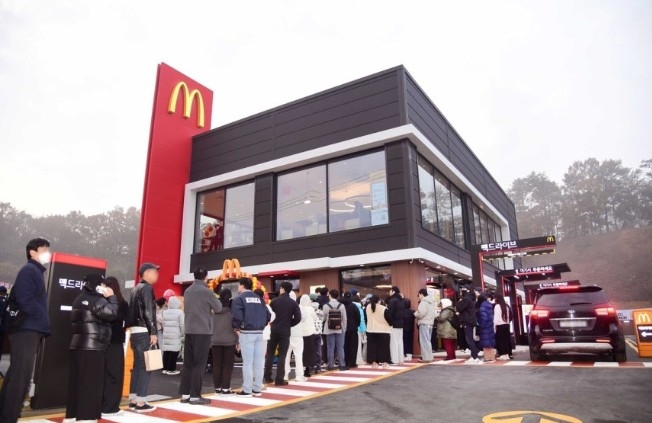
Sejong has shed its reputation as South Korea's only McDonald's-free city — 14 years after it was established. The fast-food chain opened its first location in the administrative capital on Friday, making Sejong the last of the country's 17 metropolitan and provincial governments to get one.
The milestone was long overdue. Hongseong, a South Chungcheong Province county of roughly 34,000 people — less than a tenth of Sejong's population of 400,000 — already had a McDonald's.
McDonald's is not the only conspicuous absence. Sejong, which is set to receive the presidential office Cheong Wa Dae and the National Assembly as part of the country's administrative relocation plans, still lacks chains commonly found in Seoul such as Coffee Bean and Paul Bassett. Above all, the absence of department stores and large shopping complexes has made it routine for residents to travel to nearby Daejeon or Cheongju just to shop.
The situation has fueled growing calls for denser lifestyle and commercial infrastructure to curb out-of-city spending and revitalize local retail.
According to McDonald's, about 300 people had gathered outside the new Sejong DT (drive-thru) location before it opened at 7 a.m. Friday.
The first customers were two university students in their 20s, Kim Ju-han and Park Ji-yong, who had been waiting since 2 a.m. — roughly five hours. Their first words were reported to be: "Sejong finally has a McDonald's."
The new outlet does come with caveats. It sits more than 10 minutes by car from Government Complex Sejong and was built on a road leading into Sejong from Gongju, rather than on a road heading toward Gongju from Sejong, making it less accessible for many residents.
Some have dismissed the fuss over a single burger outlet as overblown, but the prevailing view among government officials in Sejong is that the opening carries real significance for a city that has grown to nearly 400,000 people in 14 years.
Sejong's population stood at 397,545 as of the end of September. Applying McDonald's general benchmark of one store per 100,000 residents, the city could support around four locations.
Analysts say the delayed entry reflects the realities of site availability, local demand by district and profitability — factors that do not always align with population figures alone.
The structural challenges run deeper. Sejong's vacancy rate for mid- to large-sized commercial properties hit 29.68 percent in the second quarter of this year, the highest in the country — meaning roughly 30 percent of commercial floor space sits empty.
A prime commercial site designated for a department store has stood completely undeveloped. The 62,000-square-meter plot — large enough to fit more than nine soccer fields — has been valued at up to 500 billion won ($375 million), and no investor has committed to it in over a decade. Half the land is used as a temporary parking lot; the rest has been left as green space. The retail vacuum has consequences: nearly 70 percent of Sejong residents' total spending of 7 trillion won last year went to businesses outside the city.
"As a joke, friends working in Seoul say they don't want to come down to Sejong because there's no Coffee Bean or Paul Bassett," a Sejong government official said.
"Most of the time, people go to Daejeon or Cheongju to buy daily necessities or expensive items, or bring things back from business trips to Seoul," the official added. "There simply aren't enough retail facilities to meet the consumption needs of Sejong residents."
The pressure to build out Sejong's commercial infrastructure is set to intensify. More than 1,800 civil servants from 23 agencies — including the Korea Communications Commission and the Personal Information Protection Commission — are scheduled to relocate to Sejong by next year.
Industry estimates suggest a department store requires a catchment population of at least 1.5 million to be viable. Even after the agency relocations, Sejong's population is expected to remain around 400,000, leading experts to argue the city should move beyond chasing large-format anchors and instead develop strategies that can realistically attract investment.
oskymoon@heraldcorp.com