- DGIST, KIST use taurine to suppress aging in perovskite solar cells
- Harmful superoxide removal extends operational lifespan from 23.6 to 130 hours
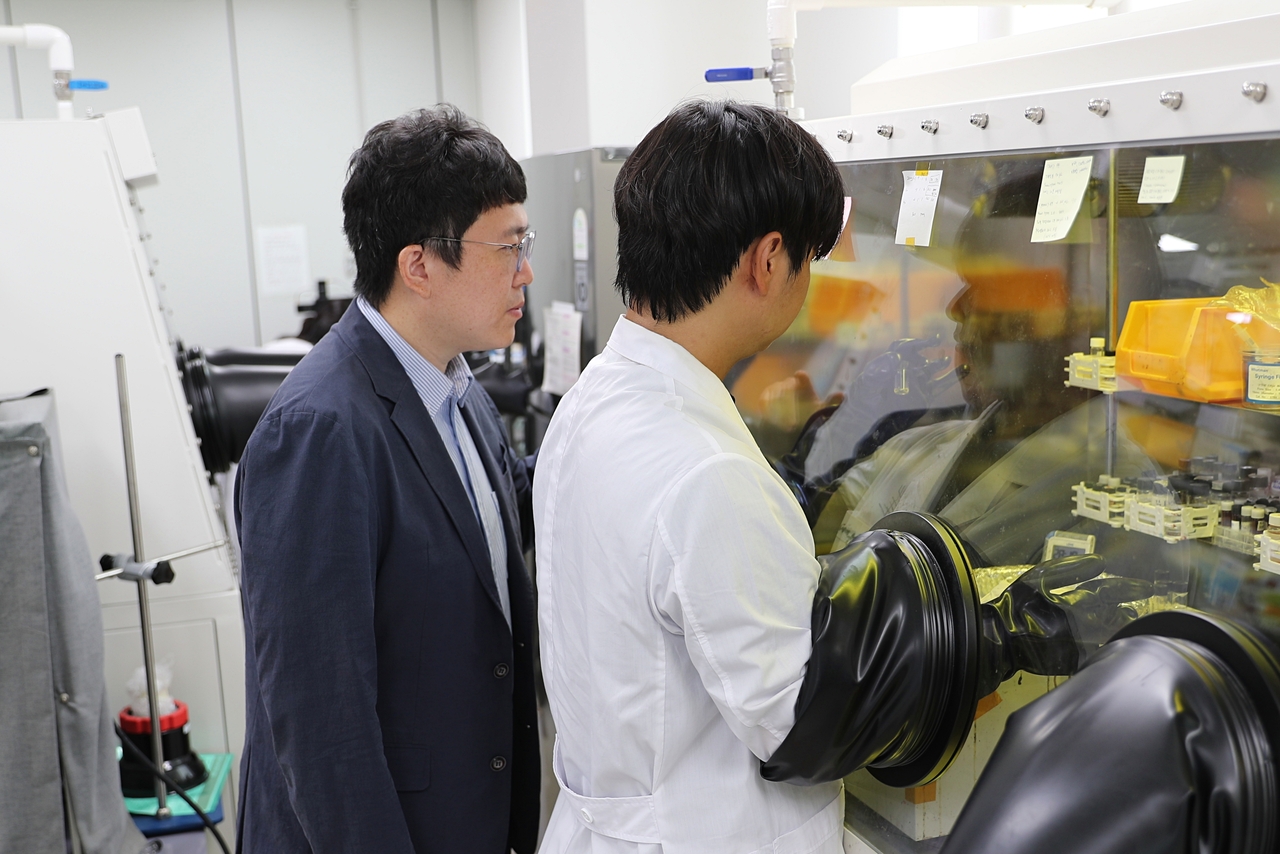
Researchers have developed a technology that extends the lifespan of next-generation solar cells by more than fivefold using taurine, an ingredient commonly found in energy drinks. The breakthrough is expected to significantly improve the durability of perovskite solar cells, which have struggled to reach commercial use due to their short operational life.
The Daegu Gyeongbuk Institute of Science and Technology announced Thursday that a research team led by Professor Choi Jong-min of its Department of Energy Engineering, working jointly with a team led by Dr. Moon Byung-jun of the Korea Institute of Science and Technology's North Jeolla Province branch, developed the technology to enhance the lifespan and efficiency of perovskite solar cells using taurine, an antioxidant compound.
Perovskite solar cells have drawn attention as a next-generation alternative to conventional silicon solar cells. While they can achieve high power-generation efficiency, prolonged exposure to light or heat damages their internal structure and causes a sharp drop in performance. Short lifespan has been identified as the single biggest obstacle to commercialization.
The research team focused on superoxide, a type of reactive oxygen species generated inside solar cells during operation. The team identified that superoxide produced in the metal oxide layer destroys the perovskite structure, shortening the cell's lifespan.
To address this, the researchers turned to taurine, widely known as an ingredient in fatigue-recovery supplements. They applied taurine to the interface where tin oxide and perovskite meet, forming a thin antioxidant layer.
The taurine layer neutralized superoxide generated during cell operation, suppressing structural degradation. At the same time, it acted as a chemical bridge connecting the two materials, reducing microscopic defects and improving electron mobility — boosting power-generation efficiency in the process.
In experiments, solar cells treated with taurine retained more than 95 percent of their initial efficiency even after more than 500 consecutive hours of light exposure.
In operational stability tests, the time for power-generation efficiency to fall to 80 percent of its initial level — known as T80 — increased from 23.6 hours to 130 hours, a roughly 5.5-fold improvement in lifespan.
The technology is significant because it can suppress reactive oxygen species generated inside the cell even after the exterior has been sealed. Unlike conventional protective technologies that block the entry of external moisture or oxygen, this approach directly controls the source of internal performance degradation.
Additional research is needed before commercialization. The team aims to apply the technology to tandem solar cells to improve power-generation efficiency and achieve operational stability exceeding 10,000 hours. Scaling the technology — currently demonstrated at the cell level — to large-area solar cell manufacturing processes remains another challenge.
"This research is significant in that it clearly identified superoxide generated from metal oxides during solar cell operation as a cause of perovskite decomposition, and resolved the problem by designing the interface with an antioxidant material," Professor Choi said. "It will serve as a key foundational technology for improving the operational stability of perovskite solar cells and accelerating their commercialization."
The findings were published as a cover paper in Advanced Energy Materials, an international academic journal in the energy field.
nbgkoo@heraldcorp.com