1.2 MW charging system installed at KERI's Ansan branch
500 hours of trials by year-end, 2,000 hours targeted by early next year
High-output continuous charging, power quality and safety to be verified
Technology push to cover large commercial EVs including trucks and buses
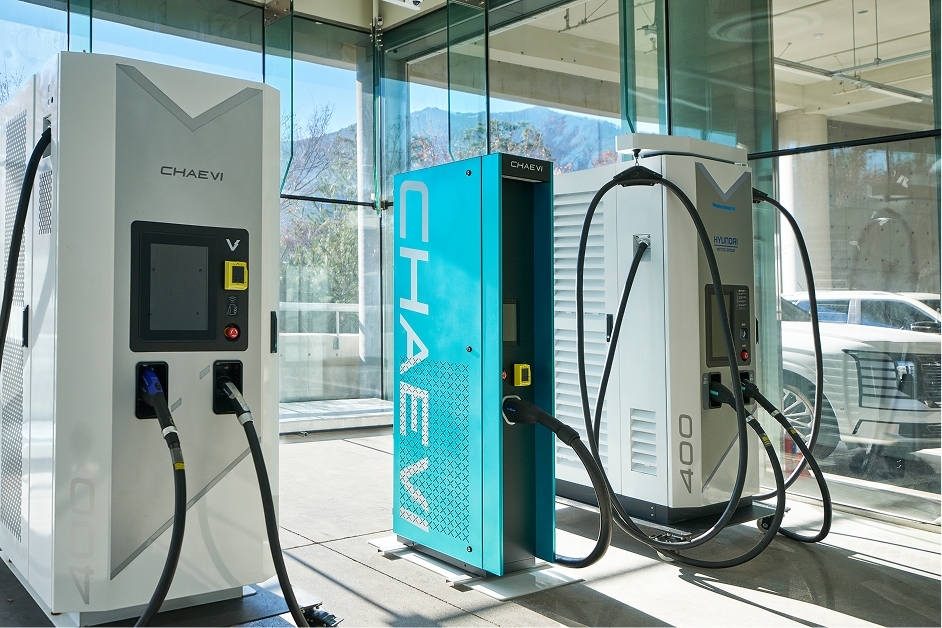
South Korea has launched its first domestic demonstration of megawatt-class ultra-fast charging technology aimed at cutting charging times for large commercial electric vehicles such as electric trucks and buses.
EV charging company Chaevi said Thursday it has installed a 1.2 MW megawatt charging system (MCS) at the Ansan branch of the Korea Electrotechnology Research Institute (KERI) and began integrated trials Monday.
MCS is a charging technology designed to deliver high levels of power to electric trucks, buses and other large commercial vehicles equipped with high-capacity batteries. Because large commercial EVs carry far bigger battery packs than ordinary passenger electric vehicles, they require high-output charging facilities to reduce charging times and improve transport efficiency.
The core objective of the current trials is to connect separately developed charging components into a single integrated system and verify real-world operating performance.
Chaevi had earlier developed a power bank capable of supplying up to 1.2 MW of electricity and an MCS dispenser that transfers that power to a vehicle. The power bank supplies the electricity needed for charging, while the dispenser connects to the vehicle via charging cables and related hardware.
With the two units now integrated and installed, Chaevi will focus on checking whether charging performance remains stable under high-output conditions and whether power quality and system safety meet the required standards.
The trials will run for 500 hours through the end of this year, with a total of 2,000 hours targeted by early next year. Chaevi plans to analyze data gathered at each testing phase to refine the system and raise the level of technological readiness needed for commercialization.
The project is part of the Energy Demand Management Core Technology Development Program supported by the Ministry of Climate, Environment and Energy and the Korea Energy Technology Evaluation and Planning Institute. Chaevi has served as the lead organization since 2024 on a task titled "Development and Demonstration of AI-Based High-Efficiency MCS and Ultra-Fast Charging Systems," working jointly with 11 participating institutions.
The first two years of the project focused on developing the core components of the charging system; the third year — this year — marks the transition to integrating those components and verifying overall performance.
Overseas, momentum is building to deploy megawatt-class charging technology on actual electric trucks. German commercial vehicle maker MAN Truck & Bus began mass production of electric trucks equipped with MCS in July. At IAA Transportation 2026, held in Hanover, Germany, in September, Daimler Truck, MAN Truck & Bus and Scania demonstrated MCS charging, showcasing the potential to cut charging times for long-haul transport.
Chaevi intends to use the current trials as a springboard to expand its charging business — currently centered on passenger EVs — into the large commercial vehicle segment.
The MCS dispenser Chaevi developed earlier won an innovation award in the vehicle technology and advanced mobility category at CES 2026 earlier this year. It also took a consumer-selected award in the charging infrastructure manufacturing category at the recently held EV Awards 2026.
Chaevi currently operates about 10,000 fast-charging units across South Korea. The company plans to enter the large EV charging infrastructure market by leveraging its existing business model, which covers charger development, manufacturing, installation and operation in-house.
"Through this integrated MCS charging system demonstration, we will extend the charging technology and infrastructure operating capabilities we have built around passenger EVs into the large mobility sector," Chaevi CEO Choi Young-hoon said. "We will enhance the completeness and field applicability of high-efficiency, ultra-fast charging technology to lead the large mobility charging market."
kwater@heraldcorp.com