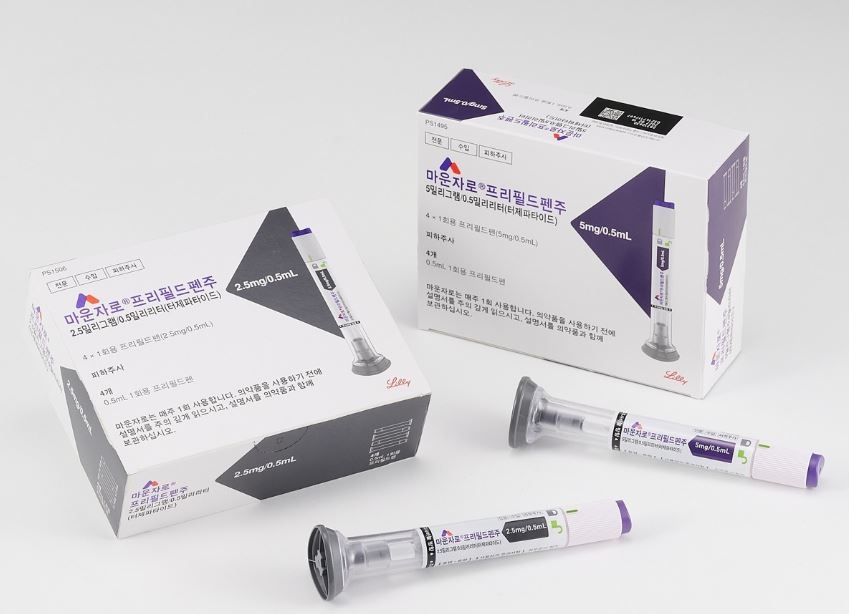
As word spreads that Mounjaro, an obesity drug sold in South Korea for around 300,000 won ($223), can be purchased in Japan for roughly 100,000 won, interest in obtaining overseas prescriptions has grown. Amid a growing trend dubbed "sushijaro" — a portmanteau of the Japanese word for sushi and Mounjaro — South Korea on Thursday began allowing travelers to bring in personal supplies of Mounjaro and Wegovy obtained through legitimate prescriptions abroad. With obesity drugs that had effectively been blocked at customs now permitted in quantities of up to a three-month supply, analysts expect overseas procurement to increase further.
According to the Ministry of Food and Drug Safety and Korea Customs Service, personal-use prescription drugs obtained through proper medical procedures at home or abroad may be carried into the country starting Thursday. The policy covers drugs officially approved by the pharmaceutical regulatory authority of the country where they were purchased, provided they were bought for personal treatment.
The change means that incretin-based obesity drugs such as Mounjaro and Wegovy, which had in effect been blocked at customs, can now be brought into the country. The Ministry of Food and Drug Safety worked with Korea Customs Service to revise the relevant standards after a series of complaints that even legitimately prescribed drugs were being held up at the border.
Japan prices up to three times cheaper than in Korea
The drug drawing the most attention under the new rules is Mounjaro obtained in Japan, where the price gap with South Korea is substantial.
A four-week supply of Mounjaro at the initial 2.5-milligram dose costs roughly 280,000 to 350,000 won in South Korea. At some medical institutions in Japan, the same dose is available for 80,000 to 120,000 won. Prices vary depending on the clinic and prescription conditions, but the difference can reach up to three times the domestic price.
Japan lists Mounjaro under its national health insurance system as a treatment for type 2 diabetes, keeping the drug price regulated. A recent 25 percent price cut there has widened the gap with South Korea further. National health insurance coverage in Japan, however, depends on local insurance eligibility and the conditions of the consultation and prescription, so the actual cost for overseas visitors may differ.
The widening price gap has spawned a new Korean term — "sushijaro," combining the Japanese word for sushi with Mounjaro — to describe the practice of traveling to Japan to obtain a prescription. Online travel communities have seen a steady stream of posts asking about clinics that can issue local prescriptions and how much the purchase would cost.
Until now, even products legitimately prescribed and purchased at Japanese medical institutions were sometimes held up when travelers returned to South Korea. Korea Customs Service had been applying to travelers' personal baggage the same list of drugs the Ministry of Food and Drug Safety maintained to prevent illegal online sales from abroad.
According to Korea Customs Service, illegal seizures of Mounjaro and Wegovy in travelers' baggage reached 1,097 cases in the January–August period this year, more than eight times the 134 cases recorded for all of last year. Calls had grown for a clearer distinction between legitimately purchased personal-use drugs and illegally distributed products.
Up to 3-month supply allowed; overseas direct purchases still banned
Under the new rules, travelers may in principle bring in up to six vials of a personal-use prescription drug. Even if the quantity exceeds six vials, it is permitted as long as it does not exceed a three-month supply based on the drug's prescribed dosage.
The Ministry of Food and Drug Safety cited weekly injectable obesity drugs as an example, noting that for a product using one injection per dose, up to 12 units — a three-month supply — may be brought in. The actual permitted quantity varies depending on the drug's formulation and dosage instructions.
The policy is not limited to drugs purchased during overseas travel. It also covers cases where a person takes domestically prescribed medication abroad and returns with the remaining supply, as well as international students on long-term stays overseas and foreign nationals entering South Korea who carry drugs prescribed to them locally.
The measure applies only to personal-use drugs carried in by the individual. Ordering drugs from overseas websites for delivery — so-called overseas direct purchases — remains prohibited, as does bringing in drugs for the purpose of selling or distributing them to others.
Narcotics and psychotropic drugs are also excluded from the general personal-carry allowance and must continue to follow existing control procedures, including separate prior approval.
One notable example is the Japanese painkiller EVE. Some formulations contain allylisopropylacetylurea, a substance classified as a psychotropic drug in South Korea, so travelers need to check the ingredients of each specific product.
Will overseas prescriptions rise? Cold storage and misuse remain challenges
The opening of a pathway to bring in obesity drugs purchased abroad has raised hopes of easing the financial burden of treatment. Because obesity drugs are often administered continuously over an extended period, the cumulative cost difference can place a significant economic strain on patients.
Medical and pharmaceutical industry circles say that if overseas procurement expands, measures to ensure the quality and safety of the drugs must be put in place alongside the new rules.
Injectable obesity drugs such as Mounjaro and Wegovy must be stored within specified temperature ranges and used within set time limits. When products purchased abroad are transported over long distances, failure to maintain proper storage conditions can affect drug quality.
The potential circulation of counterfeit drugs or products of unclear origin is another concern. Industry observers say there is a need to distinguish between products prescribed at legitimate medical institutions and those traded illegally online, and to manage bulk imports and resales that go beyond personal treatment purposes.
Discussions are also under way on ways to reduce the domestic cost of obesity drugs. Health and Welfare Minister Jeong Eun-kyeong told a plenary session of the National Assembly's Budget and Accounts Committee on Monday that national health insurance coverage for obesity drugs should be extended to people with severe obesity or chronic conditions, and that fiscal considerations were being reviewed.
The Ministry of Food and Drug Safety said it plans to monitor drug import trends together with customs authorities following the policy change and to pursue management measures to ensure safe use.
"There was widespread opinion that banning the personal import of self-treatment drugs was excessive regulation, so we revised the rules after thorough discussion," a ministry official said. "We will separately pursue policies to ensure safe use and closely monitor how the situation evolves after implementation together with customs authorities."
rainbow@heraldcorp.com