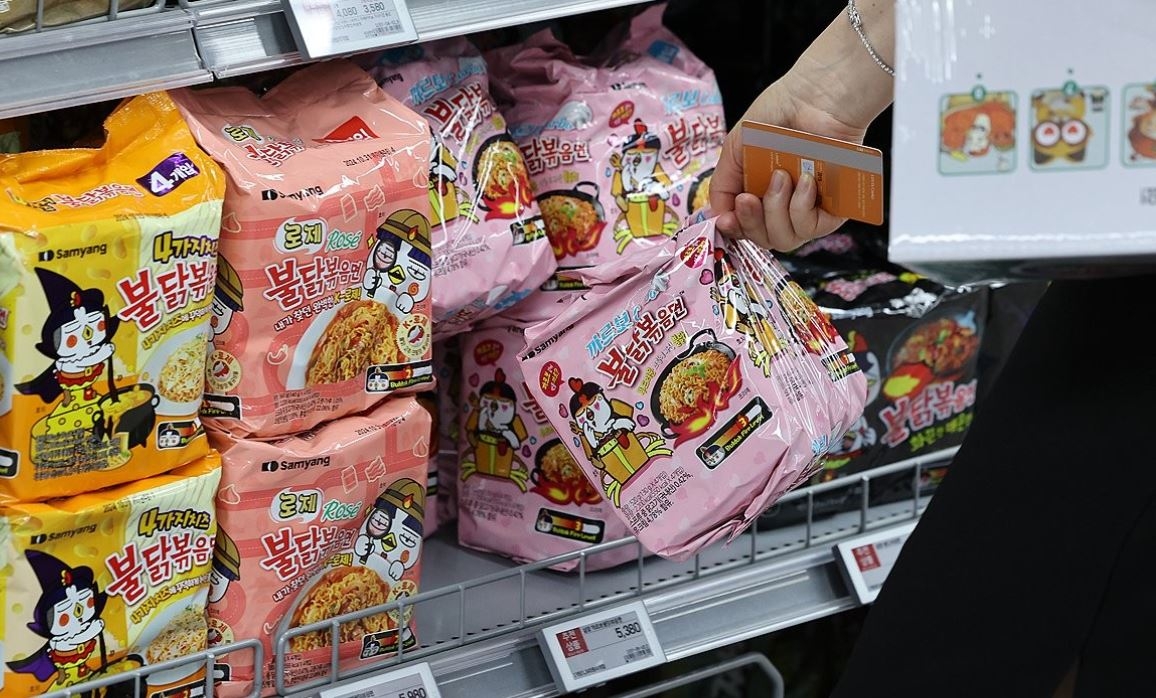
Samyang Foods, which has been breaking its own earnings records on the back of the global popularity of Buldak Bokkeummyeon, is moving quickly to expand its overseas production network. With more than 80 percent of its total sales coming from abroad, the company has decided to build a factory in Vietnam at a cost of around 220 billion won ($164 million), following a similar investment in China. The worldwide "Buldak craze" is now driving the company beyond domestic capacity expansions toward building a full global production footprint.
Samyang Foods disclosed Wednesday that it will invest a total of 218.6 billion won to construct a manufacturing factory in the Thuan Thanh area of Vietnam. The company plans to inject 131.1 billion won into a local production subsidiary, tentatively named Samyang Foods Bac Ninh LLC, to secure a 100 percent stake, with the factory set to be completed by Jan. 31, 2029.
The investment is part of a strategy to diversify production bases in response to surging overseas demand, centered on Buldak Bokkeummyeon. Having long used its domestic factories as export hubs, Samyang Foods now aims to strengthen a region-by-region supply structure by establishing local production facilities in both China and Vietnam.
Overseas sales at 83.5% of total — record earnings driven by Buldak craze
The push to expand overseas production facilities comes alongside rapid earnings growth. Global demand for Buldak Bokkeummyeon has continued to climb across major markets including the United States, China and Europe, driving a sharp rise in overseas sales.
Samyang Foods reported consolidated third-quarter sales of 791.8 billion won on Friday, up 25.3 percent from the same period last year. Operating profit rose 49.9 percent to 196.2 billion won. Both figures set all-time quarterly records, with the operating profit margin reaching 24.8 percent.
Overseas operations drove the results. Third-quarter overseas sales reached 660.8 billion won, up 29.4 percent year on year. Overseas revenue accounted for 83.5 percent of total sales, underscoring that Samyang Foods has in effect become a company whose growth is centered on global markets.
The US and China subsidiaries each posted sales exceeding 200 billion won, while European sales reached 86.9 billion won, up 65.5 percent from the same period last year. As Buldak Bokkeummyeon expands beyond Asia into North American and European markets, overseas demand continues to grow.
Cumulative sales for the first three quarters of this year reached 2.28 trillion won, up 32.8 percent from the same period last year. Cumulative operating profit also rose 42.7 percent to 549.5 billion won. In line with this growth, Samyang Foods is concentrating investment on expanding production capacity and restructuring its supply chain.
From China to Vietnam — up to 8 production lines secured
The Vietnam factory will be built to accommodate up to eight production lines. To prepare for future demand growth, Samyang Foods will first secure the land and building, then initially install one line of equipment for dried noodle production.
Dried noodles are made by drying with hot air rather than deep-frying in oil, and this will mark the first time Samyang Foods has set up dried noodle production equipment overseas. The company plans to establish a production base for related products including its dried noodle brand "Tangl," with decisions on additional production lines to follow based on market demand.
The remaining seven lines will be reserved as space for equipment such as fried noodle production facilities for products like Buldak Bokkeummyeon. The specific timing of equipment installation and the scale of investment for those lines will be determined later.
Samyang Foods completed its Miryang No. 2 factory in South Gyeongsang Province in June last year — an export-dedicated production base — and has since been expanding overseas as well. Its first overseas production base, a factory in Jiaxing, Zhejiang Province, China, is on track for completion early next year. That facility, built with an investment of around 207.2 billion won and equipped with eight production lines, is intended to supply products primarily to the Chinese domestic market.
Once the China factory begins full operation, domestic production facilities will be able to supply greater volumes to other export markets such as the US and Europe. With the Vietnam production base added, Samyang Foods' manufacturing footprint will expand to three countries: South Korea, China and Vietnam.
This represents a shift away from producing goods domestically and exporting them abroad, toward a global supply chain in which products are manufactured directly in regions close to key markets.
Targeting Europe and Southeast Asia at once — logistics costs and tariff risks spread
Samyang Foods chose Vietnam as its second overseas production base partly for its manufacturing cost advantages and logistics competitiveness. Vietnam offers conditions that allow the company to reduce procurement costs for raw materials such as flour and palm oil, as well as labor costs, and is seen as a strategic location from which to target both the ASEAN market and Europe simultaneously.
Given that overseas sales now account for more than 80 percent of total revenue, concentrating production in a single country would leave the company exposed to logistics disruptions, tariff changes and geopolitical tensions that could affect product supply. Samyang Foods' strategy is to spread production bases across regions to reduce such risks and respond flexibly to shifts in demand across different markets.
The time and cost required to build a factory also factored into the choice of Vietnam. Samyang Foods said that compared with the US or Europe, Vietnam offers a relatively shorter permitting and construction timeline, as well as advantages in capital expenditure and operating costs.
With this Vietnam investment, Samyang Foods' overseas production strategy has taken on a clearer shape: China will absorb local domestic demand, Vietnam will serve as a production base targeting Europe and Southeast Asia, and domestic factories will continue to handle major export markets such as the US and Europe.
"We plan to separate production bases by region to spread the risks associated with any single location — geopolitical issues, logistics and tariffs — and to respond stably to rising demand in each market," a Samyang Foods official said.
rainbow@heraldcorp.com