Editor's note
We tell stories through paintings — exploring the issues embedded in art, the histories soaked into masterworks, and the human anxieties and desires that breathe through them. We begin with a single canvas and step out into the world beyond the frame.
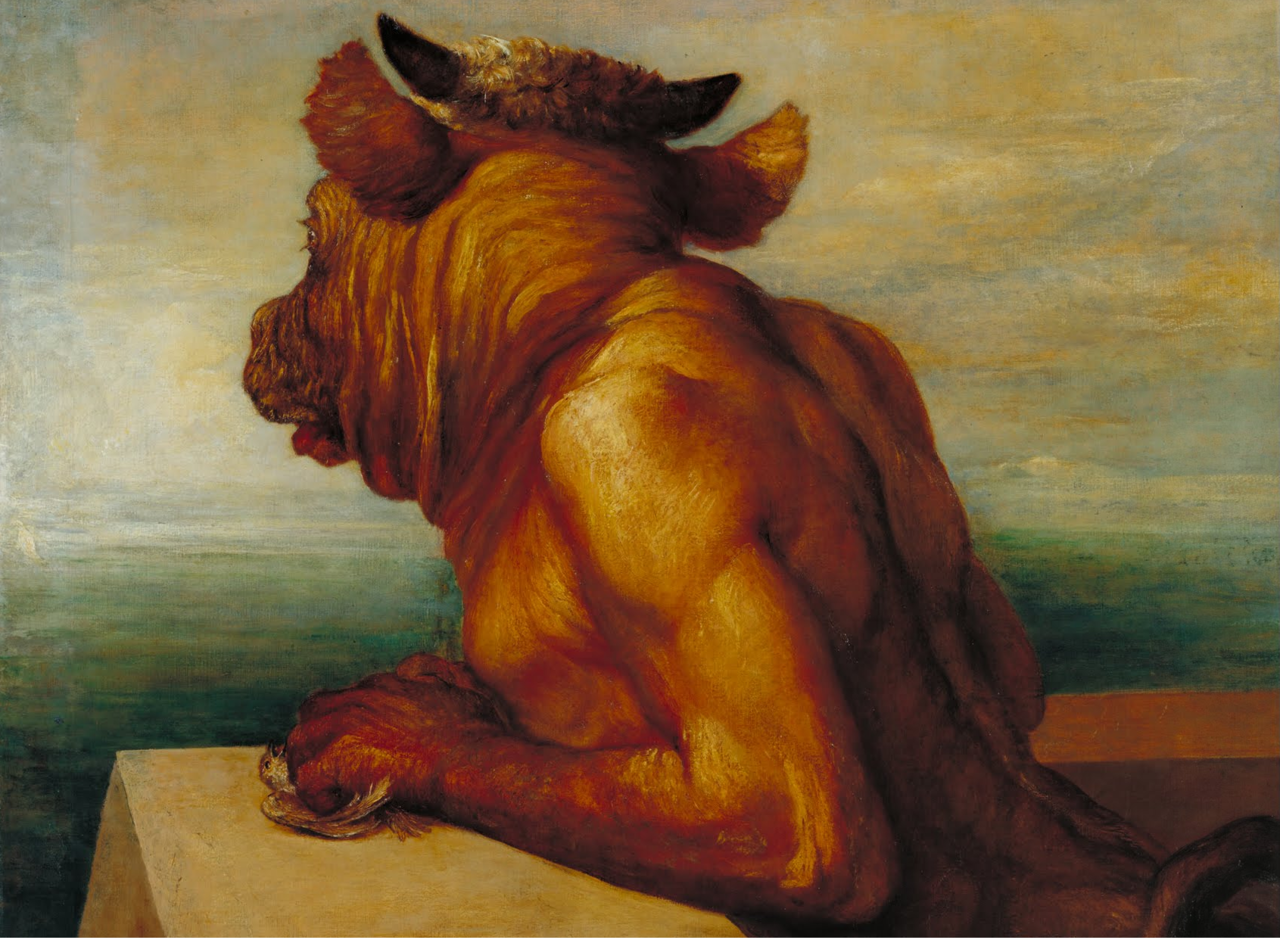
The Minotaur was born with the head of a bull and the body of a man. From the moment of its birth it grew with terrifying speed — stretching its muscular arms, devouring every human it could reach. King Minos could not let the creature roam free, so he lured it into the labyrinth beneath his palace and locked it away.
He would have liked nothing more than to starve it to death. But he could not. However much the creature was the product of a divine curse, it was still the child of his wife and queen, Pasiphae.
The question then became: what to feed it. The Minotaur would eat nothing but human flesh, which made the problem all the more vexing. Minos could not sacrifice his own Cretan subjects. A convenient target presented itself — Athens. The city was already in his debt: his son Androgeos had died there in a sudden accident. Minos issued his demand: "Once a year — or once every nine years — send seven boys and seven girls as tribute."
Those children became food for the Minotaur, until the hero Theseus joined one such procession of sacrifices and changed everything. This is the story as told in Greco-Roman mythology.
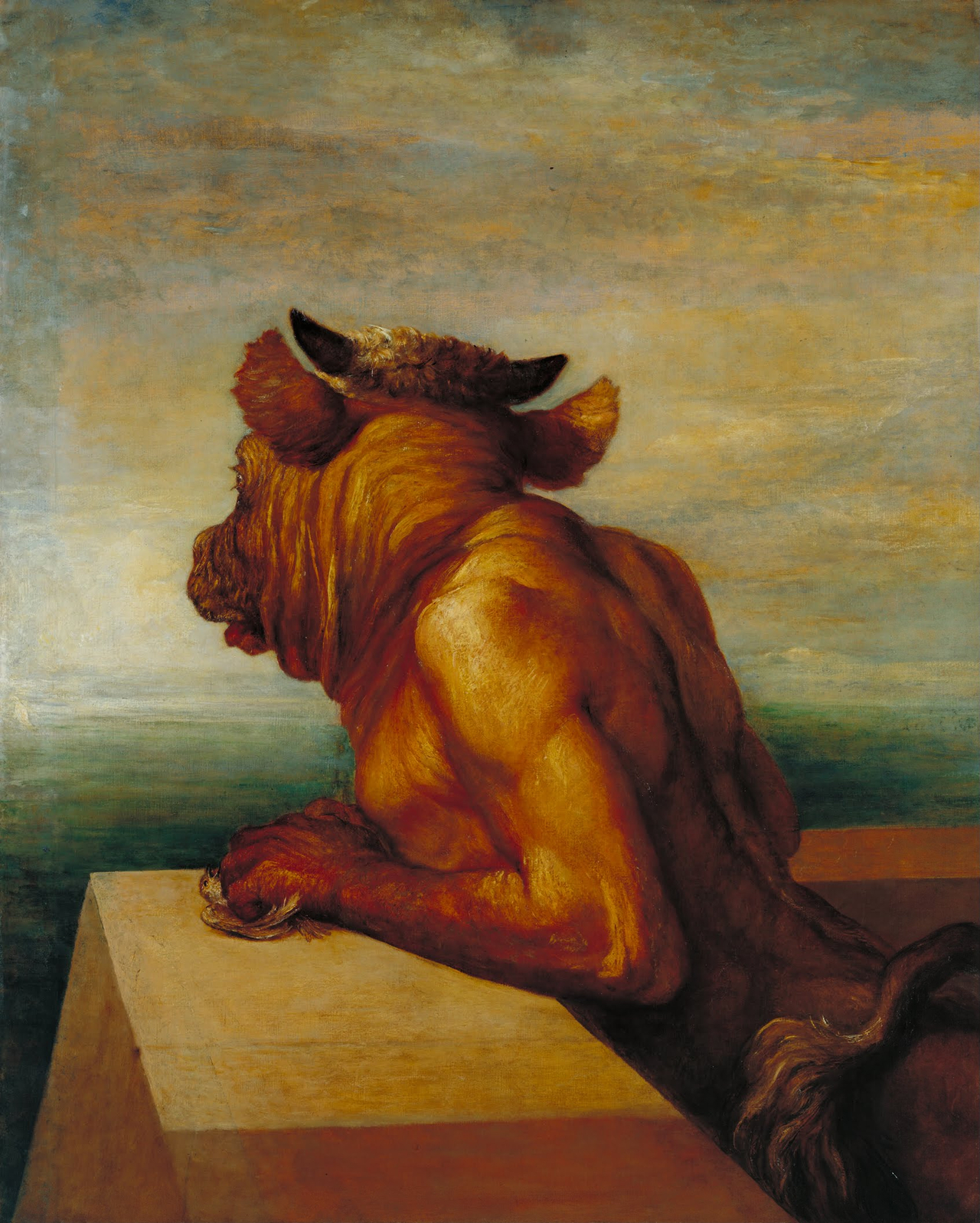
That Minotaur is staring out to sea.
Leaning against the edge of the labyrinth's countless corridors, it gazes endlessly toward the horizon. Its horns rise sharply; its eyes seem never to blink; its nose and ears are alert and focused; its tongue lolls forward as if saliva might follow at any moment. The Minotaur waits for one thing only — a ship, laden with fresh prey, to appear on the water once more.
With its hulking, muscular arms, the creature pins a baby bird against the wall. Tate describes the bird as a symbol of innocence and fragility. The small creature, mouth open in pain, will soon become no more than a morsel. This is George Frederic Watts's The Minotaur.
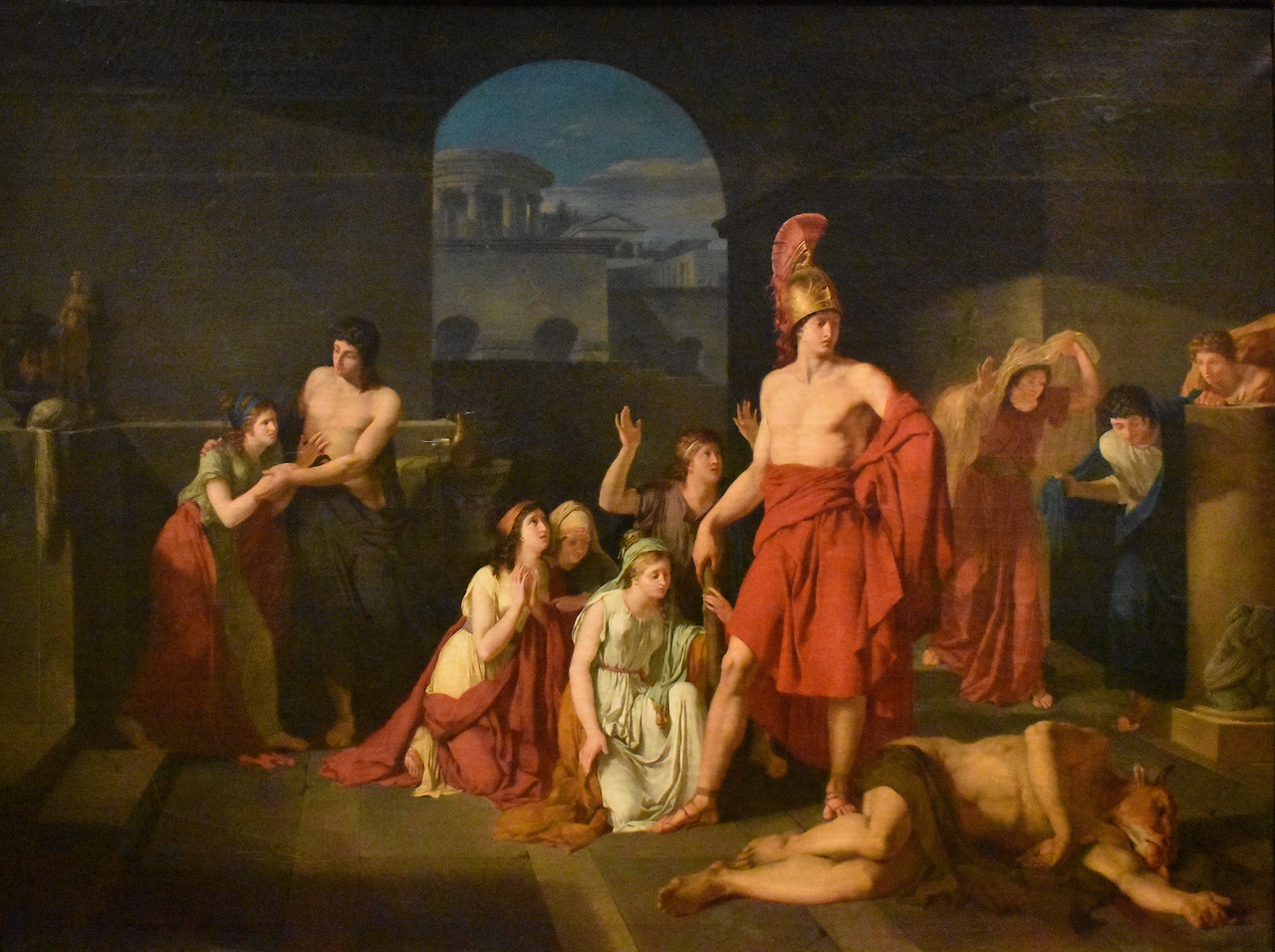
Mythological paintings depicting the Minotaur have typically chosen the dramatic moment when the hero Theseus vanquishes the beast. Paintings devoted to the Minotaur alone — with no hero in sight — were rare. Yet Watts had his reasons for this unusual composition. That reason was rage.
In ancient times, if we can believe the myth, Athens ( ... ) was compelled to send seven young men and seven young women to Crete as tribute. ( ... ) Tonight, in London, not seven maidens only, but many times seven — nightly, yearly — are offered up as tribute. ( ... )
With the labyrinth entrance that is the back streets of London ( ... ) the insatiable maw of London's Minotaur is never satisfied.
Watts read these words one day in July 1885, written by William Thomas Stead. They appeared in "The Maiden Tribute of Modern Babylon," a series published in the Pall Mall Gazette from July 6 to 10 of that year — an exposé of child prostitution in the Victorian era.
Stead had mapped the sex buyer onto the Minotaur and the victims onto the boys and girls of Athens. Watts was deeply struck by the analogy. One passage inflamed him above all others: a London "Minotaur" had approached a family and attempted to "purchase" their 13-year-old daughter for a mere five pounds ($6).
Disgusted, Watts picked up his brush immediately. By his own account, he conceived and completed The Minotaur straight away — driven, as he put it, by a desire "to arouse indignation at bestial and cruel things." Rage can be among the most powerful forces in creation. Watts is said to have laid down his final brushstroke within a single day, or at most a few days.
Watts first exhibited The Minotaur at the Liverpool Autumn Exhibition in 1885.
The Minotaur in Watts's painting.
This creature embodied the monsters of his age — the London predators with an insatiable, devouring maw. The work transcended simple mythological illustration to become an indictment of contemporary society.
Stead's series ultimately contributed to the passage of Britain's Criminal Law Amendment Act that same year. Its central provision raised the age of sexual consent from 13 to 16. The articles are also credited with helping create the climate in which a string of child abuse cases were brought to trial.
yul@heraldcorp.com