Rebuilding Korea Party research chief calls for 'second free school meals agenda'
Says long-term, high-quality public rental housing is 'true residential ladder'
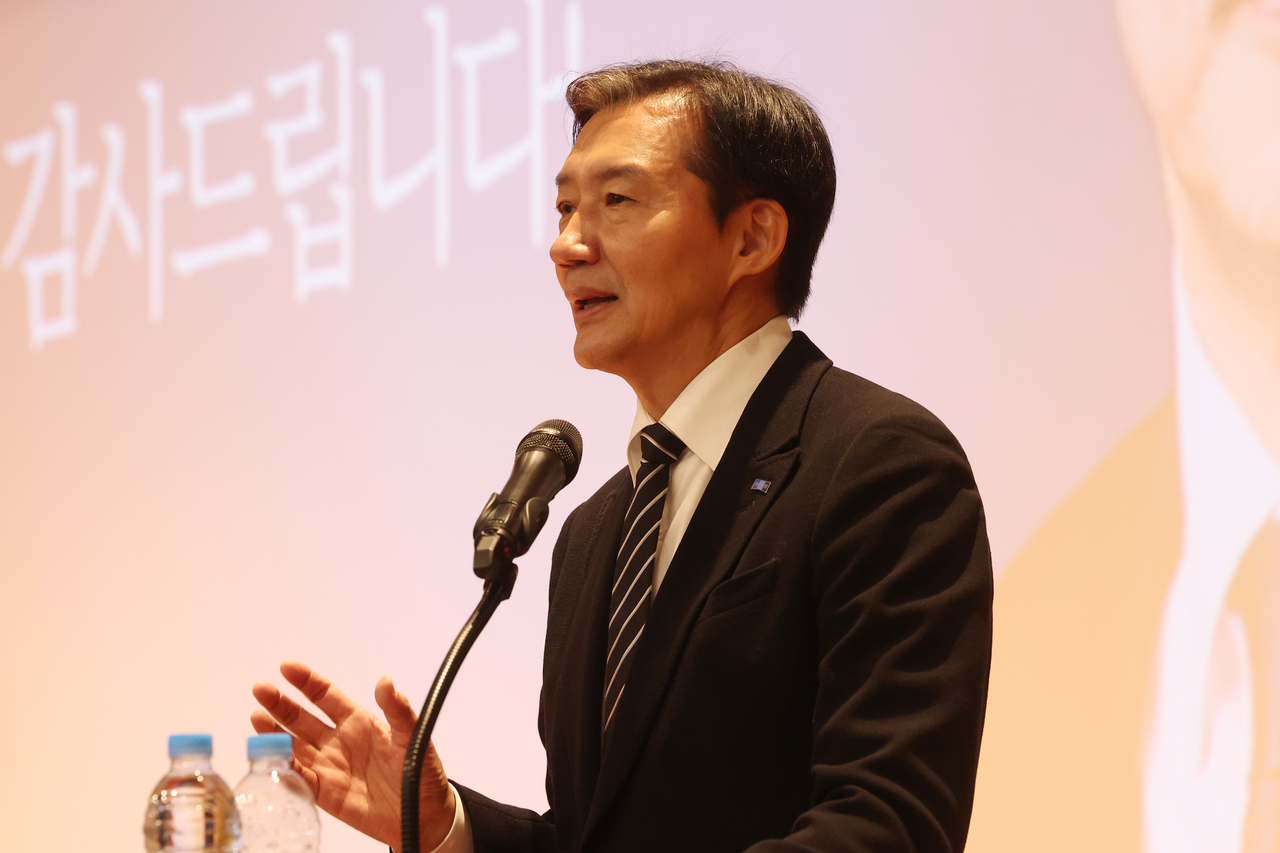
Cho Kuk, head of the Rebuilding Korea Party's innovation policy research institute, warned Sunday that the Lee Jae Myung government must pursue a "people's livelihood and welfare mega-project" alongside its three flagship initiatives, or the next general election will be difficult to win.
In a Facebook post, Cho said the Lee government holds "the largest reform majority in the National Assembly and record-breaking tax revenues," adding that no previous Democratic administration had enjoyed such favorable conditions. "Alongside the three mega-projects the government is currently focused on — semiconductors, physical AI and AI data centers — a people's livelihood and welfare mega-project must and can be pursued at the same time," he said.
Cho said the realization of housing rights and care rights was the core of such an initiative. "If this livelihood and welfare mega-project is not made visible within the next year, the April 2028 general election will be difficult," he warned.
He added that for the public, clearing the legacy of the insurrection and reforming the prosecution were now either past reform tasks or ones nearing completion. "The government must present reform tasks that change people's lives and secure their futures, and show that it is taking concrete steps toward them," he said.
Cho also noted that President Lee had pledged to use surplus tax revenues to "supply large quantities of long-term public rental housing for young people and the middle class at an early stage," but said the Korea Land and Housing Corp.'s ground-breaking record had not been dramatic. "The government and the ruling Democratic Party must push this hard," he urged.
The remarks were widely interpreted as a warning that even if the Lee government's economic performance remains positive, failure to resolve housing and other livelihood issues would make it difficult to expect a strong showing by the broader pro-government camp in the next general election.
Cho also invoked the 2010 free school meals debate, when the issue of "social rights" gained broad public traction. "Think back to the 2010 free school meals debate, when the discourse on social rights was widely shared by the public. Seoul Mayor Oh Se-hoon resigned over his opposition to it," he said. "Free school meals are now provided nationwide. They have become a 'right.'"
"There is not much time," he added. "The democratic reform camp must advance by putting forward multiple 'second free school meals agendas' that resonate with the public."
Cho also revisited arguments from his book, drawing on examples from the Netherlands, Austria and Singapore to call for a mass supply of high-quality, long-term rental housing and a "Korean-style 99-year housing" scheme to realize housing rights.
He pointed in particular to a 27-story inverted-Y-shaped building in Vienna, Austria, which houses indoor and outdoor swimming pools, a sauna, a school, a hospital and a shopping center, calling long-term, high-quality public rental housing "the true residential ladder."
"Imagine such housing built on land owned by the national or local government across the country," he said. "Young people, ordinary citizens and the middle class would be freed from the burden of jeonse and monthly rent. Their disposable income would grow, their savings would increase, and they would be able to accumulate the funds needed to buy their own home far more quickly."
shindw@heraldcorp.com