Naver Pay's Npay Connect merchant network tops 100,000 stores
Kakao Pay's external merchant payments up 26% year on year
Both platforms expand alternative credit scoring for loans
Competition heats up from pension analytics to AI-driven financial transactions
Naver Pay and Kakao Pay, the two dominant players in South Korea's mobile payment market, are racing to attract merchants with sales and commercial-district analytics while pushing deeper into consumer finance with proprietary credit-scoring models and AI-powered asset management services. The competition to expand financial businesses built on payment data is intensifying on every front.
Both companies are accelerating their push into external merchant networks, according to industry sources. Naver Pay said its offline integrated terminal network, Npay Connect, surpassed 100,000 merchant locations in June, while cumulative membership in its merchant support platform, Npay biz, has reached about 2.2 million. Kakao Pay is leveraging its base of more than 40 million payment users and about 23 million MyData subscribers to analyze spending patterns and deliver targeted marketing support to merchants. Its payment volume at merchants outside the Kakao Group ecosystem grew 26 percent year on year in the third quarter of this year.
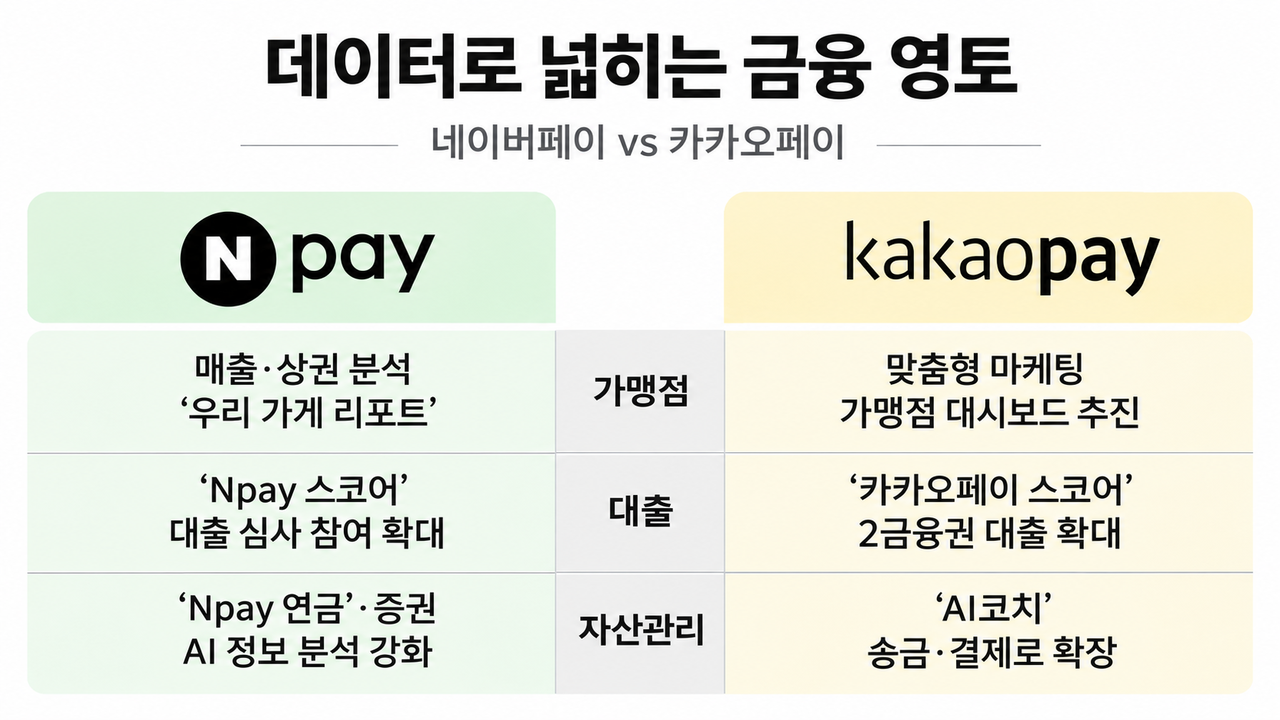
Naver Pay last month launched Npay biz My Store Report, a sales and commercial-district analytics service, to strengthen support for store operators. Food and beverage merchants using Npay Connect receive free data on hourly sales, performance relative to nearby stores, and customer and commercial-district analysis. The push to expand its merchant base is paying off: external payment volume outside the Naver ecosystem rose 26.2 percent year on year in the second quarter of this year to 14.1 trillion won ($10.5 billion).
Kakao Pay is countering with data-driven personalized marketing. At its third-quarter earnings call on Tuesday, the company said it analyzes customers' spending patterns using payment and MyData information to deliver tailored benefits to users most likely to make a purchase. Online payment sales from external merchants outside the Kakao ecosystem grew 22 percent year on year in the second quarter, lifting their share of total online payment sales to 65 percent. The company plans to provide merchants with customer analytics through a dashboard interface going forward.
In lending, both companies are competing to sign up more financial institutions as users of their proprietary credit-scoring models. Naver Pay said about 30 financial firms were using its Npay Score to offer preferential loan rates and credit limits as of September. Last month it signed an agreement with Welcome Savings Bank to launch a dedicated personal loan product before year-end, under which Naver Pay — acting as a designated agent of the Financial Services Commission — conducts credit assessments using non-financial data, while Welcome Savings Bank makes the final lending decisions on approval and limits.
Kakao Pay is also expanding adoption of its alternative credit-scoring model, Kakao Pay Score, among financial institutions. As of the second quarter, 12 financial institutions had signed adoption agreements, and the company aims to grow that number to more than 20 by year-end. It is also stepping up data-driven identification of loan applicants. Loan service sales rose 18 percent year on year in the third quarter, marking four consecutive quarters of growth. Next year, Kakao Pay plans to further expand its lending business in the secondary financial sector, drawing on its borrower analytics capabilities.
Personal financial data-driven asset management has emerged as a new battleground. Naver Pay launched Npay Pension in July, allowing users to consolidate and view their national pension, retirement pension and personal pension assets in one place, with AI analysis of their retirement preparedness. Users can compare their projected pension income against target living expenses and benchmark themselves against the top 30 percent of pension savers in their age group. The service also connects users with pension specialists at Woori Bank and Korea Investment & Securities.
A Naver Pay official described Npay Pension in July as a "preview service" ahead of a broader pension business expansion. The company plans to extend the service beyond the accumulation phase to cover the payout stage, and is also developing an AI-powered feature to guide users aged 55 and older through their individual tax situations. In September, Naver Pay revamped the desktop version of Npay Securities, enhancing information on domestic and overseas markets and virtual assets, along with an AI market briefing function.
Kakao Pay is focused on connecting AI-driven asset management to actual financial transactions. Its AI Coach service, launched in August, analyzes users' spending history to help them set and manage consumption goals. Cumulative visitors exceeded 450,000 as of late October, and the number of users in September was roughly three times the figure from August, the service's launch month. The company plans to add transaction functions such as remittances and payments, and intends to begin linking financial benefit information with Kakao's AI service Kanana before year-end.
snsd@heraldcorp.com