Solidigm VP Choi Jeong-dal touts floating-gate edge
Samsung, SK hynix race ahead with CTF-based high-layer stacking
FG isolates charge per cell, giving QLC an advantage
KV cache demand rises with spread of AI inference
SK hynix runs two-track strategy with CTF and FG
Editor's note: Chip Chip Fab Fab is a series that explores the semiconductor industry driving the AI era — breaking down complex technology clearly and in depth. The name links the "chip" at the heart of the AI revolution with the "fab" that makes it, and echoes the rhythmic chug of a train to capture the industry's relentless advance. The series reads the present and future of semiconductors with its audience: difficult technology made accessible, and the stories behind the news told with depth.
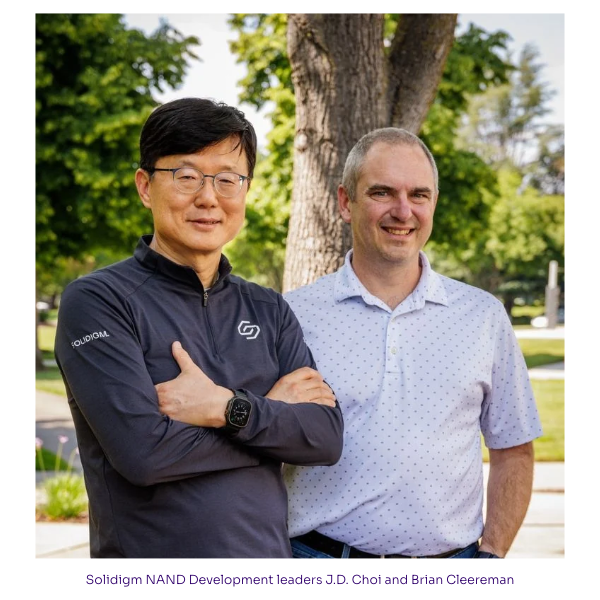
"Solidigm is working to ensure that NAND does not merely add storage capacity but structurally underpins the economics of AI. To that end, we are focused on the sustainable scaling of high-density NAND, maintaining cost competitiveness per bit, and securing the economic viability of hyperscale AI infrastructure." — Choi Jeong-dal, executive vice president and head of NAND development at Solidigm
Choi recently outlined Solidigm's NAND development direction for the AI inference era through the company's official newsroom, according to industry sources Saturday.
What drew attention was Choi's emphasis on the floating-gate, or FG, architecture. Choi said the FG approach is well suited to the growing volume of KV (Key-Value) cache — the intermediate data generated during AI inference — and to large-scale context storage.
Choi previously led NAND development at SK hynix before moving to Solidigm in 2025. Originally from Samsung Electronics, Choi joined SK hynix in 2016 to strengthen its NAND technology capabilities and brings more than 30 years of development experience in the NAND field.
FG was once the dominant technology in the NAND market, but the industry has since shifted toward charge-trap flash, or CTF. Both Samsung Electronics and SK hynix now use CTF architecture, which is better suited to the race to stack ever-higher layers.
The FG technology Solidigm uses traces its commercial origins to 1971, when Intel introduced the EPROM — erasable programmable read-only memory — widely regarded as a forerunner of flash memory storage.
NAND retains data even when powered off, distinguishing between 0 and 1 based on whether electrons are stored in a cell. In an FG structure, electrons are stored in a separate conductor for each memory cell, which is wrapped in an insulating layer to prevent electrons from escaping.
CTF works differently. It traps electrons in a thin layer of non-conductive material — hence the word "trap." The structure is simpler than FG and reduces interference between cells, making it easier to stack layers higher.
With the exception of Solidigm, virtually every NAND maker has adopted CTF as its primary approach.
Samsung Electronics was the first in the world to commercialize CTF in 2006, a foundation that enabled it to begin mass-producing three-dimensional vertical NAND in 2013. The company's 10th-generation V10 BV-NAND, unveiled at FMS 2026 in the United States in August with more than 400 layers, also builds on that technology.
SK hynix likewise develops its NAND on a CTF basis. US chipmaker Micron also signaled a shift to CTF when it introduced its 176-layer NAND in 2020.
Solidigm has maintained the FG structure, focusing on data retention characteristics. NAND is categorized by how many bits of data are stored per cell — TLC (triple-level cell), QLC (quad-level cell) and so on.
Solidigm targets the enterprise solid-state drive, or eSSD, market with QLC — which stores 4 bits per cell — as its core technology. Because QLC stores more data per bit than TLC, it maximizes storage density per unit area.
Distinguishing data accurately becomes harder as storage density increases. TLC differentiates eight voltage states to store data, while QLC must distinguish 16. As the gaps between voltage states narrow, even small charge fluctuations can cause data errors.
The FG structure, with its isolated storage space per cell, is better at suppressing charge movement. CTF, by contrast, carries a risk of charge migration along its thin layer. Solidigm believes this charge-isolation characteristic gives FG an advantage in preserving data integrity and ensuring stable operation in high-density QLC products.
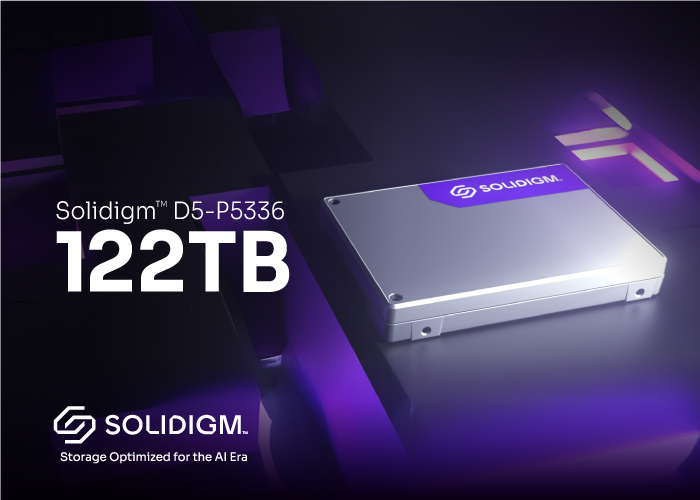
Solidigm's D5-P5336 eSSD, introduced in 2024 with a maximum capacity of 122 terabytes, was also developed using FG technology. Built on 192-layer QLC NAND, it is optimized for data center environments with heavy read workloads. Solidigm argues that the FG structure offers advantages not only in maximizing raw storage capacity but also in data retention and cost competitiveness per bit.
Demand for high-capacity, read-intensive storage is expected to grow as agentic AI becomes more widespread. As the space required for KV cache expands, storing it solely in HBM or server DRAM is increasingly impractical. With large-capacity SSDs gaining attention as storage for KV cache and large-scale context, the economic case for FG technology is being reassessed.
However, for tasks involving frequent data creation and updates, TLC SSDs with higher write speeds and endurance may be more suitable. Solidigm therefore runs a parallel strategy, using TLC for workloads that demand high write performance and durability.
Solidigm has maintained the FG structure since its days as Intel's NAND business unit. Even now, as a subsidiary of SK hynix — which completed its acquisition in 2020 — the company continues to advance FG technology rather than switching to CTF for its flagship high-capacity QLC products.
SK hynix, meanwhile, is pushing aggressively into high-layer stacking with CTF. Earlier this year it began supplying the PQC21, a client SSD built on CTF-based 321-layer QLC technology.
SK hynix uses both CTF and FG architectures to address the full range of AI data center storage demand — a two-track strategy cited as a key strength of its NAND business. SK hynix's CTF-based TLC targets the high-performance and mixed-workload market, while Solidigm's FG-based QLC goes after the high-capacity, read-intensive segment.
"Solidigm's floating-gate architecture is particularly well suited for AI inference," said Brian Clearman, head of NAND development process and integration at Solidigm. "It combines industry-leading read characteristics, scalable storage density and predictable operating behavior to help storage take its place as a core component of AI systems."
jeongwan@heraldcorp.com