Survey of 7,230 adults finds 7% victimized by AI-generated sexual images
Women reported higher rates of depression and fear; men more likely to say they were fine or found it funny
More than half of perpetrators were people victims knew only online

About 7 in 100 adults in the United States, the United Kingdom and Australia have been victimized by AI-generated fake sexual images, according to new research.
So-called deepfake sex crimes — in which AI is used to superimpose someone's face onto pornographic material — are growing rapidly. One analysis found that 96 percent of deepfake videos posted online in 2019 were non-consensual sexual images.
Sites offering "undressing apps" — tools that generate images making a person appear unclothed from a single photo — drew an average of about 18.5 million visitors per month in the first half of last year across 85 platforms, and were estimated to earn up to $36 million annually.
Yet most research to date has focused on the victimization of celebrities and public figures, leaving little known about how ordinary people are affected and what harm they suffer.
A team led by Nicola Henry, a professor at RMIT University in Australia, and researchers from Google recently published findings in the International Journal of Human-Computer Interaction based on a survey of 7,230 adults in the US, UK and Australia on AI deepfake sex crime victimization.
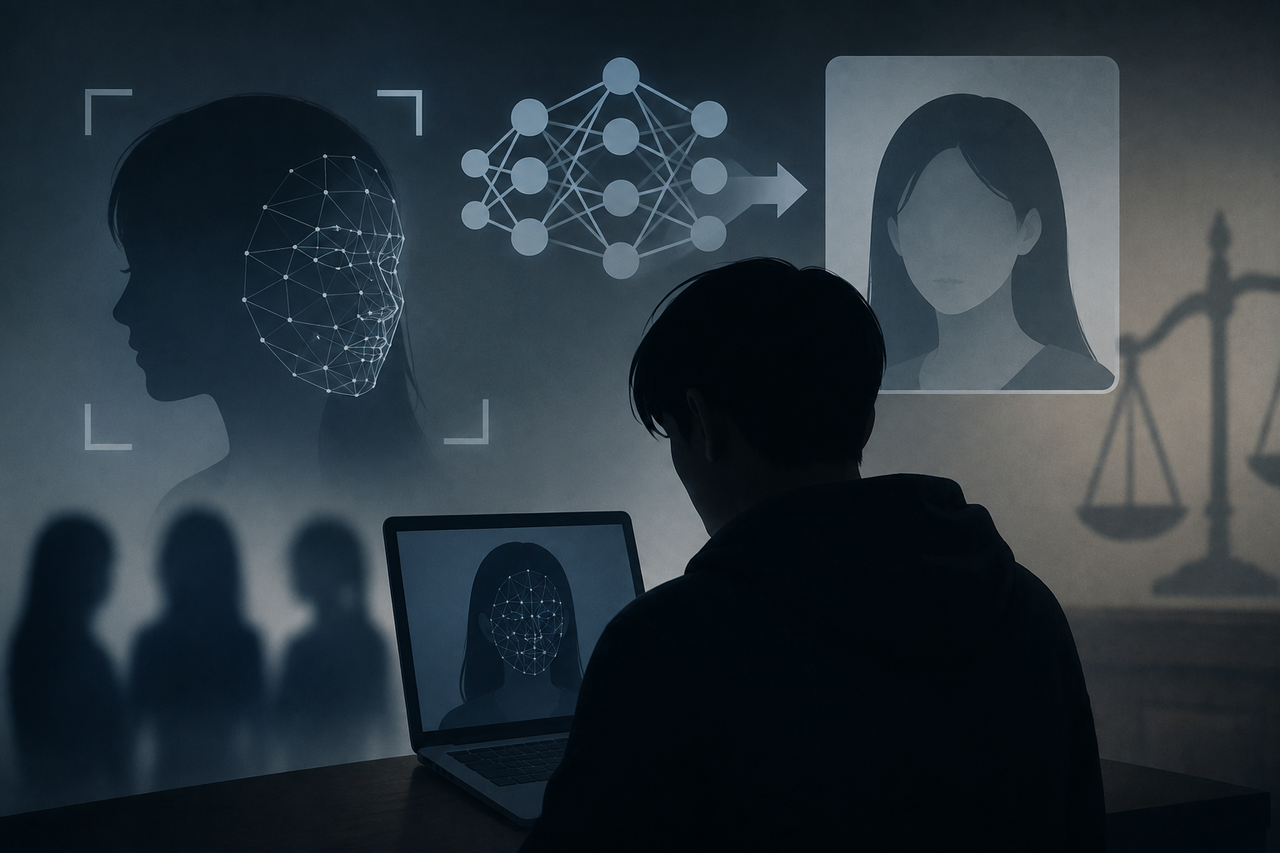
15.1% victimized by basic image manipulation; 7% by AI-generated fakes
The research team surveyed adults in the US, UK and Australia in July and August 2024, asking whether anyone had ever created or threatened to distribute non-consensual fake sexual images of them since they turned 18.
When basic image manipulation tools such as Photoshop were included, 15.1 percent of respondents said they had experienced such victimization. Of those, 7.0 percent reported being victimized specifically by AI-generated images.
Among respondents, 4.3 percent said someone had used AI to create sexual images of them, 4.4 percent said such images had been distributed, and 3.6 percent said they had been threatened with distribution.
In an earlier survey the same research team conducted across 10 countries, Australia recorded the highest rate of AI sexual image victimization at 3.7 percent, with South Korea second at 3.1 percent.
Social media posts were the most common channel through which harmful images spread, accounting for 39.4 percent of cases. Private messages accounted for 32.9 percent, images shown to others on a screen for 30.4 percent, and group chats for 28.9 percent.
Victimization rates were higher among those under 35, LGBTQ+ individuals, people of color and people with disabilities. Men reported victimization at more than twice the rate of women.
However, the research team said this may be because male victims are more likely to be aware when they are targeted through sexual extortion or pranks, while images created and circulated covertly may go entirely undetected by victims.
Women reported depression and fear; men more likely to say they were fine or found it funny
According to the research team, 90.3 percent of victims experienced negative emotions such as anger or shame.
A woman in the UK aged 25 to 34 said she "felt humiliated watching the video" and "couldn't pull myself together for a long time." Another woman in the UK aged 18 to 24 said it was "degrading" and that "it happened in an instant, but what followed was unbearably long."
Female victims were significantly more likely than male victims to report depression (42.6 percent vs. 25.7 percent), fear for their physical safety (42.4 percent vs. 18.1 percent) and sadness (32.7 percent vs. 10.7 percent).
Women were also more than twice as likely as men to say their mental health had deteriorated — 35.5 percent compared with 16.0 percent.
Among male respondents, 11.4 percent said they were fine, and 12.3 percent said they found it funny.
More than half of perpetrators — 55.6 percent — were people the victim knew only online. Those the victim had met in person accounted for 29.7 percent, while 14.6 percent of victims did not know who was responsible.
Victims most commonly responded by blocking the perpetrator (69.2 percent) or reporting them to the platform (56.8 percent). More than half also gathered evidence (55.0 percent) or requested that the images be removed from the site (52.6 percent).
Meanwhile, 33.0 percent of victims were unaware of StopNCII, an online tool designed to help prevent the spread of non-consensual intimate images.
About 1 in 10 victims (12.0 percent) neither told anyone nor filed a report.
A woman in Australia aged 35 to 44 said she "was too embarrassed." A woman in the US in the same age group said she "didn't know who to report it to or what good it would do."
A woman in the UK aged 18 to 24 said "nobody cared, and nobody believed me or listened to me."
The research team said follow-up studies are needed to examine victimization among those under 18 and in countries outside the Western world.
Reference
DOI: 10.1080/10447318.2026.2723677
Henry, N., Umbach, R., Shelby, R., & Gonzalez-Pons, K. (2026). "That Experience Still Haunts Me to This Day": A Multi-Region Survey on AI-Generated Image-Based Sexual Abuse Victimization. International Journal of Human-Computer Interaction, 1-26.
dbsdn1110@heraldcorp.com