Technology verified on Gyeonggi Province stretch of Gyeongbu Line
AI adjusts base station handover timing; broader rollout under review
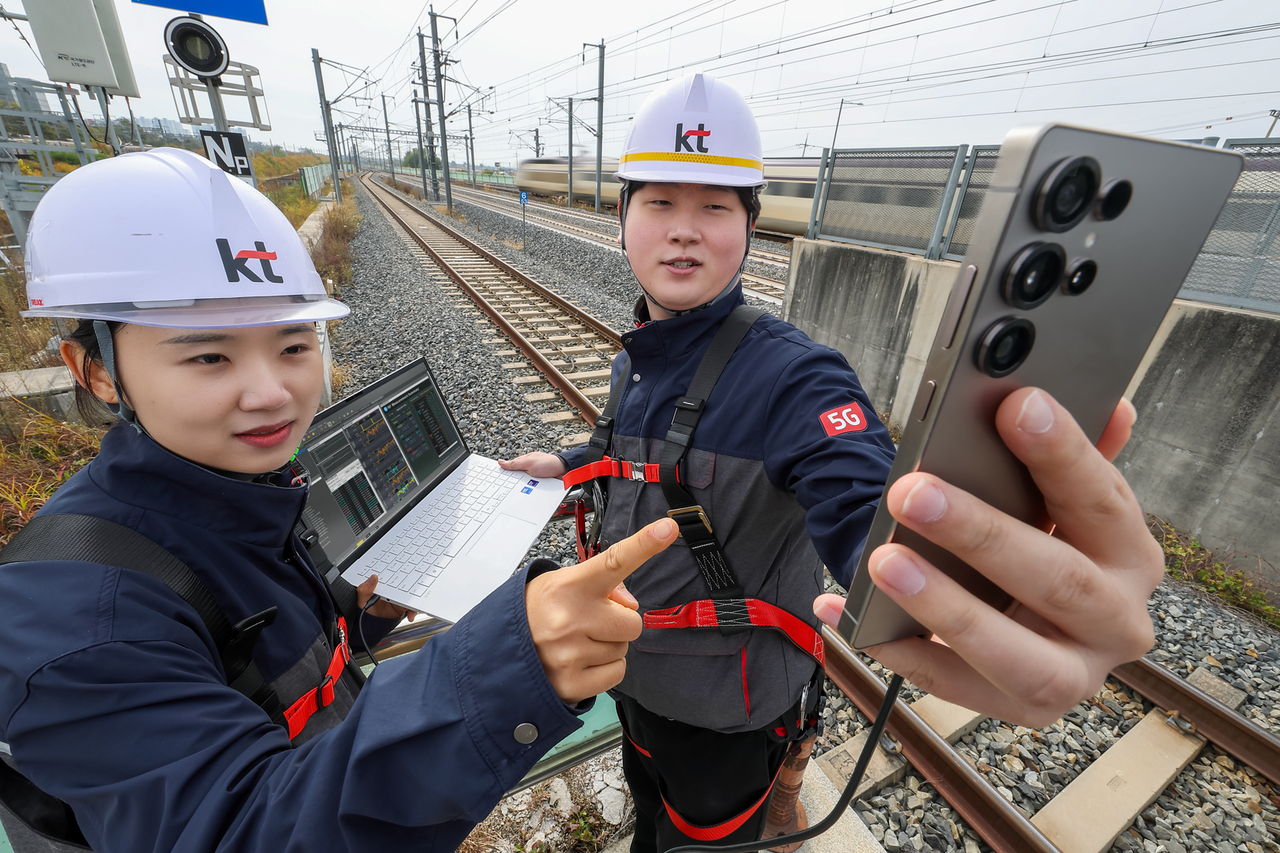
KT Corp and Samsung Electronics have developed an AI-powered technology to reduce connectivity drops on high-speed rail lines. A field trial on an actual high-speed rail segment showed the rate of connection failures fell by about 29 percent.
KT Corp said Thursday it jointly developed a wireless network optimization technology tailored for high-speed rail environments with Samsung Electronics and verified its effectiveness on a live rail segment.
On trains traveling at speeds above 250 kilometers per hour, base station signals change far more rapidly than in ordinary communication environments. As a train moves, it frequently switches between base stations, and when those handovers are delayed, data transmission can slow and call quality can deteriorate.
To address the problem, the two companies used AI to analyze communication quality data collected along high-speed rail corridors. The system draws on signal strength readings and connection failure histories to identify segments where quality repeatedly degrades and to map base station handover patterns. Unlike the previous approach — which focused on improving individual underperforming base stations based on field measurements — the new method uses AI and large-scale data to pinpoint recurring problem zones and optimize handover timing between stations.
The analysis found that the primary cause of in-cabin connectivity drops was a delay in switching from the currently connected base station to the next one during high-speed travel.
In response, the two companies selected the segments where the problem recurred and tested a technology that advances handover timing so trains connect to the next base station earlier.
The trial was conducted on the Gyeongbu Line between Godeok-myeon in Pyeongtaek and Maesong-myeon in Hwaseong, both in Gyeonggi Province. The companies compared communication quality data before and after applying the technology to measure the improvement.
The rate of connectivity drops during high-speed rail travel fell by about 29 percent — equivalent to reducing 100 connection failures to roughly 71.
KT Corp plans to review applying the technology validated in this trial to its live high-speed rail network. The company also intends to continue collaborating with Samsung Electronics in the AI radio access network, or AI-RAN, field to jointly develop and verify technologies that improve communication quality.
Jeong Jin-guk, executive vice president and head of Samsung Research's Next-Generation Communications Research Center at Samsung Electronics, said the trial "proved that perceived communication quality for customers can be improved even in high-speed mobile environments where conditions are challenging," adding that the company would "continue to lead core AI-RAN technology development with KT Corp to drive user-centered experience innovation."
Lee Jong-sik, executive vice president and head of KT Corp's Network Division Future Network Lab, called the trial "a meaningful achievement that confirmed the potential to improve customers' perceived quality in coverage-challenged areas such as high-speed rail using AI," and said KT Corp would "continue developing AI-RAN technologies that deliver real, tangible improvements to customer experience."
Meanwhile, KT Corp said Monday it also verified AI-based autonomous wireless network management technology with Samsung Electronics at KT Wiz Park in Suwon. A trial conducted at the live baseball stadium showed traffic imbalance between base stations improved by up to 34 percent, while load concentration on specific base stations fell by up to 16 percent.
woo@heraldcorp.com