Bloomberg Economics has warned that a slowdown in AI investment enthusiasm could deal a bigger blow to South Korea's stock market than to the United States, Taiwan or other major markets. The analysis identified the Kospi — already under pressure from leveraged investment burdens and a reassessment of AI sector growth and profitability — as one of the hardest-hit markets alongside Taiwan in a scenario modeling a complete one-year halt in AI infrastructure spending.
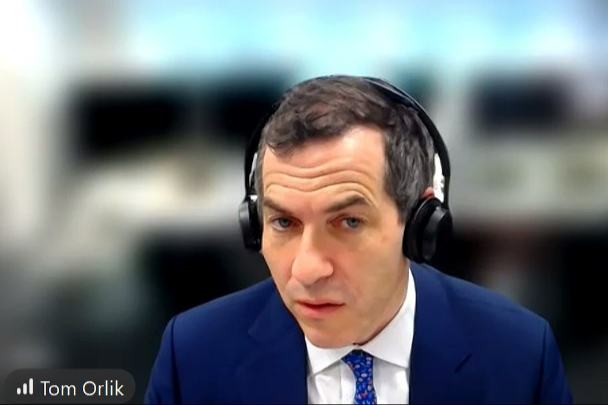
The Korea Financial Investment Association hosted a webinar Wednesday, inviting Tom Orlik, chief economist at Bloomberg Economics, to speak on the economic outlook following the US midterm elections. Using Bloomberg's scenario analysis tool "Global Shock," Orlik estimated that a collapse in the AI investment bubble would reduce South Korea's GDP by about 3 percent relative to the baseline forecast, and Taiwan's by about 5 percent. The model assumed a 20 percent decline in US equity markets, a widening of credit spreads and a one-year suspension of data center investment.
Orlik said the market's shifting view of the AI industry could dampen investment enthusiasm going forward. Where investors once poured money into AI-related stocks on the strength of growth potential alone, he said, the focus has now turned to whether massive capital outlays will actually generate returns. "Investors are moving past the stage of buying AI-related stocks indiscriminately," Orlik said. "They have started asking where all that capital expenditure will actually produce profits."
Orlik also cited tightening data center regulation in the United States as a variable that could affect AI semiconductor supply. Data centers consume enormous amounts of electricity and water, he noted, potentially raising costs for local communities — a concern shared by both major parties, making post-election regulatory tightening a real possibility. "Neither party in the US wants data centers moving into their communities," Orlik said. "Governors in areas with heavy data center construction could read the election results as a political signal and introduce new restrictions."
Orlik argued that South Korea and Taiwan, which have emerged as key players in the AI semiconductor supply chain, are particularly exposed to risks from data center regulation. "South Korea's and Taiwan's advanced semiconductor technology has been a critical enabler of the rapid advance of the AI revolution, but if the AI boom turns to bust, the damage to both countries will be equally severe," he said. "A pullback in data center investment could ripple through to semiconductor demand and exports."
However, a counterargument emerged that tighter regulation is unlikely to trigger a sharp drop in data center demand. Kwon Hyo-sung, Bloomberg Economics' Korea economist, who also participated in the webinar, said stricter rules would more likely prompt data centers to relocate to alternative sites rather than disappear altogether. "Semiconductor demand itself is expected to remain fairly solid for now, but how these shifts will be reflected in equity markets and investor sentiment is difficult to predict," Kwon said.
Separately from AI data center concerns, Orlik said the outcome of the US midterm elections could prove broadly favorable for financial markets. He pointed to a historical tendency for US equities to rise in the year following midterm elections, and said a divided government — with power split between the two parties — could reduce policy uncertainty and regulatory risk. "Looking at US midterm election history since 1950, the S&P 500 has often risen in the year after the vote," Orlik said. "Political gridlock that limits the introduction of new regulations and taxes tends to be positive for financial markets."
Orlik also flagged the Federal Reserve's monetary policy path as a key variable shaping markets after the midterms. He said the Fed's rate decisions could hinge on movements in global oil prices driven by the war with Iran and on the trajectory of AI asset prices. "If oil prices climb to $120 to $130 a barrel and AI asset prices hold firm, the Fed could move to raise rates in December," Orlik said. "But if war tensions ease and oil falls to $60 to $70 a barrel while AI markets stabilize, a rate hold becomes more likely."

kacew@heraldcorp.com