Workers aged 15–29 up 24,000; those in their 30s up 37,000
Non-wage workers in wholesale and retail rise 75,000; accommodation and food service falls 47,000
Share of new self-employed citing difficulty finding jobs climbs 3.8 percentage points to 21.7%

The number of self-employed workers with no employees rose by 62,000 over the past year.
Workers aged 15 to 29 and those in their 30s together accounted for 61,000 of that increase — nearly matching the total gain on their own. Overall, the self-employed population grew by 109,000, but the number who had started a business within the past year fell by 26,000. Eight out of 10 newly self-employed workers had no employees.
According to the Ministry of Statistics' supplementary survey on non-wage workers from the August 2026 economically active population survey, released Wednesday, the number of self-employed workers without employees stood at about 4.303 million in August, up 62,000 from the same month a year earlier. Self-employed workers with employees numbered about 1.481 million, an increase of 47,000. Combined, the total self-employed population reached about 5.784 million.
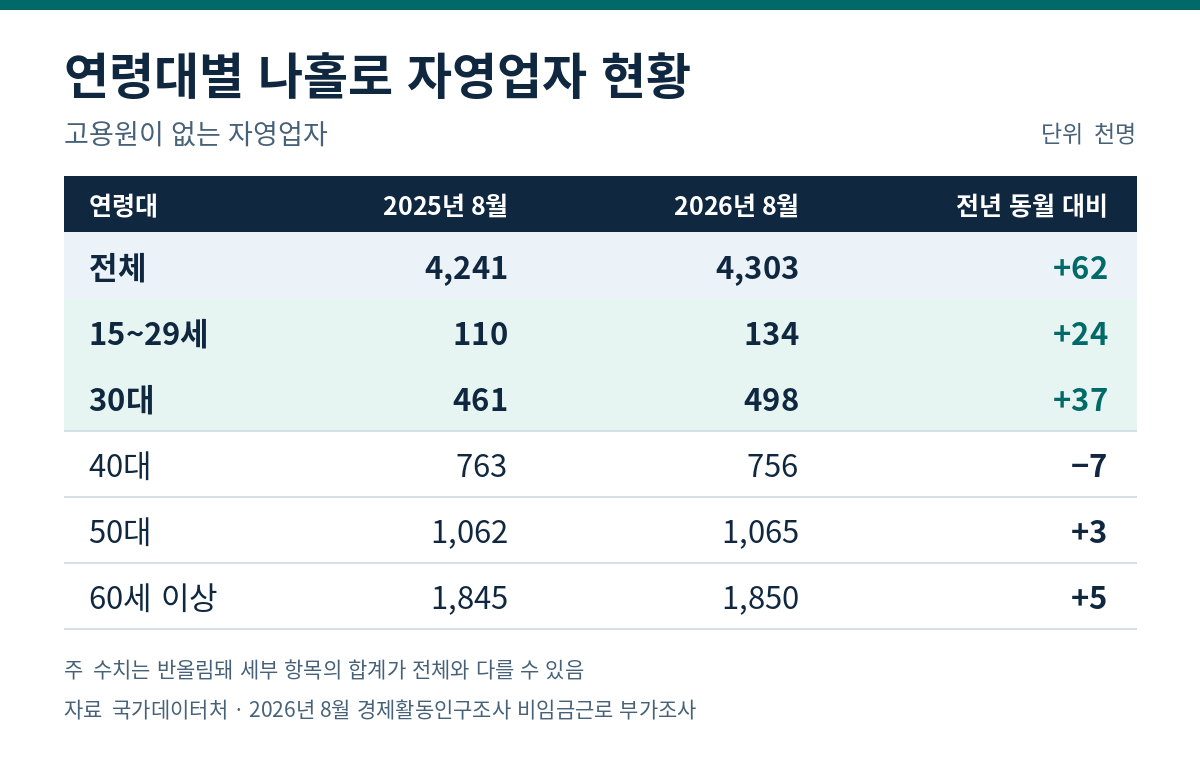
Among self-employed workers without employees, those in their 30s rose by 37,000 to 498,000, while those aged 15 to 29 increased by 24,000 to 134,000. Workers in their 40s fell by 7,000, while those in their 50s and those aged 60 and older rose by 3,000 and 5,000, respectively. Among self-employed workers with employees, those aged 60 and older accounted for 44,000 of the total 47,000 increase.
Non-wage workers — a category that includes the self-employed and unpaid family workers — totaled about 6.625 million, up 71,000. Unpaid family workers numbered 841,000, down 37,000. Non-wage workers made up 22.7 percent of all employed persons, up 0.1 percentage point.
Wholesale and retail up 75,000; accommodation and food service down 47,000
By industry, non-wage workers in wholesale and retail posted the largest gain, rising 75,000. Professional, scientific and technology services added 25,000, while transportation and warehousing and arts and sports each grew by 20,000. Agriculture, forestry and fishing fell by 94,000, and accommodation and food service and manufacturing declined by 47,000 and 38,000, respectively.
Non-wage workers aged 60 and older numbered about 2.719 million, accounting for 41.0 percent of the total. By gender, men increased by 94,000 while women fell by 23,000. Female self-employed workers rose regardless of whether they had employees, but female unpaid family workers dropped by 49,000. By education level, those with a college degree or higher rose by 140,000, while those with a middle school education or below fell by 119,000.
The average length of time non-wage workers had been running or affiliated with their current business was 15 years and 2 months, three months shorter than a year earlier. Average weekly working hours stood at 44.1, down 0.1 hours. Self-employed workers with employees worked 47.5 hours per week, while those without employees worked 43.4 hours. By industry, accommodation and food service had the longest hours at 52.5 per week.
The most common primary workplaces were business premises, at 61.7 percent, followed by outdoor work sites at 20.3 percent. The share of businesses with official registration rose 2.6 percentage points to 76.0 percent. Some 86.6 percent of non-wage workers said they planned to continue their current work, while 5.0 percent said they planned to quit. Among those planning to quit, the most commonly cited reasons were personal circumstances (41.4 percent) and poor business outlook or sluggish performance (35.8 percent).
The combined share of self-employed workers enrolled in the national pension or receiving public pension benefits rose 1.4 percentage points to 83.3 percent. The figure was 92.1 percent among those with employees and 80.3 percent among those without. The industrial accident insurance enrollment rate for self-employed workers with employees rose 0.4 percentage point to 65.5 percent.
35.2% of new self-employed started with less than 5 million won
The number of people who had started a business within the past year stood at 305,000, down 26,000 from the same month a year earlier. Of these, 250,000, or 82.2 percent, had no employees.
Among all newly self-employed workers, 21.7 percent said they had started a business because they found it difficult to get a salaried job — up 3.8 percentage points from a year earlier. The most common reason remained a desire to run their own business, cited by 70.8 percent, though that share fell 3.0 percentage points from the previous year.
The share of new self-employed workers who started with less than 5 million won ($3,730) in startup capital rose 3.3 percentage points to 35.2 percent. Some 70.3 percent said they had funded their startup with personal or family savings, while 18.9 percent used banks, insurance companies or other financial institutions.
Nearly half, at 47.0 percent, said they spent between one and three months preparing before launching their business. The most commonly cited challenges at startup were acquiring business information and management know-how (28.4 percent) and securing startup capital (24.1 percent). Some 80.7 percent of newly self-employed workers had work experience immediately before going into business. Among all new self-employed, 60.6 percent had previously held a salaried position and 20.1 percent had been in non-wage work.
fact0514@heraldcorp.com