
Korea Labor Institute to discuss cross-company bargaining at 38th anniversary seminar Wednesday
Bonus pay, performance incentives identified as key drivers of widening wage gap
Industry-level bargaining needed beyond individual company negotiations, researchers say
Proposal would extend collective agreement coverage to non-union members and similar-sector firms
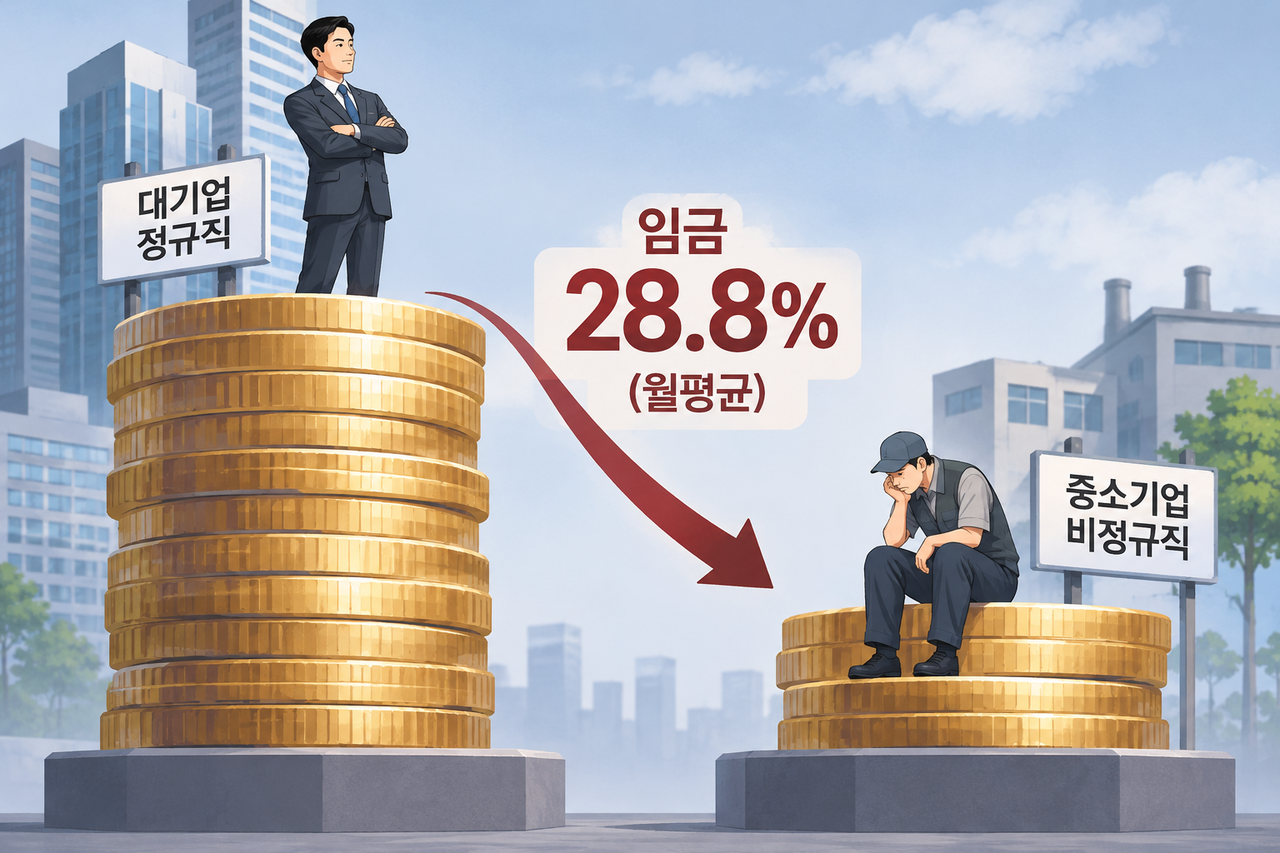
Non-regular workers at small and medium-sized enterprises last year earned an average of just 28.8 percent of what regular workers at large companies took home each month. Bonus pay and performance incentives were identified as the decisive factors driving the widening wage gap between large firms and SMEs.
The Korea Labor Institute said the wage-determination system itself must be overhauled, given that the gap has not narrowed despite minimum wage increases, various subsidies and expanded social insurance coverage. The institute proposed extending collective bargaining — currently centered on individual companies — to the industry, sector and regional levels, and making collective agreements binding on workers who are not union members.
According to a report the institute released Tuesday titled "Easing Polarization, Starting with Improving the Distribution Structure: A Proposal for Cross-Company Collective Bargaining," non-regular workers' average monthly wages in 2025 were limited to 46.0 percent of those of regular workers — less than half. On an hourly basis, the figure was 65.2 percent. The findings are based on the institute's own analysis of Ministry of Employment and Labor survey data. Workers at small and medium-sized establishments earned an average of 53.2 percent of their counterparts at large establishments on a monthly basis, and 57.3 percent on an hourly basis.
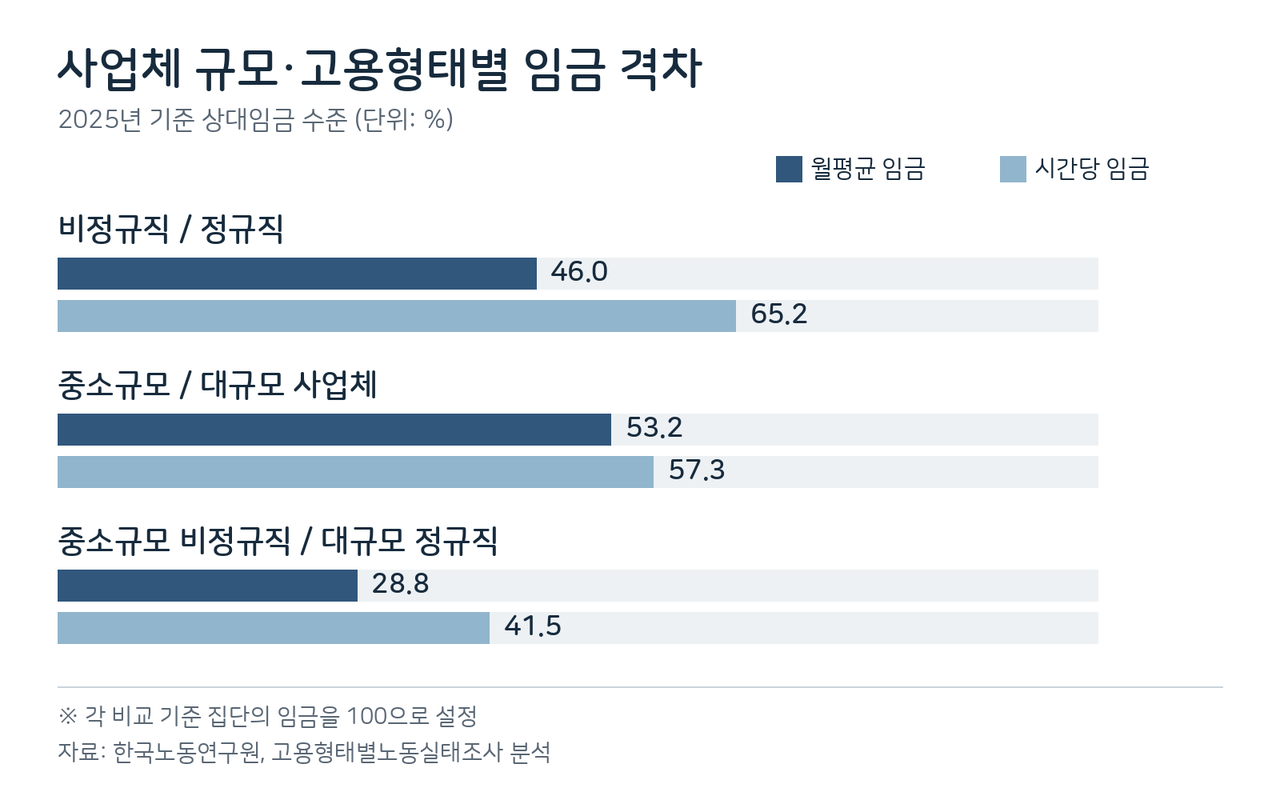
When establishment size and employment type are combined, the disparity widens further. Non-regular workers at small and medium-sized establishments earned just 28.8 percent of regular workers at large establishments on a monthly basis, and 41.5 percent on an hourly basis. In practical terms, when a regular worker at a large firm earns 1 million won ($743) a month, a non-regular worker at a small or medium-sized firm takes home just 288,000 won.
Performance bonuses at large firms drive wage gap, youth employment woes
The researchers identified special allowances — bonuses and performance-based pay — as the decisive factor behind the widening wage gap between companies.
The finding draws on an internal seminar presentation by Hong Min-gi (2026) analyzing the Basic Survey on Wage Structure. While wage ratios among establishments with fewer than 500 workers showed little change, the relative wages of establishments with 500 or more workers — compared with those employing 30 to 99 — increased.
The analysis points to a structural dynamic in which large companies distribute profits only to their internal workforce while strengthening variable pay such as performance bonuses, and use subcontractors as a cost-reduction buffer. This is compounded by companies' moves since the late 1990s to reduce their internal workforce and expand their use of external labor.
Company-level collective bargaining has been the primary mechanism driving wage increases and improved working conditions for workers since 1987. However, the researchers concluded that nearly four decades of bargaining confined to individual companies has proven inadequate for narrowing the gaps between firms.
The wage disparity is also linked to youth unemployment. As the fruits of economic growth have concentrated in large companies, young people prefer regular positions at large firms that offer high wages and stable employment — but the supply of such jobs is limited. Citing research by Min Sun-hong (2026), the report said the intense competition forcing young people to delay or abandon entry into the labor market can be seen as one factor behind the growing number of youth classified as "resting" — neither working nor actively seeking employment.
Yellow Envelope Act falls short; sector-level bargaining proposed
The researchers said the revised Trade Union and Labor Relations Adjustment Act, which took effect in March, is insufficient on its own to resolve the dual structure of the labor market, and that additional institutional reforms are needed.
Under the revised act, prime contractors that effectively control and determine working conditions are now required to bargain with subcontracted workers within that scope. This goes beyond the limitations of the existing company-level bargaining structure, which had been premised on direct employment contracts. However, if bargaining remains confined to individual prime contractors, the working conditions of subcontracted workers performing similar tasks could still vary depending on which prime contractor they are affiliated with.
The researchers said the "vertical expansion" of bargaining between prime contractors and subcontractors must lead to a "horizontal expansion" at the industry and sector level.
Cross-company collective bargaining could also benefit SMEs' operating conditions, the researchers said. Establishing common wage and working-condition standards by sector would give SMEs grounds to demand that rising labor costs be reflected in the unit prices they negotiate with prime contractors, and would also curb low-wage bidding competition among companies.
The spread of AI and industrial transitions driven by decarbonization were also cited as reasons cross-company bargaining is needed. Disappearing job functions, newly required skills and the cost burden of industrial transition are issues that cannot be resolved through labor-management negotiations at individual companies alone.
Labor board to consolidate multi-company bargaining units; public procurement incentives proposed
The researchers proposed four specific institutional reforms to promote cross-company collective bargaining: consolidating cross-company bargaining units, expanding union representativeness, extending the coverage of collective agreements, and introducing a collective bargaining committee (tentative name).
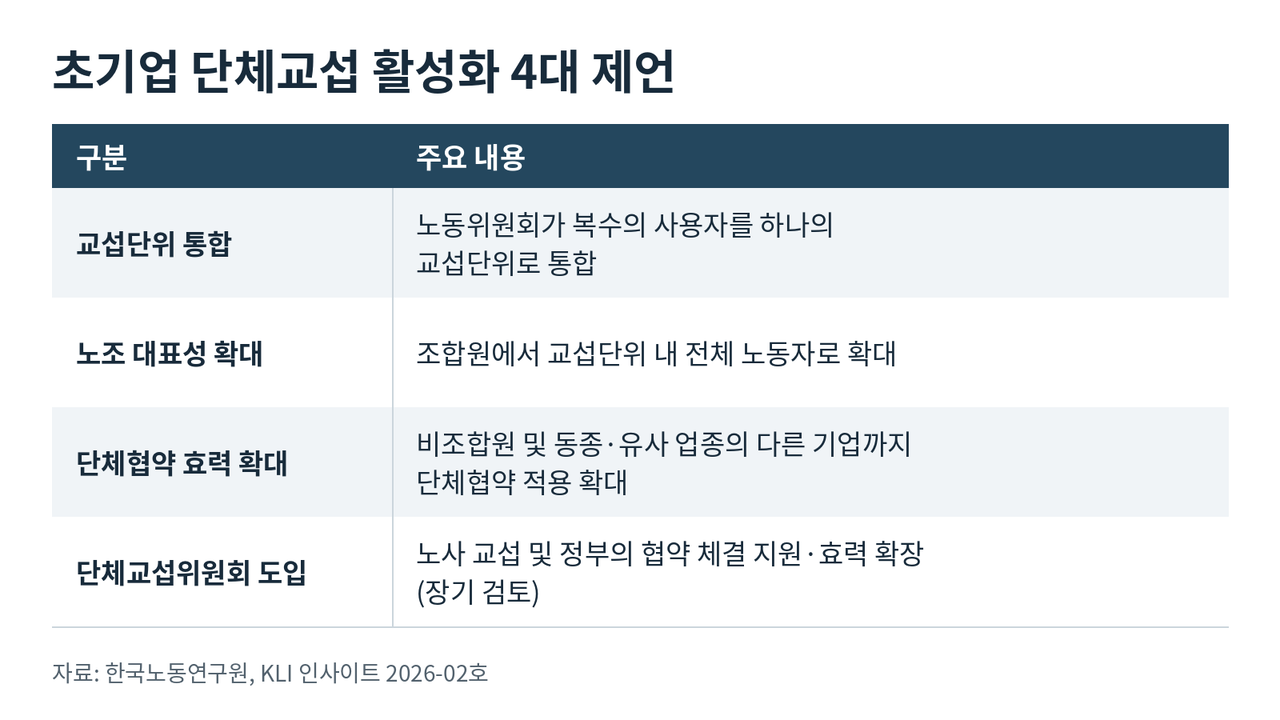
The first proposal calls for the Labor Relations Commission to consolidate multiple employers into a single bargaining unit upon application by either or both labor and management, and to impose a certain obligation on those employers to participate in cross-company bargaining.
However, the researchers said employers who refuse cross-company bargaining need not face criminal penalties for unfair labor practices. Their reasoning is that company-level bargaining derives from the employment contract relationship, whereas cross-company bargaining is promoted through administrative action — making the two fundamentally different in nature. Instead, they proposed offering bonus points or preferential treatment in institutional evaluations (such as university and public institution assessments), public procurement, and participation in government bodies to employers and employer associations that take part in cross-company bargaining.
The report also includes a proposal to expand union representativeness from members to all workers. Collective agreements currently applied primarily to union members would be extended to all workers within the relevant bargaining unit, and through administrative decisions, the agreements' coverage would be further extended to companies in the same or similar sectors that did not participate in the bargaining.
For example, if 14 out of 30 companies in a given sector conclude a cross-company collective agreement, the agreement would apply to all workers at those 14 companies regardless of union membership, and an administrative decision could then apply the same agreement to the remaining 16 companies.
Over the longer term, the researchers recommended considering the introduction of a collective bargaining committee in which labor and management negotiate and conclude agreements while the government supports the process through fact-finding surveys, information provision and the extension of agreement coverage.
"To ease the disparity, it is not enough to supplement after-the-fact redistribution through subsidies and tax incentives — we need to reform the way primary distribution is determined, that is, the governance of distribution itself," the researchers said. "In the short term, the government should bolster SMEs' ability to pay through government support and fair-trade measures between large and small companies, and over the medium to long term, cross-company bargaining should be used to establish sector-wide standards and improve working conditions."
Meanwhile, the Korea Labor Institute is set to present these findings and discuss the need for cross-company collective bargaining and how to institutionalize it at the second session of its 38th anniversary seminar, to be held Wednesday at the Korea Federation of Banks building in Seoul under the theme "Labor in Transition and New Policy Challenges."
fact0514@heraldcorp.com




