
KLI to present findings at 38th anniversary seminar Wednesday; researchers urge procedural rights, direct labor protections for gig workers

The Korea Labor Institute has called for regulation of the algorithms that platform companies use to assign jobs to delivery workers, set per-delivery pay and determine when to suspend accounts.
Researchers said platform workers should be guaranteed the right to request explanations of algorithmic decisions and to contest them. They also said regulators must examine whether the design and operation of algorithms push workers toward long hours or dangerous behavior. Direct protections for working conditions — including a guaranteed minimum pay — are also needed, the institute said.
The institute released the findings Tuesday in a report titled "Current Policy Status and Future Directions for Labor Service Providers," authored by senior research fellow Kim Geun-ju, research fellow Namgung Jun and associate research fellow Park Su-min. The researchers said workers in special-type employment, platform jobs and freelance arrangements are no longer a niche concern but a growing presence across the broader labor market.
Algorithms control jobs, pay and sanctions — while workers are kept in the dark
The researchers called for correcting the misclassification of workers who are effectively employees but labeled as freelancers or independent contractors, while also establishing new principles of rights and responsibilities suited to platform work.
Even when platform workers are classified as independent contractors, they have little real power to find their own customers or set their own prices. Algorithms control the entire process — from job assignment and pricing to performance evaluation and sanctions.
The core problem, the researchers said, is that platform companies can change job allocation, pay and evaluation criteria at any time through their algorithms, yet workers have no reliable way to understand the criteria being applied or how changes affect them.
A bonus structure that rewards completing many deliveries in a short time may appear to give couriers a choice while in practice nudging them toward dangerous behavior or excessive working hours. Companies further limit outside scrutiny by treating their algorithms as trade secrets.
The researchers said regulators must look beyond mere disclosure of algorithmic information and assess whether the design and operation of these systems distort worker autonomy or amplify risk.
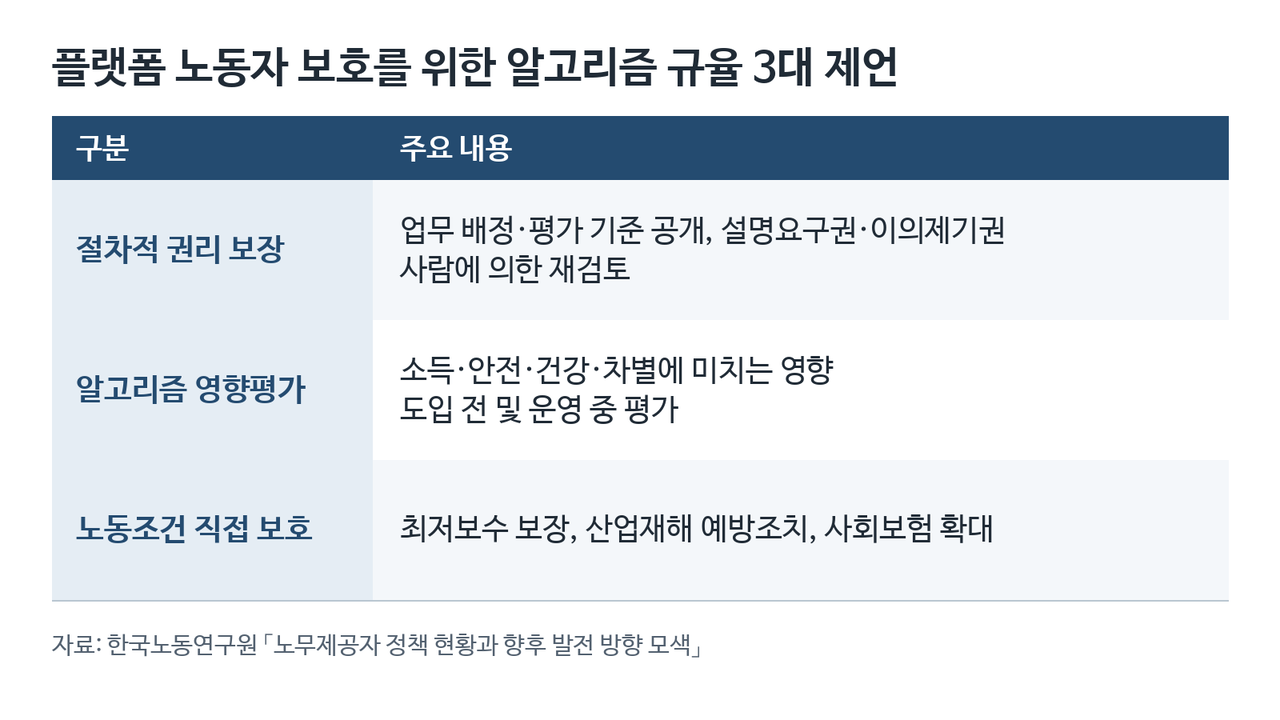
The researchers outlined three broad approaches to algorithm regulation. The first is guaranteeing procedural rights — giving workers the ability to request explanations of job assignment and evaluation criteria, to challenge adverse decisions such as account suspensions, and to have those decisions reviewed by a human being.
The second is algorithmic impact assessment. Rather than evaluating individual decisions in isolation, the researchers proposed assessing the effects of an entire algorithmic system on workers' income, safety and exposure to discrimination — both before deployment and during operation.
The third is direct protection of working conditions, covering minimum pay, industrial accident prevention and social insurance. Because algorithms change rapidly, regulating their effects and procedures alone is not enough to address the real consequences for workers, the researchers said.
Taiwan enshrines minimum pay for delivery workers, bars unilateral changes to pay formulas
The researchers highlighted Taiwan's Outsourcing Worker Rights Protection and Platform Management Act, which took effect July 21 this year, as an overseas model worth examining.
Taiwan divides delivery platform workers' pay into base pay and incentives, applying a minimum pay standard to the base component. The formula sets base pay at 1.25 times the minimum hourly wage, prorated to the service time per delivery order, with a floor of 45 New Taiwan dollars per order.
Waiting time before a delivery order is accepted is excluded from pay calculations, but waiting time at restaurants and for customers after an order is accepted is included. Both base pay and incentives must come with a stated calculation method, and any change to that method constitutes a contract amendment that platforms cannot make unilaterally. The law also establishes "reasonable dispatch" standards for courier safety, covering external factors such as weather and time of day as well as elements that affect accident risk — including the time given to accept an order and the sending of messages during a delivery.
The researchers noted it is too early to assess the impact of Taiwan's minimum pay system, as it has only recently taken effect. New York City, which introduced a minimum pay requirement earlier, has reported a reduction in waiting times and an increase in earnings since the measure came into force.
The EU's Platform Work Directive requires companies to assess the effects of automated systems on workers' personal data, working conditions, and safety and health. It also provides for explanations of algorithmic decisions and human review mechanisms.
8.69 million people subject to withholding on personal service income — labor law blind spots grow
The growing need to protect labor service providers reflects a broader diversification of employment arrangements.
According to the National Tax Service's national tax statistics yearbook, the number of people subject to income tax withholding on personal service and other business income rose from about 2.85 million in 2008 to about 5.152 million in 2016 and about 8.691 million in 2024 — more than tripling over 16 years.
However, the researchers cautioned that this figure does not represent the full legally defined population of labor service providers. An analysis by Lee Seung-ho and co-authors (2026) found that 31.9 percent of personal service income earners also had other income sources, such as regular or daily wage employment — indicating that many people move between or combine employee and labor service provider work.
The government has expanded social insurance coverage in response to these labor market shifts. The number of labor service providers covered by industrial accident insurance grew from 184,000 in 2020 to about 1.438 million in 2024, while employment insurance coverage nearly doubled from 422,000 in 2021 to 843,000 in 2024.
Social insurance enrollment, however, does not automatically extend the wage, working-hours and dismissal protections provided under the Labor Standards Act.
The researchers said correcting the legal status of workers who are effectively under an employer's direction and supervision but classified on paper as freelancers or sole proprietors must be the starting point of any labor service provider policy. A separate protection regime, they warned, must not become a mechanism that entrenches misclassification.
Responsibility should follow actual authority, not just who signed the contract
Because responsibility for determining platform workers' conditions is now spread across multiple parties, the researchers said liability should be allocated according to where real decision-making power lies.
When authority over contracting, pay-setting, job assignment and risk management is divided among different actors, each should bear responsibility commensurate with its role. If a platform sets pay and allocates work through its algorithm, it must also be accountable for how that algorithm is designed and operated.
End consumers who use household and care services should bear a basic duty to respect workers' dignity and safety, the researchers said, though that obligation must be distinguished from the responsibilities of companies that profit commercially from the labor.
The researchers also called for a pan-government comprehensive strategy for labor service providers. They said labor policy must be linked with the policies of relevant ministries covering transportation, public health and commercial regulation, and that the Ministry of Employment and Labor should establish a dedicated internal structure to review and coordinate policies on labor standards, employment insurance, industrial accident and safety, vocational training and welfare in an integrated way.
"Beyond disclosure, explanation and the right to contest, we must also assess whether the design of dispatch, evaluation and pay systems induces unfair discrimination or dangerous behavior," the researchers said. "Risks and costs must not be concentrated solely on workers and public finances."
The Korea Labor Institute is set to present the findings at the first session of its 38th anniversary seminar, to be held Wednesday at the Korea Federation of Banks building in Seoul under the theme "Labor in Transition and New Policy Challenges," where participants will discuss ways to protect the rights of labor service providers.
fact0514@heraldcorp.com




