After public institution asset-sale restrictions lifted
IBK severs 20-year equity tie with Korea Investment
Kamco announces 367 billion won real estate sale
Eyes on Korea Deposit Insurance Corp.'s Camko City disposal
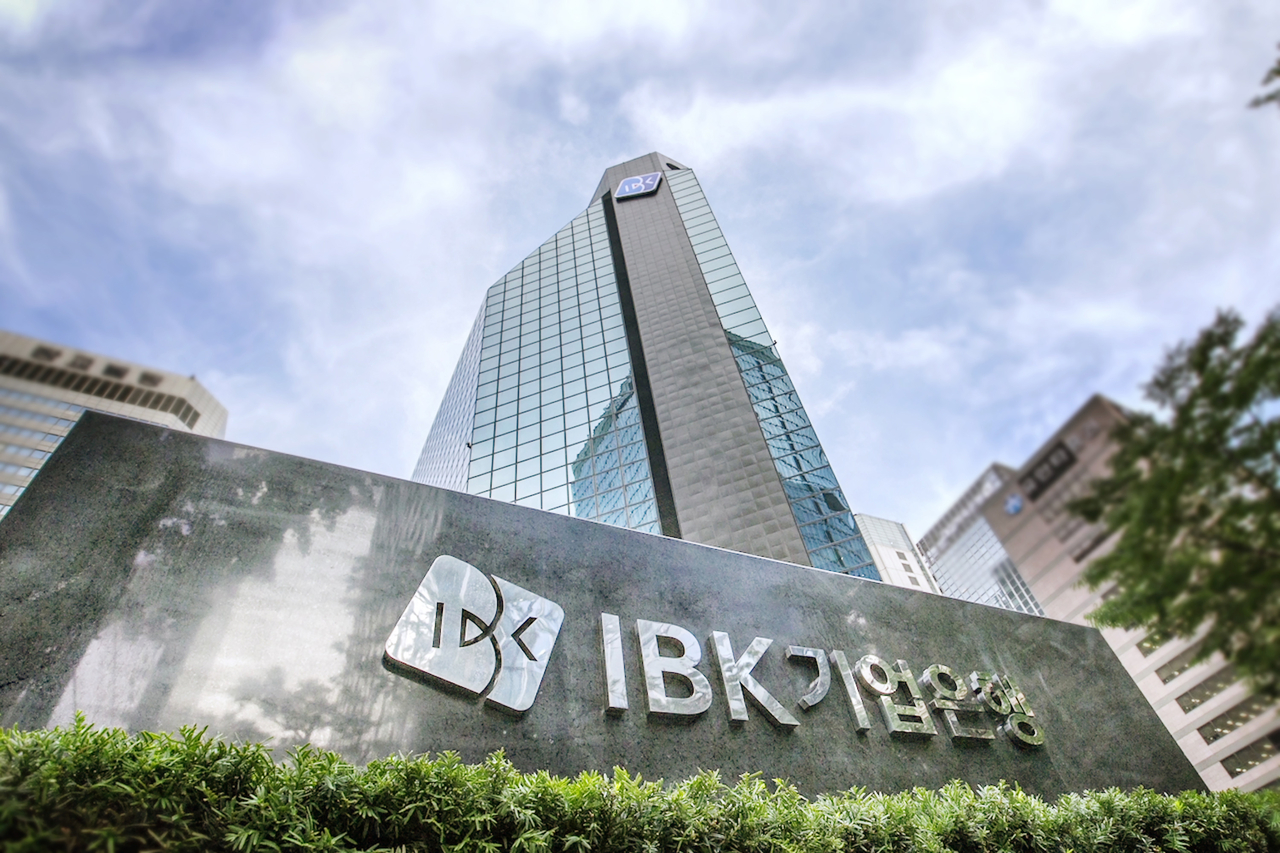
The Industrial Bank of Korea has sold off its entire stake in Korea Investment Holdings after the government lifted restrictions on asset disposals by public institutions, ending a shareholding relationship of more than two decades. The move is expected to accelerate asset sales at other state-backed financial institutions, including Korea Asset Management Corp. (Kamco) and Korea Development Bank.
According to investment banking industry sources, IBK sold 62,300 shares of Korea Investment Holdings on the open market on Friday. The bank began the sale Monday and completed it in four days.
IBK had acquired 1.25 million shares of Korea Investment Holdings across two transactions in 2005 and 2006, aiming to build a comprehensive financial platform extending into the securities business and broaden its revenue base. To that end, the bank signed a strategic MOU with Dongwon Financial, the predecessor of Korea Investment Holdings.
However, after IBK Securities was established and the envisioned cooperation with Korea Investment Holdings failed to materialize, IBK decided to divest the stake, closing out the two companies' equity relationship after more than 20 years.
The disposal followed the government's recent decision to lift its prior-approval requirement for public institution asset sales. The government notified relevant ministries and public institutions that they may now proceed with asset sales without prior approval from the prime minister.
IBK had begun selling down its Korea Investment Holdings stake in September last year, but the process was halted about two months later in November when President Lee Jae-myung ordered a suspension of government asset sales.
Lee issued the freeze after controversy erupted over Kamco's alleged fire-sale disposal of assets, following which the government required public institutions to obtain prior prime ministerial approval before proceeding with any asset sale. Last month, however, the government revised the relevant guidelines to allow public institutions to pursue asset sales without such approval, in effect lifting the restrictions.
With IBK's disposal of its Korea Investment Holdings stake complete, other public institutions are expected to pick up the pace on their own asset sales.
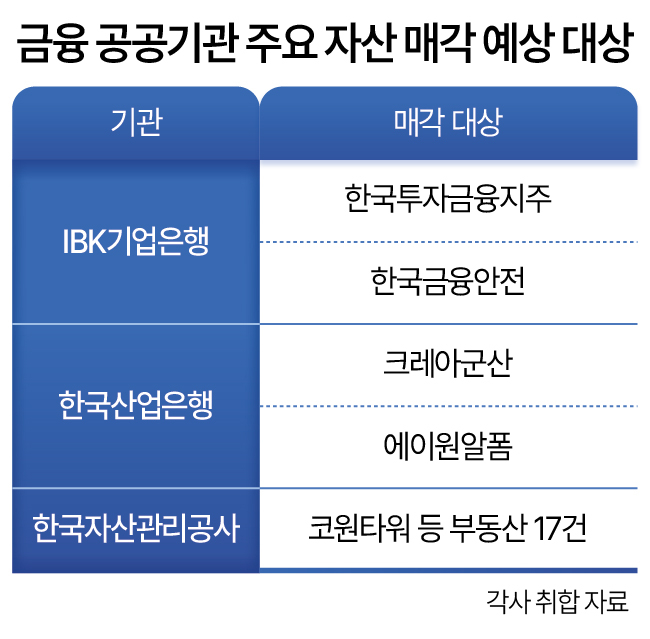
A notable candidate is IBK's 14.67 percent stake in Korea Financial Safety, a cash-transport specialist jointly established by IBK, KB Kookmin, Hana, Woori and Citibank. After a string of losses, the five banks formed a share-sale committee in 2022 to find a buyer, but dissolved it in the first half of this year after failing to attract one. An IBK official said the bank currently has no concrete plans to resume the sale.
Korea Development Bank has also been reviewing whether to dispose of stakes it holds in unlisted companies. Among the assets under consideration are a 0.8 percent stake in Crea Gunsan, a supplier to GM Korea, and a holding in A-One Alform, an aluminum formwork manufacturer. The Crea Gunsan stake was acquired during a corporate restructuring process and had previously been put on hold under the government's restrictions.
Korea Deposit Insurance Corp. is also expected to accelerate the sale of Camko City in Cambodia, a real estate development project identified as a contributing factor in the 2012 Busan Savings Bank collapse. The deposit insurer took over the related stake after Busan Savings Bank went bankrupt.
Kamco recently announced plans to sell 367 billion won ($274 million) worth of real estate — properties acquired through its sale-and-leaseback program whose preferential purchase rights held by the original corporate owners have since lapsed. The sale covers 17 properties in total, including the Cowon Tower building in Gangnam-gu, Seoul.
Meanwhile, even as the sale restrictions have been lifted, the government is expected to maintain tighter oversight to prevent public assets from being sold at below-market prices. Late last year, the government proposed a policy requiring public institutions to report in advance to the relevant National Assembly standing committee before selling assets worth more than 30 billion won. The Assembly is also currently deliberating an amendment to the Act on the Management of Public Institutions that would require prior Assembly approval for any disposal of public institution equity stakes.
hyuk@heraldcorp.com
rim@heraldcorp.com