Missing rebar fallout: 'Safety verification comes first'
Two reinforcement options remain; full reconstruction also on the table
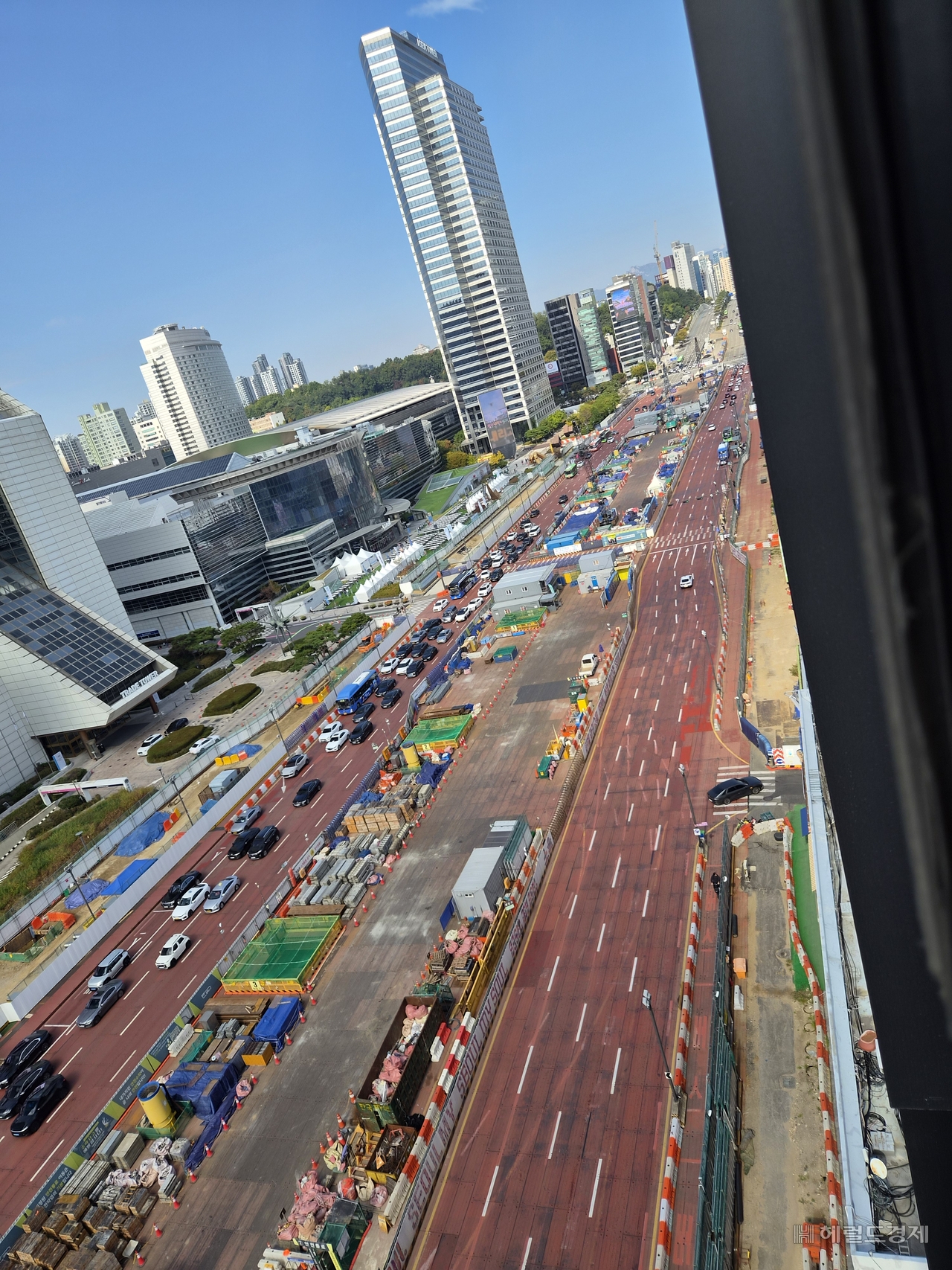
Trains on the GTX-A line will not stop at Samsung station this year, with the Ministry of Land, Infrastructure and Transport saying Tuesday that service there is not expected until the first half of next year, after reinforcement work and trial commercial operations are completed.
The ministry said it is conducting a thorough review of a construction error involving columns at the GTX-A Samsung station section, including an inspection by a joint government task force and a study by the Korea Concrete Institute on reinforcement options — covering the cause of the error, the adequacy of the construction process and verification of proposed fixes.
The Seoul Metropolitan Government has argued that delays stem from unnecessary additional verification, contending that had its reinforcement plan — submitted in April — been adopted and construction completed, trains could have stopped at the station in August. The ministry pushed back, saying the reinforcement planning and construction work inherently require time.
The ministry said it held a comprehensive coordination meeting Friday with the Seoul Metropolitan Government, Korea National Railway, the joint government task force and the Korea Concrete Institute to align progress among the agencies involved and discuss next steps.
The joint government task force has been investigating all four construction sections of the Yeongdong-daero complex development project — including Section 3, where missing rebar was confirmed — since May 21, examining the adequacy of design and construction, fire and electrical safety, and the causes of the construction errors.
Among the deficiencies identified, minor issues or those requiring immediate action — such as faulty safety railing installations — have already been corrected by the relevant contractors. The task force is continuing additional verification work, including structural analysis.
The task force is also verifying the adequacy of the original two-dimensional structural analysis using three-dimensional modeling. Rebar surveys have revealed additional shortcomings, including insufficient concrete cover and bearing strength, and further reinforcement measures are under discussion.
In addition, violations of guidelines and regulations identified during the inspection are to be finalized by year's end, after which penalty points and administrative measures will be imposed.
A decision on how to reinforce or reconstruct the columns has yet to be made. The reinforcement study, which began May 28, initially examined 12 options, including a steel-plate reinforcement method proposed by Seoul. That has since been narrowed to two: a high-strength mortar section enlargement with rebar placement, and a composite reinforcement method combining high-strength mortar section enlargement with steel-plate reinforcement. Researchers are conducting further analysis covering the impact on train operations, seismic performance, three-dimensional precision modeling and construction details.
The Korea Concrete Institute, which is carrying out the reinforcement study, determined that the large-scale rebar omissions have created an unusual situation in which the columns lack sufficient structural load-bearing capacity, and that existing steel-plate reinforcement cases cannot be directly applied given differences in fill area and materials. The institute is running physical model tests to verify the performance, injectability and fill quality of the materials, and is analyzing the results.
The possibility of demolishing and reconstructing the columns is also being reviewed through the Korea Institute for Structural Maintenance and Inspection. The ministry said it is keeping all options open and plans to select the best solution by year's end in consultation with Seoul and other relevant agencies, taking into account safety, constructability and construction timelines.
The ministry said it will select the optimal solution by year's end based on the results of the reinforcement verification and reconstruction analysis, with safety as the top priority, and will work closely with the agencies involved to advance the GTX-A Samsung station stop schedule as much as possible. The station is currently expected to begin service in the first half of next year.
Kim Tae-byeong, director general of the ministry's railroad bureau, said the ministry will "inspect and review everything meticulously, with public safety as the top priority," adding that "a specific timetable for train stops at Samsung station will be confirmed after deciding on the optimal reinforcement solution by year's end and comprehensively considering factors such as the feasibility of running reinforcement work and trial commercial operations in parallel."
smh@heraldcorp.com