Selected from 16 proposals by local governments
Total project cost estimated at 53.6 trillion won
Geumjeong-Dangjeong, Geumjeong-Daeyami routes flagged for further review
Nine railway sections, including Seoul's Gyeongbu Line (Seoul Station to Geumcheon-gu Office Station) and Gyeongwon Line (Seobinggo Station to Dobongsan Station), are set to move forward as new underground development projects, marking an expansion of the initiative beyond the three pilot projects already underway in Busan, Daejeon and Ansan.
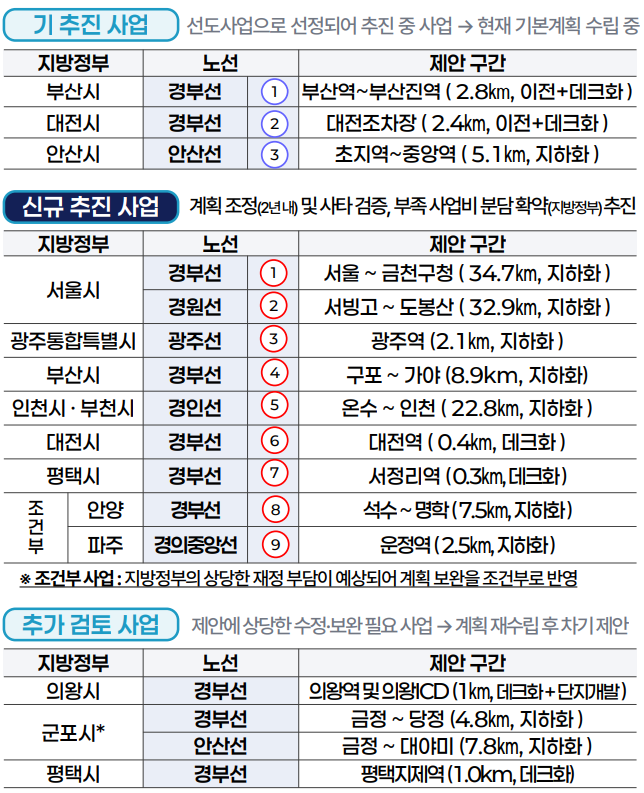
According to materials presented Thursday at a public hearing on the comprehensive plan for integrated railway underground development, held at the Korea Research Institute for Human Settlements, six metropolitan and provincial governments submitted a total of 16 project proposals. Of these, three are already designated pilot projects, nine are identified as new projects to proceed, and four require additional review.
The nine new projects are: the Seoul Gyeongbu Line from Seoul Station to Geumcheon-gu Office Station (34.7 kilometers, underground); the Seoul Gyeongwon Line from Seobinggo Station to Dobongsan Station (32.9 km, underground); the Gwangju Line at Gwangju Station (2.1 km, underground); the Busan Gyeongbu Line from Gupo to Gaya (8.9 km, underground); the Gyeongin Line from Onsu to Incheon, spanning Incheon and Bucheon (22.8 km, underground); the Daejeon Gyeongbu Line at Daejeon Station (0.4 km, deck-over); and the Pyeongtaek Gyeongbu Line at Seojeongni Station (0.3 km, deck-over). Two additional sections — the Gyeongbu Line from Seoksu to Myeonghak in Anyang, Gyeonggi Province (7.5 km, underground), and the Gyeongui-Jungang Line at Unjeong Station in Paju (2.5 km, underground) — were conditionally included, as both are expected to place a considerable fiscal burden on local governments and must submit revised plans.
Once the comprehensive plan is officially announced, the new projects must refine their proposals to reflect review findings and pass a preliminary feasibility screening before moving into the basic plan stage. During that stage, they will undergo a public institution preliminary feasibility study, followed by deliberation by the Central Urban Planning Committee and approval by the relevant local councils before final designation. Conditionally approved projects must adjust their plans and demonstrate financial viability within two years of designation.
The hearing also outlined challenges specific to each line. The Seoul Gyeongwon Line will require a construction plan that keeps Metropolitan Subway Line 1 and the Suin-Bundang Line running without interruption. Planners must also ensure the project does not conflict with the depth of the GTX-B and GTX-C lines, and will need to coordinate the relocation of the Cheongnyangni depot and negotiate plans and costs for sections in Guri and Namyangju, which lie outside Seoul.
Because the Seoul Gyeongbu Line and the Gyeongin Line also serve as metropolitan rail corridors, measures to minimize disruption to passengers will be needed. For the Gyeongin Line, outstanding issues include the underground relocation of the Incheon Station overnight depot and cost-sharing negotiations for the Onsu Station section.
The Gwangju Line must secure alternative transport during any temporary suspension of service and examine the possibility of overlap with the Dalbit Railway corridor. The Busan Gyeongbu Line must resolve conflicts with a military rail line, while the Daejeon Station project will need a relocation and compensation plan for market vendors near the station.
The Seojeongni Station project must reassess demand by factoring in the development of Godeok International New Town and the current level of unsold units and vacancies in the surrounding area. The Anyang section received conditions requiring cost-sharing negotiations for the boundary section near Seoksu Station and consultations over a cultural heritage management zone. The Paju section must revisit its track layout plan in light of a potential extension of the Sohae Line and demonstrate the feasibility of incorporating private land, which accounts for 74.9 percent of the project site.
Four projects — the Gyeongbu Line in Uiwang (Uiwang Station and Uiwang ICD), the Gyeongbu and Ansan lines in Gunpo (Geumjeong to Dangjeong, and Geumjeong to Daeyami), and the Gyeongbu Line in Pyeongtaek (Pyeongtaek-Jije Station) — were deemed to require substantial revision and will be deferred to the next comprehensive plan cycle for resubmission and review.
The three existing pilot projects — Busan Station to Busanjin Station, the Daejeon marshalling yard, and the Ansan section from Choji Station to Jungang Station — are currently in the basic plan development stage and are scheduled to undergo a public institution preliminary feasibility study in 2027.
The hearing estimated the total cost of underground construction and above-ground site development at 53.6 trillion won ($40.3 billion). Development gains based on land sale proceeds were projected at 42.5 trillion won, though some projects were noted as likely to require additional financing. The broader economic ripple effect was estimated at 197.4 trillion won, with projected employment creation of 659,000 jobs.
smh@heraldcorp.com