National Assembly Speaker Jo Jeong-sik serves as guest of honor; vessel carries 70 domestically produced systems
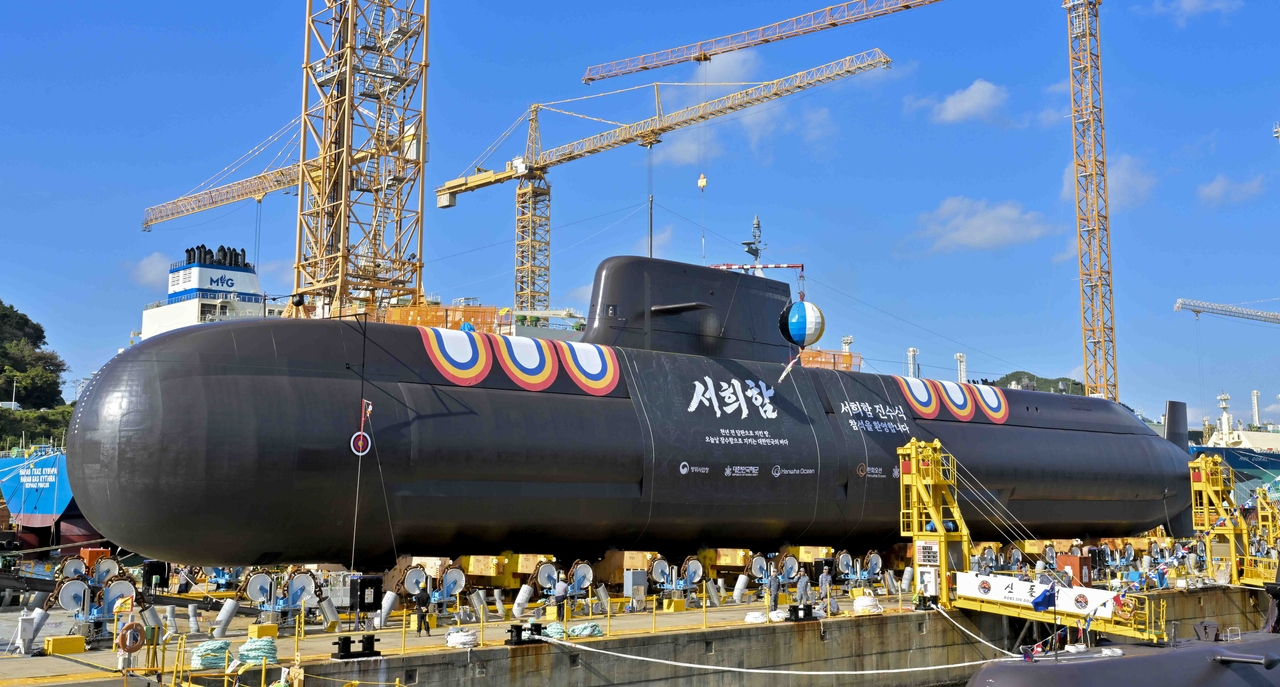
The Navy held a launching ceremony Tuesday for the Seohi (SS-088), a 3,600-ton submarine equipped with submarine-launched ballistic missile (SLBM) tubes.
The Navy and the Defense Acquisition Program Administration (DAPA) announced that Hanwha Ocean launched the vessel — the second ship of the Jangbogo-III Batch-II class — at its Okpo Shipyard in Geoje. About 200 guests attended the ceremony, with National Assembly Speaker Jo Jeong-sik serving as the guest of honor, joined by senior officials from government agencies, the National Assembly, South Korea's Ministry of National Defense, the Navy, DAPA, and the defense industry.
The Navy named the submarine after Seo Hui, a Goryeo-era statesman renowned for his exceptional military and diplomatic achievements and his spirit of overcoming national crises — qualities the Navy said befit a state-of-the-art submarine. Independently designed and built in South Korea, the Seohi was contracted for construction in 2021, with a ground-breaking ceremony held that same year and a keel-laying ceremony in 2024.
Following naval tradition, the launching ceremony featured Speaker Jo's wife, Jo Mi-seon, cutting the launching rope connected to the hull — a ritual symbolizing the bestowal of life upon a newly built vessel, much like cutting a newborn's umbilical cord. The speaker and his wife, along with other distinguished guests, then cut multicolored ribbons with scissors and smashed a champagne bottle against the hull in a ceremony wishing the submarine safe voyages.
The Seohi, the Navy's second 3,600-ton submarine, is regarded as one of the world's finest diesel submarines and a key strategic asset capable of deterring maritime security threats around the Korean Peninsula and maintaining a firm strategic response posture in contingencies.
At approximately 89 meters in length, the Seohi has a larger hull than the Jangbogo-III Batch-I Dosan Ahn Chang-ho class, giving it greater capacity to accommodate a wider range of weapons and equipment. Improvements to the combat system — the submarine's brain — and the sonar system — its eyes and ears — have also enhanced its ability to identify and precisely strike multiple long-range targets.
The Seohi was built as a hybrid submarine combining an air-independent propulsion (AIP) system developed by Hanwha Ocean with a lithium-ion battery system from Hanwha Aerospace. The combination of AIP and lithium-ion batteries in a single propulsion system is a world first, giving the vessel the longest underwater endurance of any diesel submarine globally. The system's reliability was secured through multiple redundant safety designs, advance verification at a dedicated land-based test facility, and rigorous safety assessments.
Particularly notable is the addition of 12 domestically produced systems compared with the Dosan Ahn Chang-ho class — including the lithium battery system — bringing the total to 70 locally sourced components. This not only ensures stable and rapid follow-on logistics support but also strengthens the export competitiveness of South Korea's submarine program.
"The Seohi is a meaningful achievement that demonstrates the excellence of South Korea's submarine design and construction technology, representing the pinnacle of cutting-edge capability in a world-class diesel submarine," said Lee Sang-woo, head of DAPA's nuclear-powered submarine project office. "Building on the expanded domestic production results, we expect it to contribute greatly to establishing an advanced defense industry base and to submarine exports."
"The Seohi is the latest national strategic asset capable of effectively responding to security threats with powerful underwater operational capabilities," said Lee Gu-seong, chief of the Navy headquarters' planning and management staff. "We will continue to build naval power grounded in advanced science and technology, fulfilling our mission as an elite navy that protects the people."
The Seohi will undergo sea trials before being delivered to the Navy in 2028, after which it will complete its operational deployment process and enter active service.
youknow@heraldcorp.com