Korea Employment and Labor Education Institute conducts first nationwide survey of 2,220 respondents; lack of information cited as top barrier, with seniors and small-business workers most underserved

More than seven in 10 respondents said they believe labor rights education is necessary, yet only 8.8 percent had actually received any — once mandatory workplace training such as industrial safety and sexual harassment prevention courses was excluded. Demand was highest for education on wages, allowances and employment contracts, but actual instruction remained concentrated in legally required programs.
The Korea Employment and Labor Education Institute released the findings Tuesday in its "2026 Lifelong Labor Education Survey," the first nationwide study to assess both the supply of and demand for labor education across all life stages and employment types.
The survey was conducted from April 14 through Sept. 30 among 2,220 adults aged 19 and older nationwide. It covered seven groups — youth and job seekers, employed workers, career changers, atypical workers, small-business owners, seniors and migrant workers — through questionnaires, an inventory of education providers, and in-depth interviews with program administrators, participants and experts.
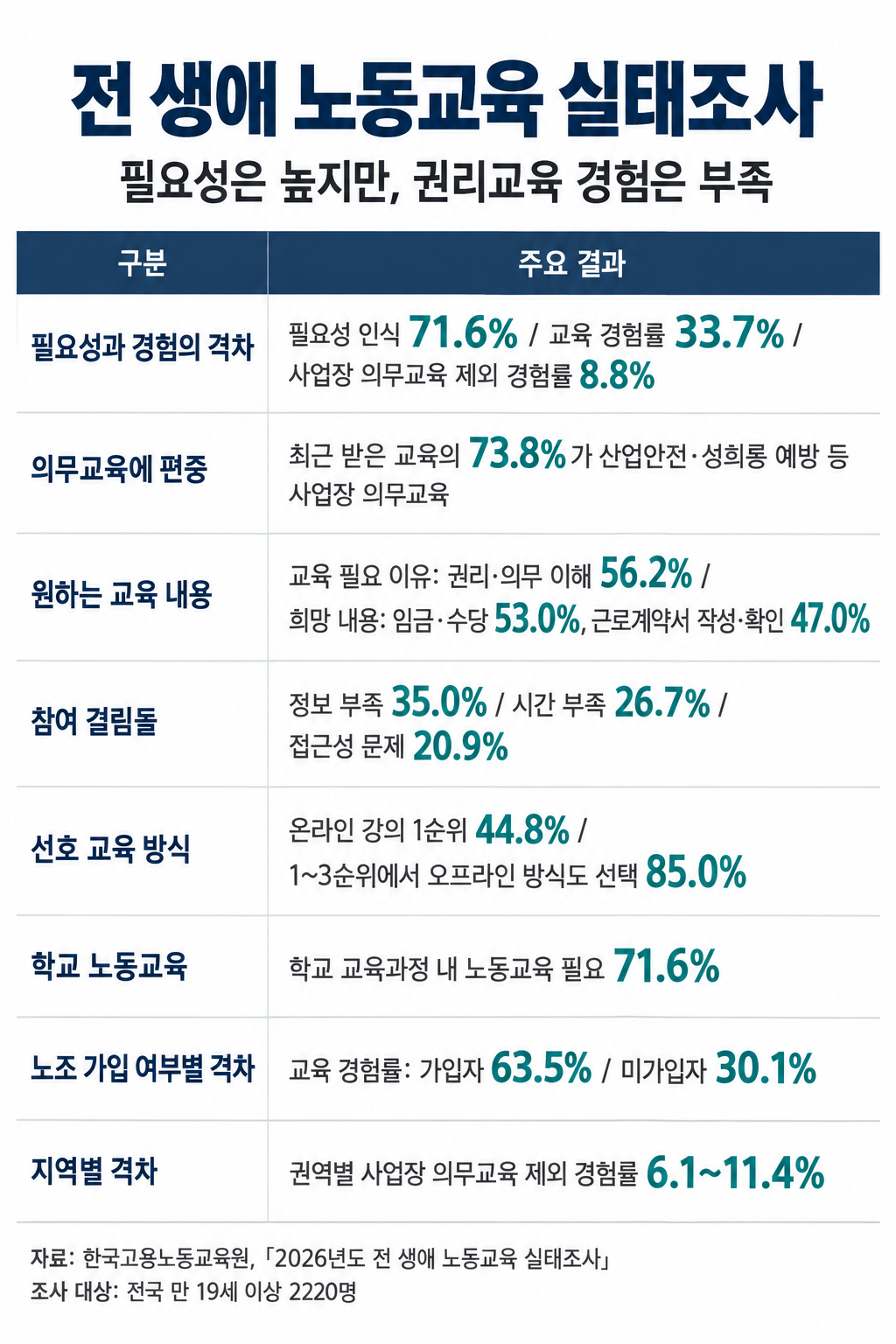
Of all respondents, 71.6 percent said labor education is necessary. Yet the overall participation rate stood at just 33.7 percent, falling further to 8.8 percent when mandatory workplace training was excluded. Among those who said such education was necessary, 61.7 percent had either never received it or could not recall doing so.
A gap also emerged between what people wanted to learn and what they were actually taught. The most common reason cited for needing labor education was "wanting to properly understand my rights and obligations," at 56.2 percent. The most sought-after topics were rights related to wages and allowances (53.0 percent) and how to prepare and review employment contracts (47.0 percent). By contrast, 73.8 percent of the education respondents had recently received consisted of mandatory workplace programs covering industrial safety and sexual harassment prevention.
The biggest barrier to participation was lack of information, cited by 35.0 percent of respondents, followed by lack of time at 26.7 percent and accessibility issues at 20.9 percent. Only 6.1 percent said they felt no need for such education — a finding the researchers said points less to a problem of awareness and more to a systemic failure to publicize available programs and connect people with opportunities to participate.
The survey also revealed gaps across different life stages. Only 20.3 percent of youth and job seekers had received labor education in school. Among career changers, 76.7 percent recognized the need for such education, but only 28.3 percent had received it — a gap of 48.3 percentage points, the largest of any of the seven groups surveyed.
Seniors showed the highest awareness of the need for labor education at 77.0 percent, yet recorded the lowest participation rate once mandatory workplace training was excluded, at just 6.9 percent. Researchers said the findings underscore the need for education tailored not only to entering the workforce but also to major life transitions such as changing jobs and retiring.
Blind spots tied to workplace size and employment type were also identified. Among workers at businesses with fewer than 30 employees, 43.7 percent said their workplace offered no labor education at all. The participation rate among freelancers was 17.5 percent.
Among platform workers, 72.2 percent said they had encountered labor-related education or information, but only 17.3 percent of that group said the content was relevant to their situation. More than half of migrant workers — 54.2 percent — identified language as a barrier to participation. Workers who belonged to a union had a participation rate of 63.5 percent, roughly double the 30.1 percent recorded among non-union workers.
The research team proposed securing dedicated class hours for labor education within middle and high school curricula and developing tailored programs for each stage of life as policy priorities. Additional recommendations included legislating labor rights education, securing a dedicated budget, training teachers and instructors, developing and distributing standardized lesson plans, and establishing a national labor education consultative body.
The institute plans to incorporate the survey findings into the development of its "Employment and Labor Education 2.0" initiative and the design of its lifelong labor education project. The full research report will be published in print and shared with labor rights centers and other relevant organizations nationwide.
"The survey confirmed that demand for labor education is very high across all stages of life, but that people who actually need it are not receiving meaningful instruction," institute director Lee Jong-seon said. "We will fulfill our role and responsibility as the national hub for labor education, ensuring that every working person can access the labor education they need at every turning point in their lives."
fact0514@heraldcorp.com