Wage claim guarantee fund reserves down 60% in three years
Disability employment fund allocates just 36.7% of assets to key programs next year
New 43.57 billion won industrial accident advance-payment scheme faces legal hurdles
A budget watchdog has flagged a widening mismatch in South Korea's labor welfare finances: the fund that pays workers their stolen wages is running low on reserves, while a separate fund supporting employment of people with disabilities is sitting on resources it is not fully deploying.
Both problems surfaced during the National Assembly's review of the Ministry of Employment and Labor's budget and fund plans for next year, highlighting twin challenges — securing stable financing for worker protection and translating available funds into measurable employment outcomes.
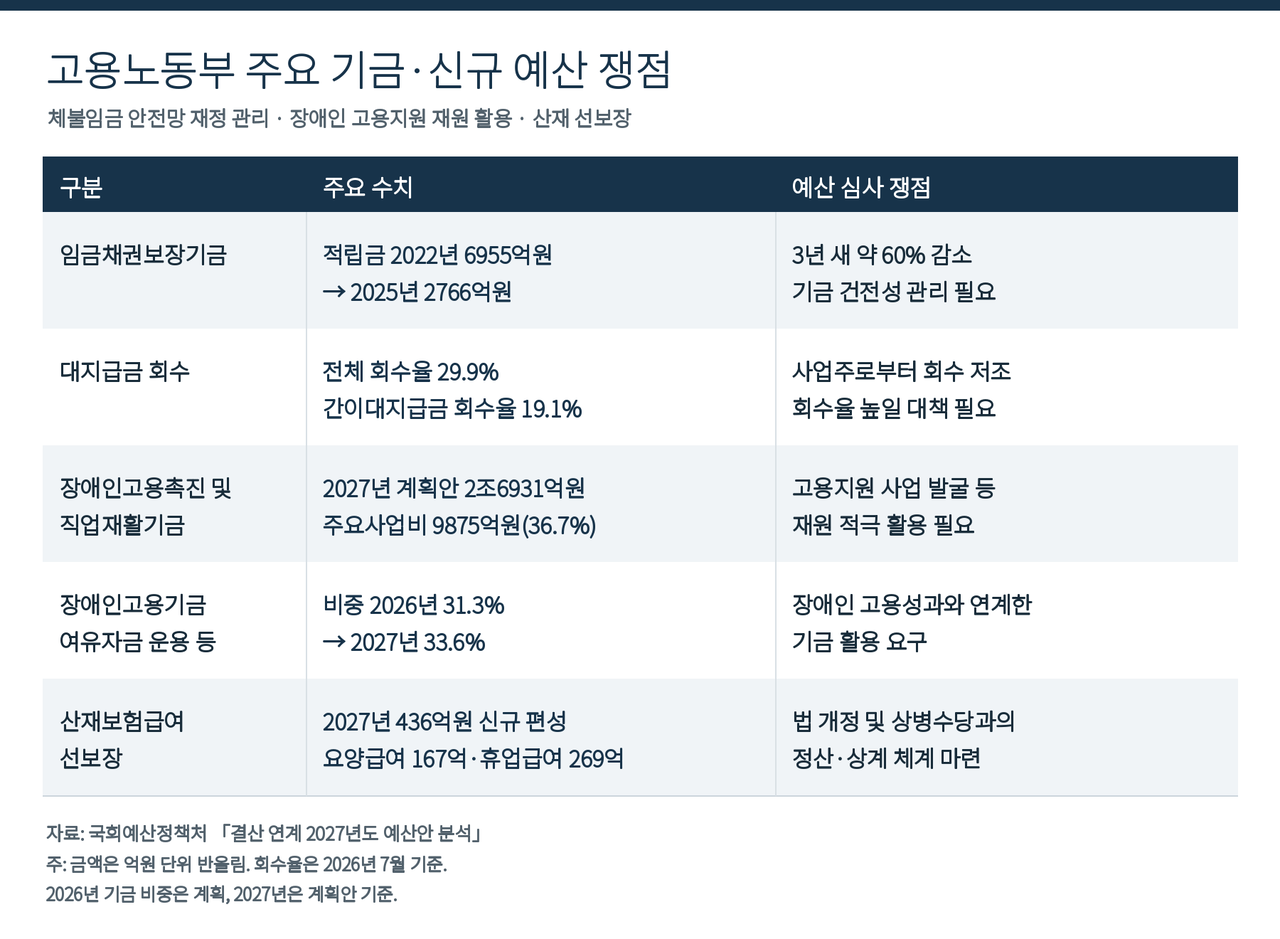
According to the National Assembly Budget Office's report "Analysis of the Fiscal Year 2027 Budget Linked to Final Accounts," released Tuesday, reserves in the Wage Claim Guarantee Fund fell from 695.54 billion won ($519 million) in 2022 to 276.6 billion won last year — a roughly 60 percent drop in three years.
The fund, financed primarily by employer contributions, steps in to pay workers a portion of wages they were unable to collect. It serves as an immediate safety net for workers' livelihoods, but expenditures have consistently outpaced revenues. Last year the fund recorded a deficit of 70.67 billion won, with revenues of 736.85 billion won against outlays of 807.52 billion won.
Recovery rates on advance payments that employers are required to reimburse have also deteriorated. The overall recovery rate slipped from 32.2 percent in 2021 to 29.7 percent last year, and stood at just 29.9 percent as of July this year. The recovery rate for simplified advance payments was even lower, at 19.1 percent — below the 20 percent mark — as of the same point.
The Ministry of Employment and Labor said it has pursued credit sanctions against employers who have not repaid their debts and has entrusted long-outstanding receivables to the Korea Asset Management Corp., completing corrective measures required in the final accounts review. The budget office, however, said recovery rates remain stagnant and called for additional measures.
The fiscal stakes grew higher after the scope of insolvency advance payments was expanded in August, extending wage coverage from the final three months to six months. The report also noted that a mismatch between the range of wage claims eligible for priority repayment and the range covered by advance payments could further complicate recovery efforts.
On the other side of the ledger, the budget office said the Fund for the Promotion of Employment of Persons with Disabilities and Vocational Rehabilitation should be putting its accumulated resources to more active use in supporting employment.
The fund's total operating scale next year is set at 2.69 trillion won, of which 987.53 billion won is earmarked for major project spending — a share of 36.7 percent, roughly in line with this year's planned 36.8 percent. Meanwhile, the share allocated to idle-fund management and similar items is set to rise from 31.3 percent this year to 33.6 percent next year. Internal government expenditures are budgeted at 800 billion won.
Although the absolute amount of major project spending will increase from this year's level, the share of total resources directed toward employment support programs will not grow. The budget office said it sees no clear justification for continuing to accumulate idle funds in anticipation of future spending needs, and called for more active deployment of available resources.
Employment outcomes have also stagnated. A survey on the economic activity of people with disabilities cited in the report showed the employment rate for people with disabilities aged 15 to 64 fell from 50.3 percent in 2022 to 48.3 percent last year. The budget office said the ministry should expand existing programs and develop new ones to ensure fund operations translate into tangible employment gains for people with disabilities.
The Ministry of Employment and Labor said it has steadily increased program spending and will seek ways to promote employment of people with disabilities — including identifying new initiatives — while pursuing a sustainable approach to fund management.
A separate challenge involves ensuring that newly allocated funds actually reach workers in need. The ministry has set aside 43.57 billion won for next year to launch an advance-payment scheme under the industrial accident insurance system, under which workers awaiting a ruling on their claims would receive partial benefits in advance. The allocation breaks down into 16.69 billion won for medical care benefits and 26.88 billion won for temporary disability benefits.
As of July this year, the average processing time for occupational disease cases under the industrial accident system stood at 218.5 days. The ministry plans to set a statutory deadline for accident investigations and, when that deadline is exceeded, allow workers to apply for advance medical care benefits and temporary disability benefits equivalent to 60 percent of the minimum wage.
However, the budget office said the scheme requires amendments to relevant legislation, meaning the budget review and the legislative process must proceed in tandem. Because advance payments would be clawed back if a claim is ultimately denied, the office also said procedures must be established to reconcile and offset payments against the sick pay program run by the Ministry of Health and Welfare.
"Preparations must be made to ensure smooth reconciliation between benefits administered by different ministries from different funding sources, and safeguards to minimize fraudulent claims must also be built into the design," the budget office said.
fact0514@heraldcorp.com