
Rezoning study for Majang livestock market to be commissioned in January next year
Oh visited the market during the June 3 local elections campaign to announce the pledge
District-unit plan revision targets 2029 for final designation
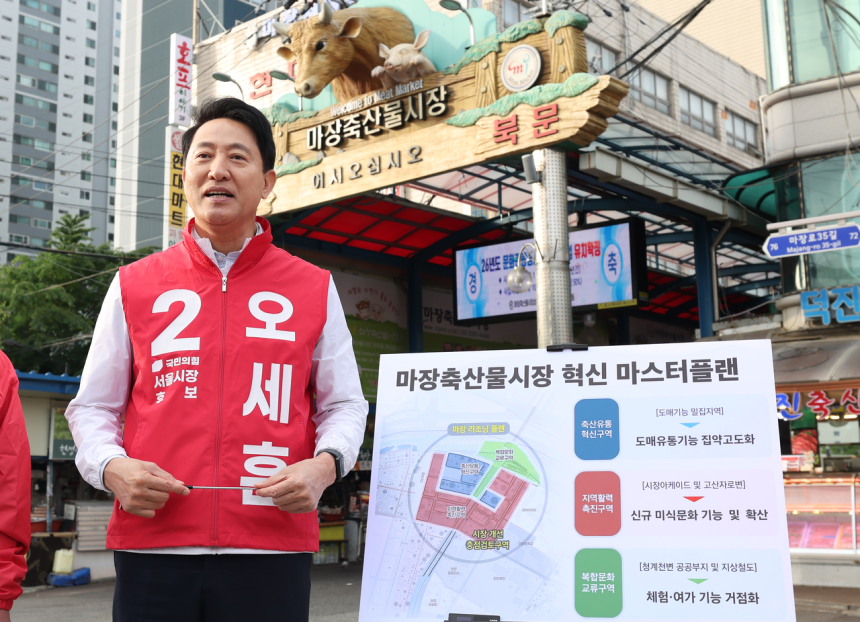
The Seoul Metropolitan Government is accelerating Seoul Mayor Oh Se-hoon's ninth-term campaign pledge to modernize Majang Livestock Market through a revision of the district-unit development plan for the area.
The city plans to commission a district-unit planning study for the modernization of Majang Livestock Market in Seongdong-gu in January next year, with a total budget of 900 million won ($680,000) to be split evenly between the city and Seongdong-gu. The study is expected to run through late 2028. The budget has been included in the 2027 budget proposal the city plans to submit to the Seoul Metropolitan Council later this month.
"We plan to reorganize the district-unit plan through a Majang rezoning plan and redistribute urban functions," a Seoul city official said. "We are pushing ahead with the project with a target of issuing the revised designation in 2029."
Under the plan, the city would divide the Majang-dong market into three zones through rezoning: a livestock distribution innovation zone, a local vitality promotion zone and a mixed cultural exchange zone. The initiative was one of the campaign pledges Oh put forward during the June 3 local elections. Oh said the rezoning would modernize the market's fragmented and small-scale distribution structure and improve the sanitary handling of byproducts in the livestock distribution innovation zone. The local vitality promotion zone would transform the Majang-dong area from a simple meat-purchasing destination into a food culture hub, while the mixed cultural exchange zone would add community amenities such as children's cafes, a library and parking facilities.
Majang Livestock Market has long drawn criticism for mixing meat distributors, restaurants and community facilities without any functional zoning, making it difficult to address persistent odor complaints and maintain hygiene standards. Oh visited the market in person on May 6, while campaigning for the June 3 local elections, and said: "There are odor problems, and because byproducts pile up, there are issues with removal and stall organization — many inconveniences. From residents' perspective, this has not been a pleasant shopping environment, and because it is mixed in with the surrounding residential area, many complaints have been filed. We will work to consolidate and upgrade the distribution functions so that everything can be handled more cleanly and hygienically."
"If the district-unit plan is finalized as pledged, tenants whose leases expire and who sign new contracts in the livestock distribution zone will naturally be guided into the right placement, as other types of businesses will no longer be permitted there," a Seongdong-gu official said.
Majang-dong takes its name from a royal horse stable that stood there during the Joseon Dynasty. The area's current identity as a meat market traces back to 1963, when a livestock market in Sungin-dong, Jongno-gu moved to the site and a slaughterhouse district took shape. As apartment complexes spread through the neighborhood in the 1990s, the slaughterhouses disappeared and only the retail operations remained. Today the market is the largest of its kind in the country, with roughly 2,000 meat-related businesses clustered together and an estimated 60 percent of all meat distributed in the greater Seoul area passing through it. Modernization efforts began in earnest in 2019, following incremental improvements that started in the early 2000s.
Despite those efforts, chronic odor complaints remain unresolved. Measures including steam-cleaning vehicles and improved byproduct collection introduced by the city, along with sewer upgrades by Seongdong-gu, have yet to fully solve the problem. "Given the nature of the market, odor complaints are unavoidable," a Seongdong-gu official said. "We plan to gather residents' opinions alongside the rezoning project and review odor-reduction measures accordingly." Public consultations are planned to begin as early as May next year.
cook@heraldcorp.com




