
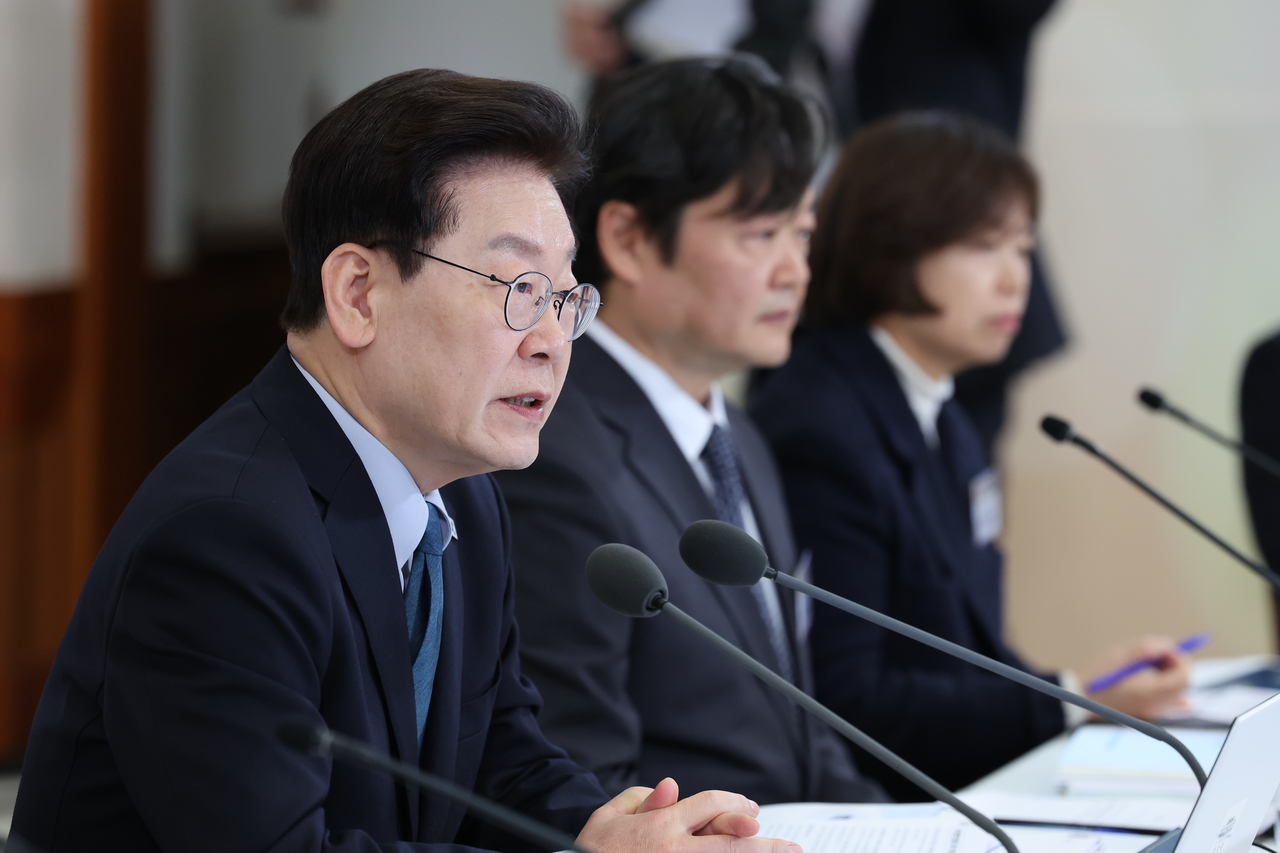
President Lee Jae Myung said Friday that preferential treatment for multicultural families warrants a thorough review if it has gone beyond restoring equality and sparked controversy over unfair advantages.
Lee shared a news report on SNS showing that multicultural mothers account for no more than around 2 percent of users of the preferential admission system at public postpartum care centers, adding remarks to the post. The move appeared to be a renewed attempt to clarify Lee's position after criticism that recent comments about revisiting preferential treatment for multicultural families amounted to a rollback of support.
"Fairness is the core value of public administration, and fairness has nothing to do with the size or quantity of a benefit," Lee said. "The fact that an amount is small does not make it acceptable to be unfair."
Lee said the original purpose of support for multicultural families is "to secure equality by compensating for elements of disadvantage that arise from differences in characteristics compared with Korean families," and said policies addressing specific vulnerabilities — such as cultural adaptation and bilingual education — should continue to be strengthened.
However, Lee said certain priority rights deserve scrutiny. "It is worth examining the problems with 'priority rights' — such as guaranteed priority placement at public daycare centers and postpartum care centers — where it is difficult to find a rational reason to give multicultural families precedence over Korean families without exception," Lee said.
Lee also noted that not all multicultural families face financial hardship. "There are plenty of multicultural households that are not economically disadvantaged — for example, those where a spouse has married a professional from a developed country," Lee said. "If poverty is the issue, the answer is to provide the same support as for low-income Korean families. Treating all multicultural families unconditionally as vulnerable groups does not reflect reality."
Lee warned that excessive preferential treatment could fuel prejudice against multicultural families. "Elements that could become controversial as unjust preferential treatment can serve as a pretext for far-right incitement and attacks," Lee said. "To help multicultural families integrate into society rather than be singled out, we must minimize the grounds for such attacks."
In closing, Lee said any welfare policy must remain within a range that those disadvantaged by it can reasonably accept in order to be sustainable. "I look forward to deeper and broader debate on this," Lee added.
hwshin@heraldcorp.com




