
- Council to coordinate military technology needs, identify 100 promising defense technologies
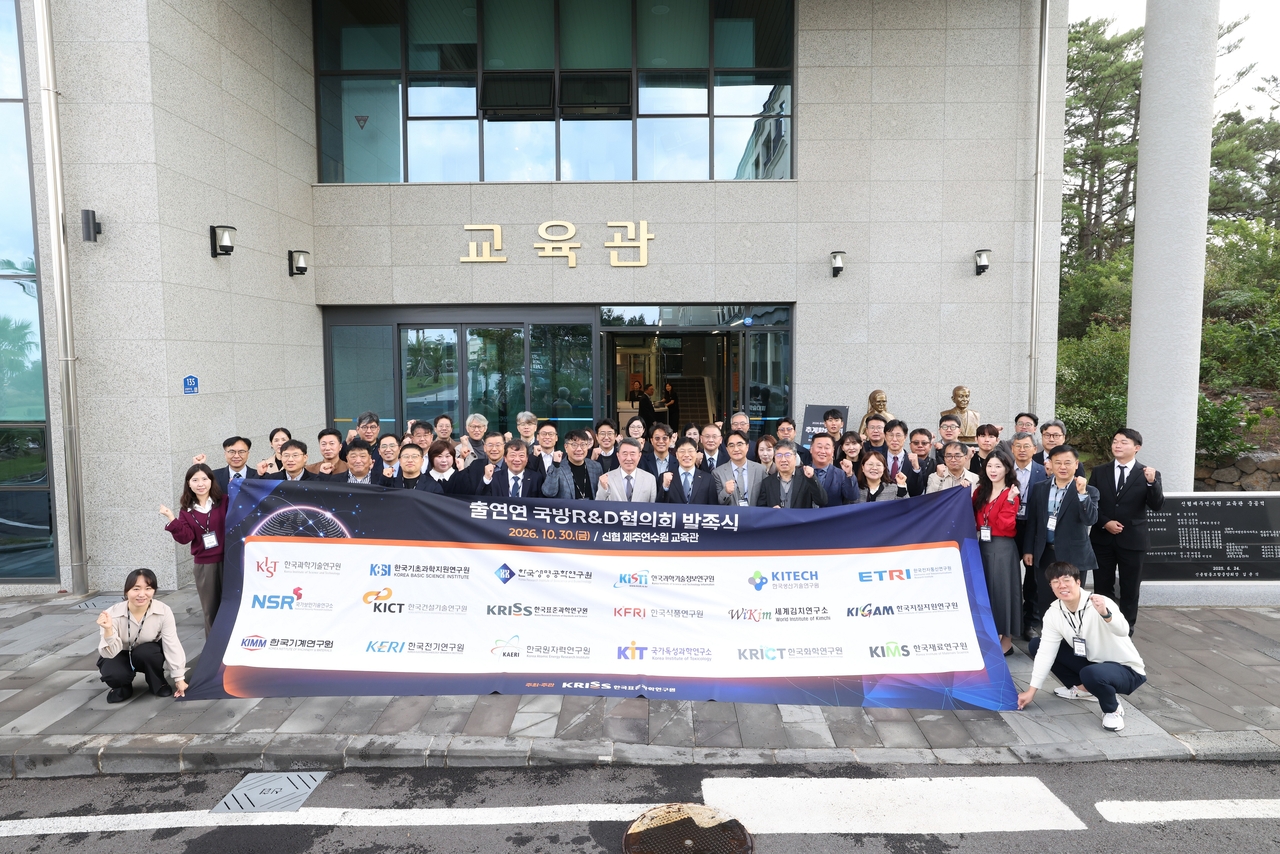
Eighteen government-funded research institutes holding national strategic technologies — including AI, quantum, semiconductors and advanced materials — are joining forces to develop cutting-edge defense technology. The initiative moves beyond institution-by-institution collaboration toward a coordinated system for jointly developing technologies the military needs, while also working to remove the institutional barriers that have long blocked research institutes from participating in defense R&D.
Korea Research Institute of Standards and Science (KRISS) said Friday it officially launched the Government-Funded Research Institutes Defense R&D Council at the Sinheop Jeju Training Center in Jeju, with 18 science and technology research institutes taking part.
Kang No-won, head of KRISS's performance and policy division, was named the council's inaugural chair, with the Korea Institute of Science and Technology (KIST) serving as the coordinating secretariat.
Until now, government-funded research institutes had secured core defense technologies in areas such as AI, semiconductors, quantum, advanced materials and precision measurement, yet their collaboration with defense research bodies remained largely bilateral and ad hoc. The lack of a joint response framework for combining technologies across institutions led to duplicated research and technology gaps, and the military was left to seek out relevant institutes on its own.
Institutional issues specific to defense R&D — particularly the assignment of intellectual property rights and security regulations — have also been cited as factors making it difficult for the institutes to participate.
The newly launched council will serve as a unified coordination channel linking the military's technology needs with the capabilities held by member institutes. Defense technology development challenges too complex for any single institute to tackle will be pursued through convergence-based joint research involving multiple institutes.
KRISS will oversee inter-institutional cooperation, while KIST handles day-to-day operations including receiving and distributing technology requests. A working-level consultative body will conduct technology needs assessments and identify research projects, and a steering committee will manage issue coordination and review joint initiatives.
In its first year, the council will prioritize building a "defense R&D capability map" of all 18 institutes and compiling a list of 100 promising technologies for defense applications. The effort aims to systematically catalog the technologies and research infrastructure held across the institutes so the military can quickly identify what it needs and connect with the right partners for joint research.
The council also plans to push for regulatory reforms to expand defense R&D participation. In light of changes to the research environment — including the planned abolition of the project-based system (PBS) — it will jointly investigate difficulties the institutes face when engaging in defense R&D and pursue the creation of a dedicated participation track for government-funded research institutes within defense technology development projects.
The inaugural ceremony was held as a special session — the Defense Research Strategy Forum — at the fall academic conference of the Korea Society for Defense Technology. About 50 officials from defense R&D-related organizations and research institutes, including the National Research Council of Science and Technology, the Agency for Defense Development and the Defense Agency for Technology and Quality, attended and discussed ways to expand civilian-military technology cooperation.
Meanwhile, KRISS operates a specialized research center for defense quantum computing and sensing technology and is advancing defense technology development in the quantum field. The institute is also collaborating with the Armed Forces Medical Command on building a quality management system for MRI and CT equipment at military hospitals, and is developing reliability evaluation technology for defense semiconductors under extreme environmental conditions.
"Eighteen government-funded research institutes have come together as one under the national duty of defense," KRISS President Lee Ho-seong said. "We will open the path for the military's technology needs to translate into substantive joint research by the institutes."
nbgkoo@heraldcorp.com




