- Hazardous species in East Sea jump from 5 to 16 in a decade; South Sea doubles
- Tropical and subtropical species reach Goseong in Gangwon Province; jellyfish stings surge 5.7-fold
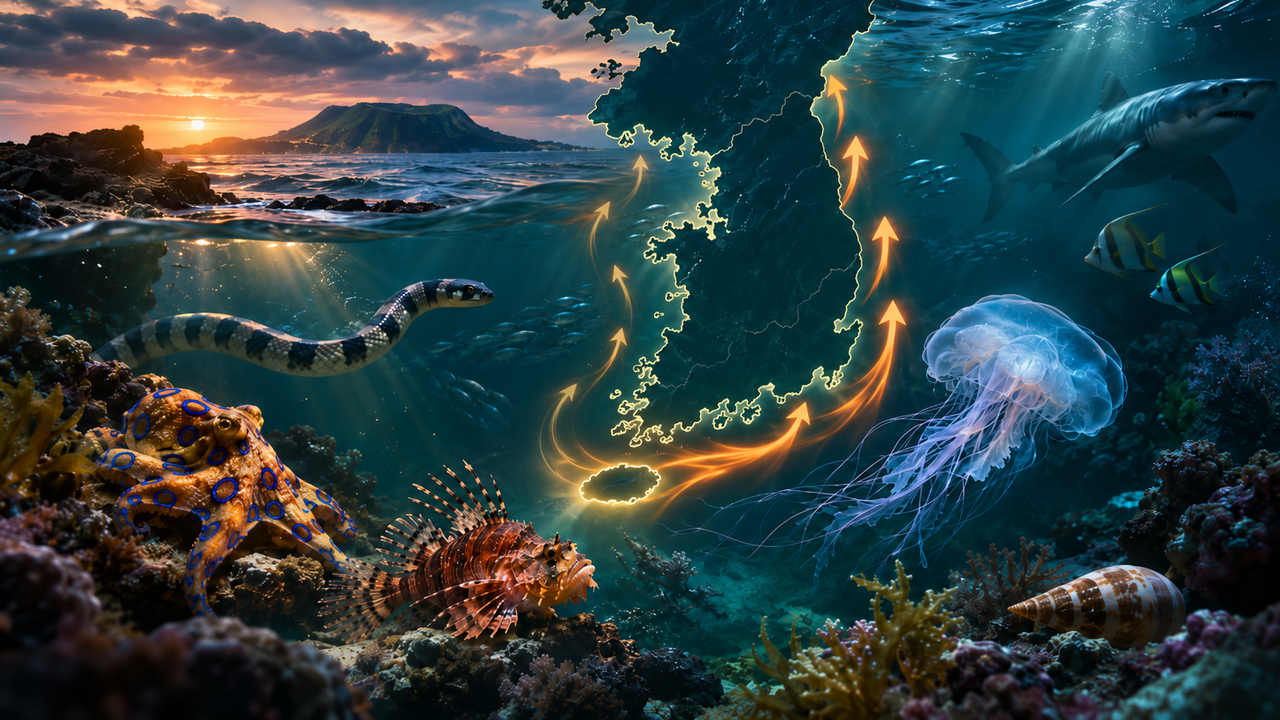
Venomous octopuses, sea snakes and toxic jellyfish are spreading rapidly beyond Jeju Island into the South and East seas, driven by rising ocean temperatures that have pushed tropical and subtropical species as far north as the waters off Goseong in Gangwon Province.
According to a KIOST analysis released Thursday, the number of hazardous marine species recorded in the East Sea more than tripled — from five between 2006 and 2015 to 16 between 2016 and 2025. Over the same period, the South Sea saw the count double from 10 to 20 species. Jeju Island rose from 13 to 15 species and the West Sea from 11 to 12, meaning hazardous species increased across every coastal region of the country.
The northward advance of tropical and subtropical species is particularly striking. Five of seven representative tropical and subtropical species have shifted their northernmost recorded appearances farther up the peninsula than before. The bannerfish and amberjack have been spotted as far north as the Goseong coast in Gangwon Province, while the highly venomous broad-banded sea snake has been found in waters off Tongyeong in South Gyeongsang Province.
The venomous blue-ringed octopus, previously found mainly around Jeju Island, has now been confirmed along the southern coast, and the toxic Portuguese man-of-war has been sighted along the East Sea coast as well.
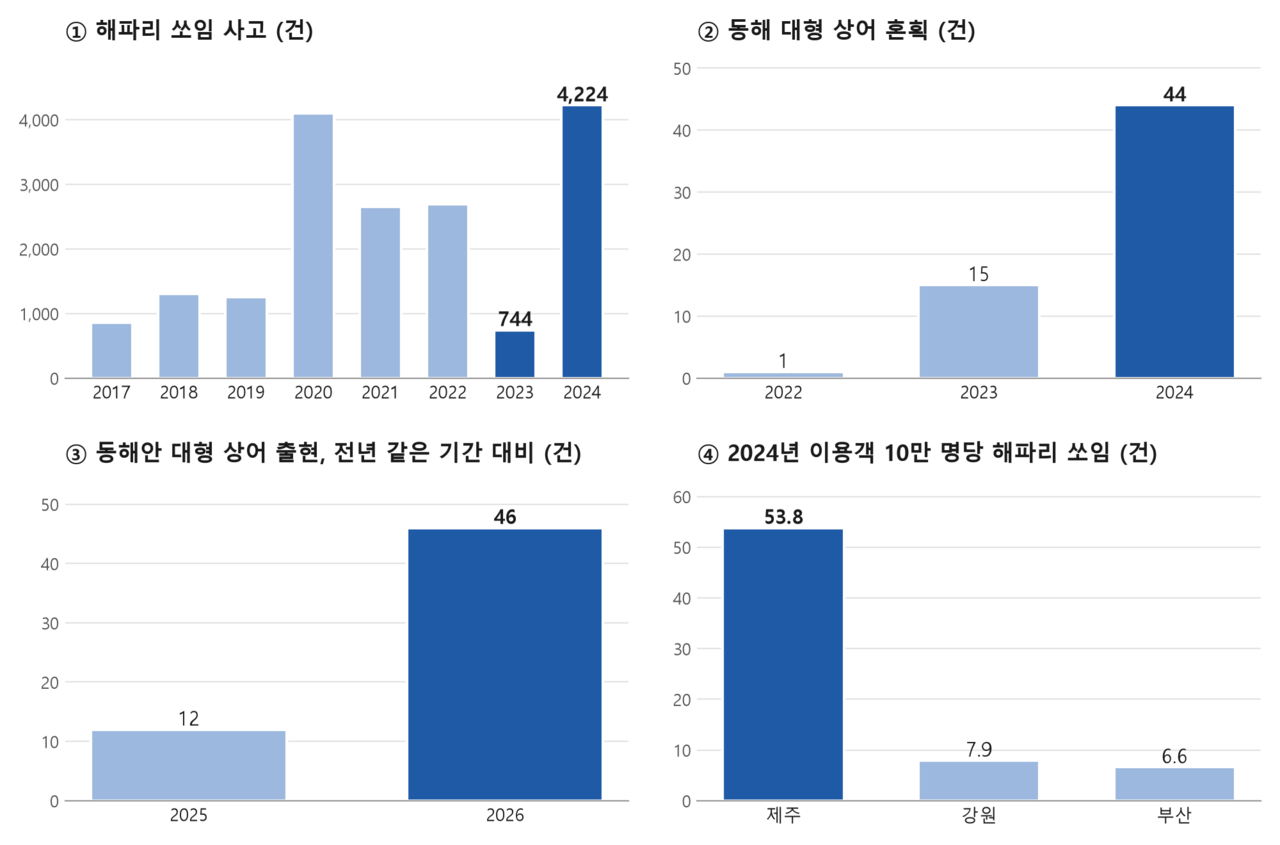
Safety incidents involving hazardous marine life are also rising sharply. Jellyfish sting cases nationwide jumped from 744 in 2023 to 4,224 in 2024, a 5.7-fold increase. Large sharks caught as bycatch in the East Sea jumped from one case in 2022 to 44 in 2024. As of June 24 this year, large shark sightings along the East Sea coast reached 46 — 3.8 times more than the same period the previous year.
Researchers attributed the trend primarily to the subtropicalization of Korean waters, driven by rising sea temperatures and the expansion of warm ocean currents.
Jeju Island is drawing particular attention as a key observation point for tracking the northward movement of hazardous marine species before they reach the mainland. Over the past decade, the rate at which toxic fish, sea snakes and cone snails were observed around Jeju was 3.4 to 4.2 times higher than in other sea zones. Of 16 domestic sightings of the devil firefish, 13 were recorded around Jeju; of five sightings of the broad-banded sea snake, three were confirmed there.
Since 2023, tropical and subtropical species have outnumbered temperate species in Jeju waters for three consecutive years.
"Hazardous marine species first spotted around Jeju are later being confirmed in the South and East seas as well," said Ko Seong-gil, a research fellow at KIOST's Tropical and Subtropical Research Center. "To understand the nationwide trend of increasing hazardous species, we need to closely monitor changes in Jeju's waters."
A key concern is that while hazardous marine species are spreading quickly, the scientific information needed to accurately identify and respond to them remains insufficient.
Domestic sighting records for the 36 hazardous marine species registered in international biodiversity databases number only 1,174 entries, and seven of those species have no domestic sighting records at all.
In fact, of 45 sea snake reports submitted with photos or video over a four-year period beginning in 2013, only 18 turned out to be actual sea snakes. The rest were misidentifications — fish or land snakes mistaken for sea snakes.
"We first need to establish a scientific basis for how dangerous newly appearing hazardous species are and where they are being found," said Choi Seon-gyeong, a senior researcher at KIOST. "We also need to provide accurate information so that haenyeo divers and marine sports users can easily identify and respond to dangerous species."
Researchers called for urgent development of a real-time monitoring and early-warning system using AI.
The proposed system would use AI video analysis to automatically identify hazardous species, with underwater drones and unmanned observation equipment providing round-the-clock surveillance of beaches, haenyeo fishing zones and aquaculture farms. Combined with ocean environment data such as water temperature, the system could predict the risk of hazardous species appearing and enable preemptive responses, the researchers said.
"Jeju is the gateway where hazardous marine species moving north from the south can be detected first," said Kim Tae-hun, a principal researcher at KIOST. "We need an AI transformation of ocean management — one that connects the entire process, from AI-based species classification to unmanned real-time surveillance, early warning and response."
nbgkoo@heraldcorp.com