
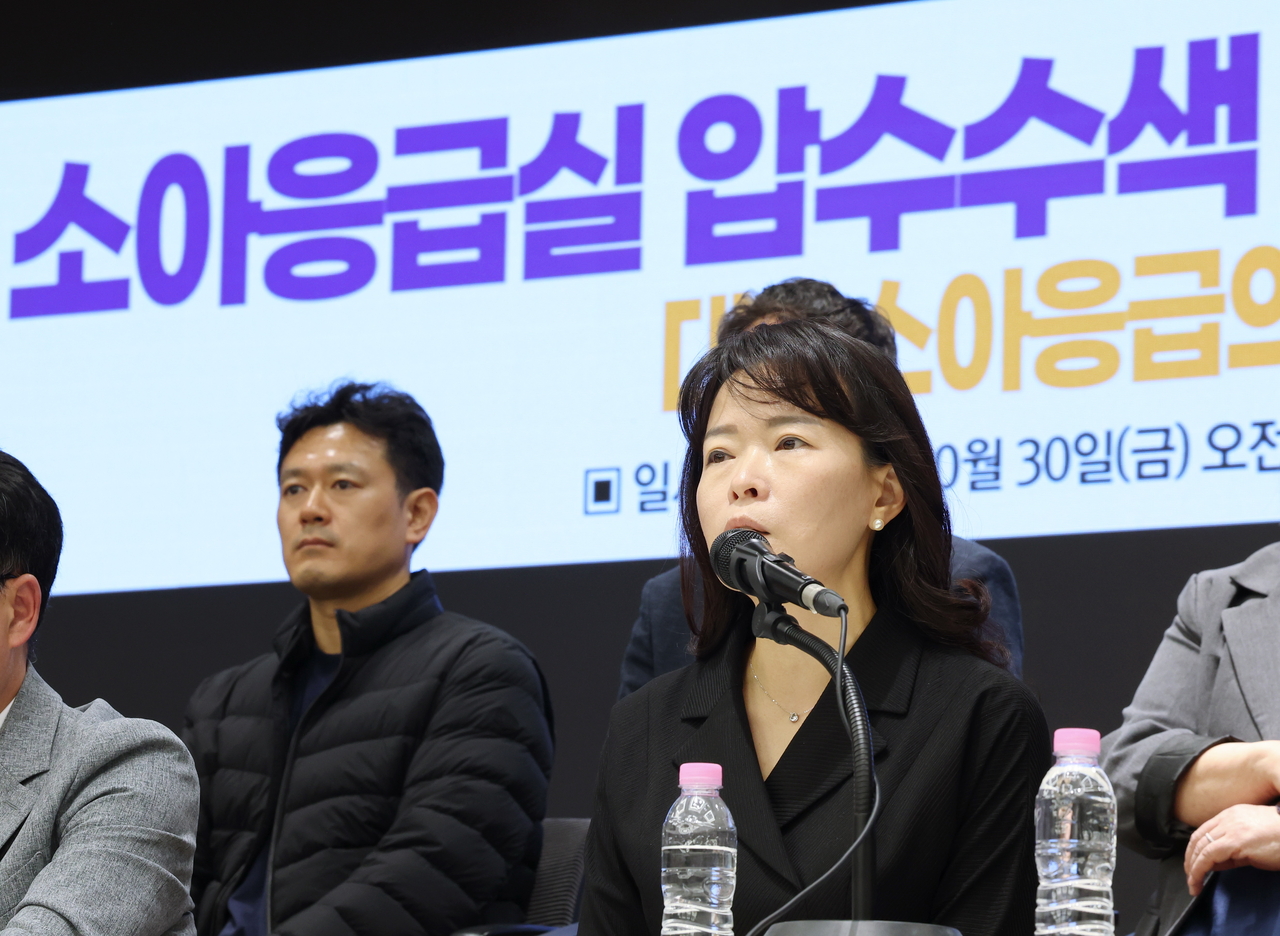
Concerns over gaps in emergency medical care are mounting after specialists at Ajou University Hospital's pediatric emergency medical center began resigning one after another over a police raid — and now the center's director has also submitted a resignation letter.
Lee Ji-suk, director of the pediatric emergency medical center at Ajou University Hospital, said at an emergency press conference held Friday at the Korean Medical Association headquarters in Yongsan-gu, Seoul, that Lee had submitted a resignation to the hospital president on Thursday.
Lee said senior police officials had visited the hospital Thursday and acknowledged a lack of understanding of how emergency medical settings operate, and apologized for the pressure and distress caused by the raid. "However, we did not receive a satisfactory explanation regarding the process by which the search and seizure warrant was requested and executed without prior notice — the very thing we wanted to understand," Lee said.
Lee added that it was unclear how many pediatric emergency specialists would ultimately resign as a result of the situation. "Whether to submit a resignation is a matter of freedom of occupational choice and depends on each individual's circumstances," Lee said.
Lee urged the public and media to refrain from using terms such as "mass resignation" or "collective action." "We are not engaging in collective action under some framing in order to achieve a particular goal," Lee said, adding that the center is currently operating normally.
The Gyeonggi Southern Police Agency raided the pediatric emergency medical center and other areas of Ajou University Hospital on Sept. 30 in connection with the death of a child patient who had been receiving treatment at the hospital in July.
The hospital pushed back, saying police had entered the emergency center on the day of the raid without regard for patients being treated, spent about an hour and a half checking computers and demanding documents. Calls also came from the political sphere for a police apology and an internal investigation into how the raid was conducted.
As the controversy grew, Korean National Police Agency Criminal Investigation Bureau Director Jeong Sang-jin and Gyeonggi Southern Police Agency acting chief Kim Hong-geun visited Ajou University Hospital on Thursday for a closed-door meeting lasting about 40 minutes with Hospital President Jo Jae-ho and pediatric emergency center Director Lee. A Ministry of Health and Welfare official was also present at the meeting, according to sources.
The press conference Friday was attended by Lee as well as Ryu Jeong-min, president of the Korean Society of Pediatric Emergency Medicine, Kim Do-gyun, chairman of the Pediatric Emergency Medical Center Association, and directors of pediatric emergency medical centers at major hospitals.
Those present said that treating physicians who did everything they could but still lost a child patient should not be presumed potential criminals from the outset, and that executing a warrant by storming into a clinical zone drives frontline medical staff into extreme fear and self-doubt, leading to defensive medicine and preventing them from making the best decisions. "The harm falls entirely on sick children," they said.
They called for police searches and seizures at essential medical facilities to be restricted as a matter of principle, and said that when such action is unavoidable, the system must be reformed to require that medical experts' opinions be incorporated into the prior consultation process and the court's warrant review.
betterj@heraldcorp.com




