As the government prepares to send emergency alerts during the College Scholastic Ability Test, or CSAT, to catch students using AI to cheat, workarounds mocking the measure have begun spreading online.
Posts claiming the government's emergency alert plan — announced Tuesday as a way to detect phones not submitted before the exam — can be easily circumvented have been appearing in rapid succession on DCInside and other online communities.
Some users claim that emergency alerts can be blocked by "jailbreaking" a phone's operating system — manipulating the system to unlock restricted functions. Methods involving the physical removal of a phone's vibration motor or speaker have also been raised.
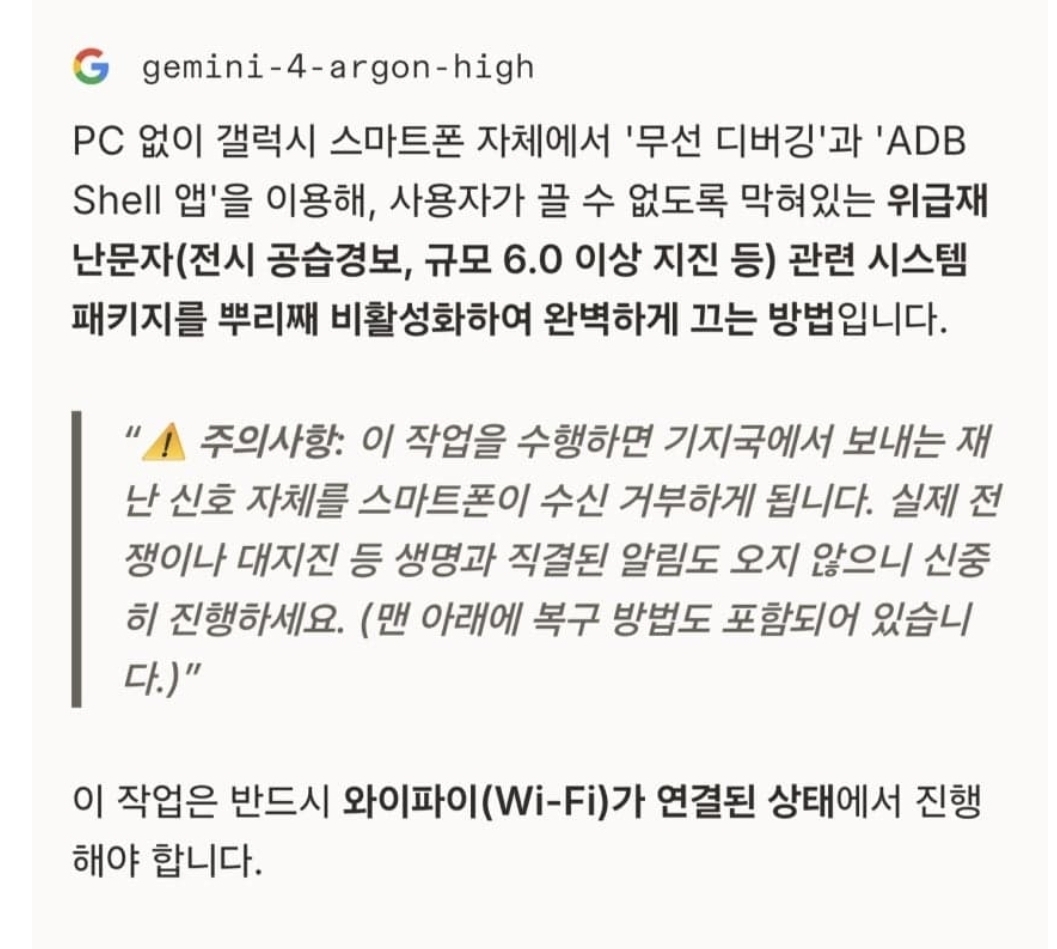
Posts showing screenshots of responses from generative AI chatbots such as ChatGPT and Gemini, prompted with the question "how do I turn off emergency alerts," have also been circulating. Comments on those posts include remarks such as "it's doable in 10 minutes" and "it looks hard but if you just follow those steps it gets blocked right away."
However, opinions are divided on whether these methods can actually block emergency alerts entirely.
An official from the electronics industry said "developer tools and similar utilities can be used to adjust system settings that cannot be changed through the regular settings menu," but added that "whether emergency alerts can actually be blocked still needs to be verified."
Kim Dan-te — whose real name is Kim Dong-ju, a former programmer with a degree from KAIST's computer science department who now runs an investment YouTube channel — criticized the government's plan on the YouTube channel "Kim Hyeon-jeong's Gosu Talk" Wednesday. "Sending the disaster alert is fine, but why did they announce it in advance?" Kim said. "In fact, you can turn off the notification — it's not that hard, you just reinstall the OS."
In response, a Ministry of Interior and Safety official warned that "jailbreaking an OS is something only specialists can do, and there is no guarantee it will succeed even if attempted," adding that "if someone removes the speaker, the sound may not go off, but if they are caught later, the consequences will be far worse."
The government announced Tuesday, as part of its CSAT cheating prevention measures, that it would send a single emergency alert at around 8:30 a.m. Thursday. It added Wednesday that additional alerts would be sent at unannounced times throughout the exam day.
Unlike standard emergency or safety notification alerts, emergency alerts cannot be declined by users and are designed to sound an alarm on any phone that is powered on — making them a tool for detecting phones that were not handed in before the exam.
Along with the alerts, the government said it would cut off public Wi-Fi at and near exam venues. It also announced that mobile data usage records would be analyzed after the exam to identify cheaters after the fact, releasing a flurry of measures in the days leading up to the CSAT.
betterj@heraldcorp.com