
- KASA conducts detailed analysis of 29 candidate landing sites
- Soft-landing verification planned for first half of 2032, resource exploration for second half
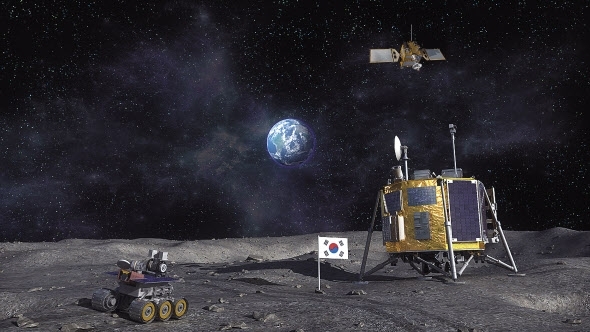
South Korea has launched a detailed analysis of 29 candidate landing sites as it works toward an independent lunar landing in 2032. The plan calls for selecting an optimal landing site by evaluating surface terrain and landing safety alongside the potential for exploring resources such as water and minerals.
The Korea AeroSpace Administration said Friday it held a roundtable on lunar landing site selection at the Korean Space Science Society's autumn academic conference, presenting scientific and engineering analyses of candidate sites for two spacecraft — a soft-landing verification vehicle and a lunar lander — both scheduled for launch in 2032.
South Korea plans to launch the soft-landing verification vehicle in the first half of 2032 and the lunar lander in the second half.
The verification vehicle will test the technology needed to touch down safely on the lunar surface and observe the lunar environment. The lander that follows will carry out precision landing and resource exploration. The long-term goal is to develop technology for utilizing in-situ lunar resources and lay the groundwork for establishing a lunar economic base.
KASA analyzed nine candidate sites for the verification vehicle and 20 for the lander, adding locations flagged by scientists to those reviewed at a public hearing on the lunar exploration mission plan in March.
Because the two spacecraft have different missions, the criteria for selecting their landing sites also differ.
For the verification vehicle, candidate sites were assessed on their suitability for observing how space weather — including solar wind and Earth's magnetosphere — affects the lunar surface. The ability to study the properties of fine dust accumulated on the surface was another key factor.
For the lander, the focus was on resource exploration potential. Analysts examined the chemical composition, mineral diversity and geological characteristics of the lunar surface, and evaluated the likelihood of finding volatile substances such as hydrogen and oxygen as well as metallic resources.
Landing safety was also a core criterion. Assessments covered conditions for observing Earth and the sun, surface slope gradients and the distribution of hazardous terrain — all aimed at minimizing risks during descent and ensuring the spacecraft can carry out its mission stably.
KASA said it will combine the analysis results with input from industry, academic and research experts to proceed with the site selection process, and plans to accelerate development of the lunar lander currently underway.
"Analyzing and debating candidate landing sites is a critical step toward the successful mission of our 2032 lunar lander," said Kang Gyeong-in, head of KASA's space science and exploration division. "Based on scientific and engineering analysis, we will select a landing site optimized for South Korea's lunar exploration mission."
nbgkoo@heraldcorp.com




