
Democratic Party policy committee and finance committee hold meeting with virtual asset industry
Kwon Chil-seung warns of 'great cost' if market uncertainty left unaddressed
Cho Seung-rae says ministry to draw up comprehensive virtual asset market strategy
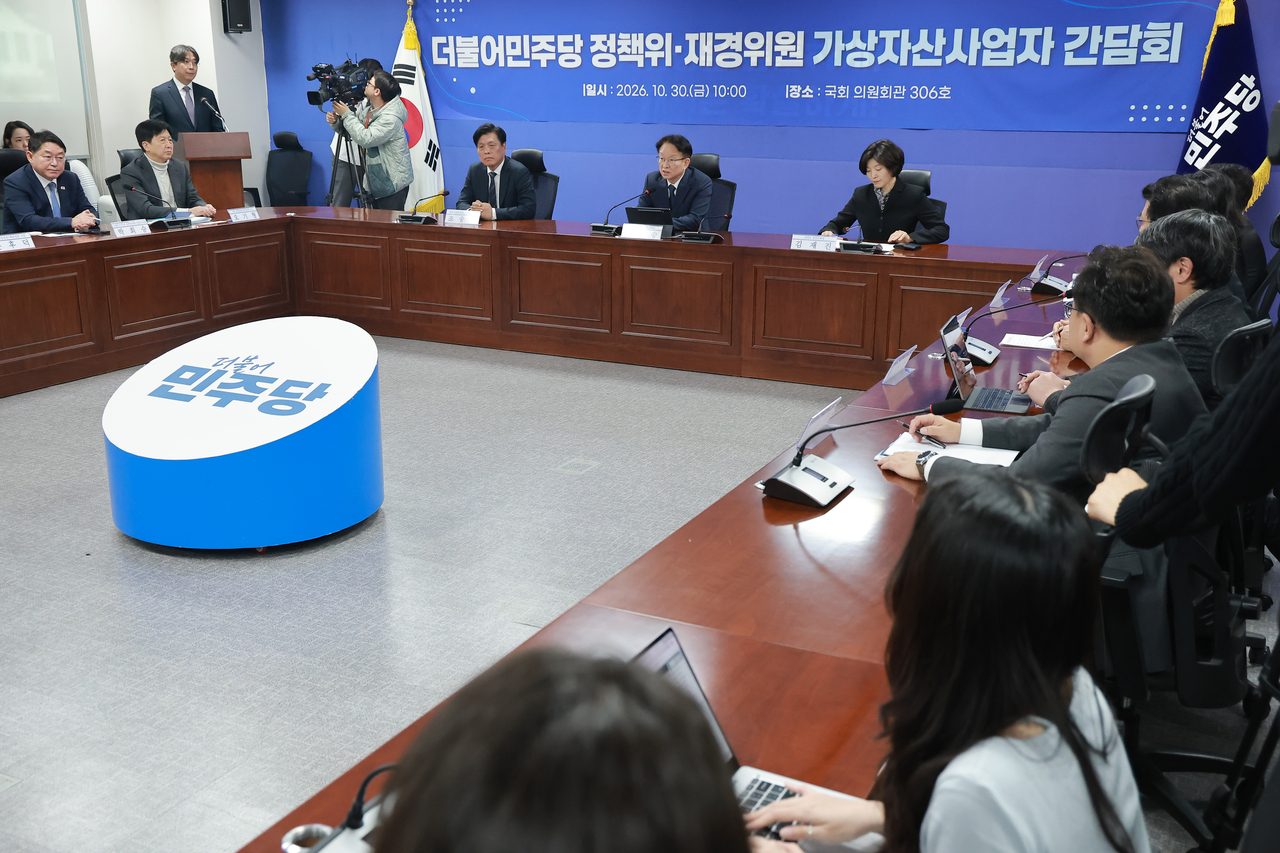
Democratic Party of Korea Policy Committee Chair Kwon Chil-seung met with five domestic virtual asset exchanges on Friday and said the party would "wrap up its position as quickly as possible" on whether to delay a cryptocurrency tax set to take effect in January.
Speaking at a meeting of the party's policy committee, finance and economy planning committee members, and virtual asset operators held at the National Assembly, Kwon said the scheduled tax date was now just two months away. "Leaving market uncertainty unaddressed any longer will impose a great cost on both the market and investors," Kwon said.
Kwon outlined the competing views within the debate. On one side, Kwon said, is the principle that income should be taxed wherever it arises, which supports proceeding as planned. On the other, the industry argues that additional delays are unavoidable given the changing environment — including new types of transactions — and the practical limits of tracking overseas exchanges and peer-to-peer trades, which leave the regulatory and operational infrastructure for taxation still inadequate.
Kwon added that there were also concerns that "unprepared taxation is not fair taxation but a punishment for conscientious taxpayers and could cause confusion." Kwon said there was broad agreement that comprehensive regulatory reform of the digital asset industry must come first, and that enacting a basic digital asset law in the near term was necessary to lay the legal foundation for user protection and a healthy ecosystem.
Kwon said participants also agreed that practical concerns raised by the industry — including reduced asset-building opportunities for younger generations in their 20s and 30s, the risk of domestic capital migrating to overseas exchanges, and the lack of loss carryforward deductions — warranted serious review. "We need to improve the predictability of taxation to foster a sound market," Kwon said.
Cho Seung-rae, the Democratic Party chair of the National Assembly's finance and economy planning committee, said the party had previously raised strong objections with the government over the absence of a clear strategy for developing the virtual asset market. Cho said the Ministry of Economy and Finance had agreed to work with financial authorities to produce a comprehensive plan for fostering the virtual asset market.
"When the basis and conditions for taxation are built on that foundation, market participants will likely have less resistance to being taxed," Cho said, adding that the party was considering how to reform the system in a way that develops the market and increases public acceptance of taxation.
Kim Jae-jin, standing vice chair of the Digital Asset Exchange Joint Consultative Body, said the digital asset market was at "a more critical juncture than ever." "Regulatory uncertainty can be a risk for both market participants and operators," Kim said. "After more than seven years of ongoing discussion, everyone will agree that this system must be designed and established with great care."
The meeting was convened to gather industry views before the party and government decide whether to delay the virtual asset tax. The tax was introduced when the income tax law was revised in 2020 but has been postponed three times since. The industry broadly holds that implementing the tax next year would be premature, and support within the Democratic Party for an additional delay is growing.
At a party-government consultative meeting on Wednesday, Democratic Party leader Kim Min-seok said there had been widespread opinion that "it would be desirable to delay taxation for a set period after reforming and supplementing the virtual asset regulatory system."
addressh@heraldcorp.com
raining@heraldcorp.com




