
Staff-designed tools cover legal review, office assistance and benefit searches; pilot runs through December, with service upgrades and public-facing rollout under consideration for next year
AI is making inroads across virtually every sector of society.
It has become the first stop for information — ahead of even search engines.
Public administration is no exception. AI has worked its way into areas such as taxation and legal affairs, making daily work more convenient.
Amid this trend, Dongjak-gu announced it will pilot three AI work-support services — developed in-house by district staff — from this month through December.
Jung Young-eun, who heads both the Smart Policy Team and the AI Planning Team at the district office's Smart Administration Division, designed and developed three programs on top of "Works," a generative AI platform already in use at the district: an AI legal review assistant agent, an AI district office assistant and an AI personalized benefit finder.
Each service was built to improve staff efficiency and can be used within the existing work environment without any separate installation.
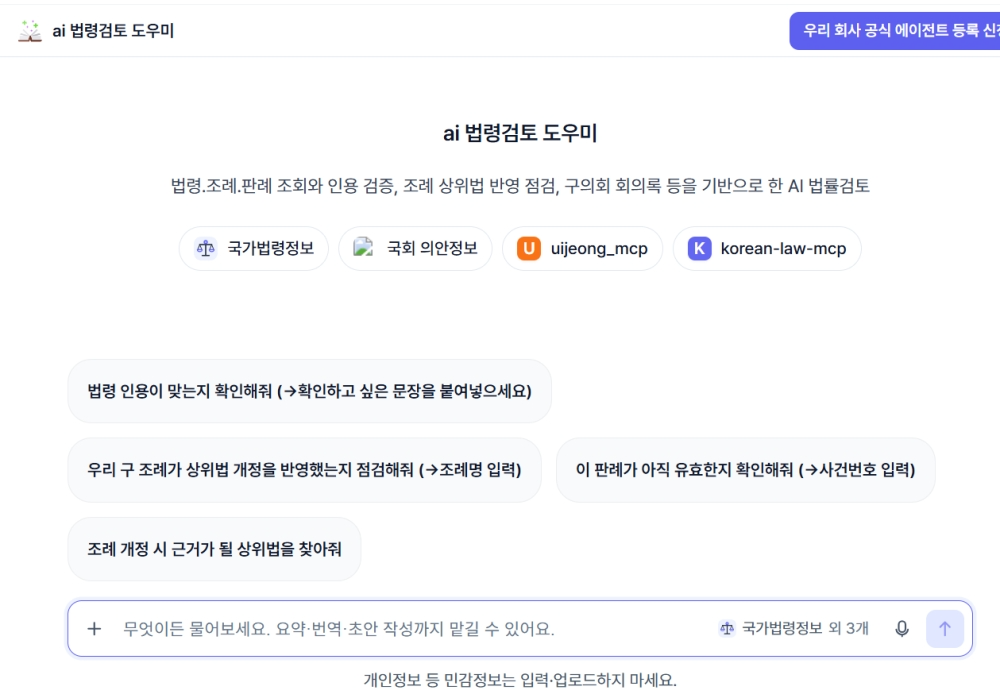
The AI legal review assistant agent searches and analyzes statutes, court precedents, ordinances and related materials to help staff examine legal issues.
The program classifies queries by subject area and automatically selects the appropriate lookup tool, pulling real-time data from official government sites including the Ministry of Government Legislation's National Law Information Center, the National Assembly's Local Council Portal and Local Finance 365. Through this, staff can access not only statutes, precedents and ordinances but also district council stenographic records and budget documents.
The AI district office assistant integrates searches across event information, resident service inquiries, budget-related data and approval documents — tasks that previously required staff to search through individual documents or websites one by one — and provides answers backed by source materials.
The AI personalized benefit finder lets users enter three pieces of information — age group, area of residence and personal circumstances — and then displays tailored benefits across seven categories (livelihood and residential support, health and care, education and childcare, employment, transportation and culture, fee reductions, and Dongjak-gu's own programs) in a table for easy reference.
Through the pilot period running to December, the district plans to collect and analyze staff satisfaction data and cases of incorrect answers, feeding the findings back into service improvements.
Next year, the district is considering upgrading the AI legal review assistant agent into a full "AI lawyer service" capable of supporting legal consultations and drafting responses for administrative appeals and litigation, while also exploring a public-facing rollout of the AI personalized benefit finder.
In addition, based on demand surveys conducted by department, the district plans to expand the development of staff workflow automation tools and public-facing services to raise overall administrative efficiency.
"We expect the programs developed this time will allow staff to handle their work more quickly and accurately," Dongjak-gu District Mayor Ryu Sam-young said. "We will continue to drive AI-based administrative innovation and raise the quality of services provided to residents."
seouldream01@heraldcorp.com




