
11st launches AI counseling support system and chatbot to strengthen customer service
Naver, Gmarket and other e-commerce platforms expand AI shopping features
Higher purchase conversion rates and order values drive adoption
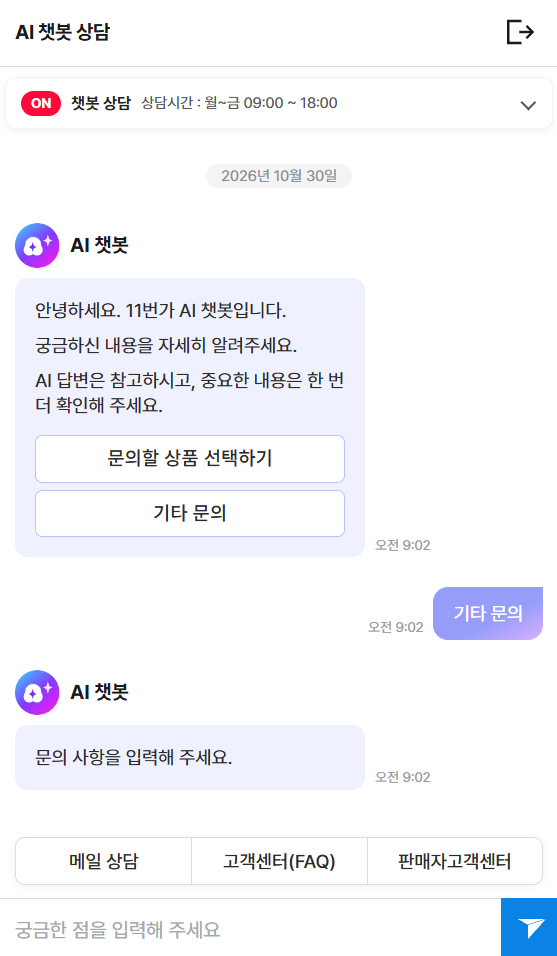
South Korean e-commerce platform 11st has launched an AI-powered customer service system and chatbot, extending its use of artificial intelligence beyond product search and recommendations into customer support — the latest sign of intensifying AI competition across the e-commerce industry.
According to retail industry sources, 11st introduced an "AI counseling support system" and an "AI chatbot" earlier this month. The counseling support system uses AI to summarize and analyze customer inquiries and supply relevant information to human agents, helping them handle cases more efficiently. The chatbot allows customers to ask questions in a conversational format and receive the information they need in real time.
"We are integrating AI technology into our customer service operations to improve counseling efficiency and enhance the customer experience," an 11st official said. "We are currently in the early stages of operation and plan to continuously refine answer quality and accuracy as we develop the service further."
11st has also been deepening AI use throughout the shopping process. In July, the platform launched an "AI search" service that recommends search keywords and related products tailored to a customer's purchase criteria. When a customer searches for "laptop," for example, the system suggests specific conditions such as "easy to carry" or "optimized for gaming" and recommends suitable products accordingly.
The platform also plans to incorporate AI shopping features into its "2026 Grand 11/11" sale, running Sunday through Nov. 11. An "AI shopping showcase" will highlight about 1,000 popular products, with AI-generated summaries of key purchase information for each item. A personalized recommendation service called "Ai Home," which predicts products a customer may be interested in, will also be prominently featured on the mobile home screen.
Other e-commerce platforms are moving quickly on AI as well. Gmarket will introduce an AI-based system for selecting discounted products during its "Big Smile Day" sale, running Monday through Nov. 13. The system uses AI to analyze product reviews, sales performance and seasonal demand to identify candidate deals.
Gmarket also plans to officially launch an LLM-based AI chatbot in early next year. The chatbot will handle routine buyer inquiries around the clock, connecting customers to human sellers only when direct assistance is needed. In the second half of next year, the platform intends to introduce an "AI shopping agent" capable of guiding customers through the entire process from product discovery to purchase.
Naver officially launched its own "AI shopping agent" in July. The service lets customers compare and receive product recommendations through a conversational AI interface. A customer who says "recommend a sofa for my new home," for instance, will receive suggestions based on the AI agent's analysis of product specifications and buyer reviews.
In September, Naver added a feature that factors in real-time delivery information to recommend products a customer can receive by a desired date. According to Naver, the number of conversations through the AI shopping agent in September rose about 60 percent from June, while transaction volume grew 82 percent over the same period.
Fashion e-commerce platform Musinsa launched an AI-powered image search service called "Musinsa Lens." Users tap the lens icon in the search bar, upload a photo, and the AI identifies the item in the image to display identical and similar products available in the Musinsa store. The service runs on an AI model developed in-house by Musinsa's technology team. In June, Musinsa also released an "AI trend curation" service that analyzes fashion trends and recommends optimal products.
E-commerce companies are expanding AI adoption because it simultaneously improves shopping convenience for consumers and drives measurable sales gains. According to the "2026 AI Market Report" by global market research firm Sensor Tower, users of Amazon's AI shopping assistant Rufus showed a purchase conversion rate roughly twice that of non-users. Average order values among users of Walmart's AI shopping assistant Sparky were also about 35 percent higher than those of non-users.
Operational efficiency is another draw. In customer service, AI can summarize and analyze inquiries and handle repetitive questions, reducing the workload on human agents. AI can also be applied to analyzing sales data and customer demand to identify competitive products.
"The ways AI is being used in e-commerce are becoming increasingly sophisticated and diverse," an industry official said. "What will matter going forward is not simply whether a company has adopted AI, but how effectively it can leverage AI to deliver real results."
korean@heraldcorp.com




