
Ministry of Land, Infrastructure and Transport investigation panel cites 'technical shortcomings and inadequate oversight'
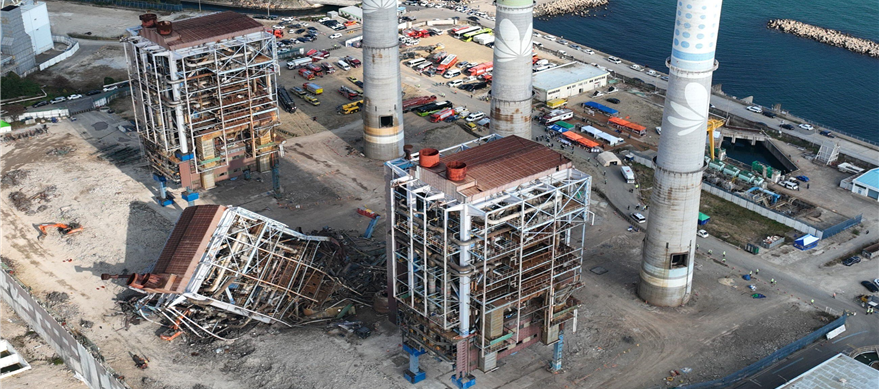
Excessive cutting of structural members that caused column failure was the direct cause of a boiler tower collapse at Ulsan Thermal Power Plant on Nov. 6, 2025, that killed seven people, an official investigation has found.
The disaster was also compounded by errors in data used for structural reviews, technical shortcomings, and inadequate stage-by-stage oversight of the demolition work — a combination that investigators characterized as a man-made catastrophe.
The Ministry of Land, Infrastructure and Transport said Friday that an accident investigation committee it formed from Nov. 18, 2025 through Oct. 17 this year — an 11-month inquiry — had uncovered these findings. The ministry had originally planned a seven-month investigation ending June 17, but extended it by four months to allow for additional examination of the area where the collapse first occurred.
According to the investigation, workers conducting pre-weakening operations — in which certain columns and beams are partially cut so a structure falls in a controlled direction — cut the columns beyond their load-bearing limit. As a result, the columns could no longer support the weight above them, and the steel plates buckled and bent in what investigators described as "local buckling," triggering a chain collapse of the entire structure.
The excessive cutting that led to local buckling stemmed from two compounding factors: errors in the structural data used during the structural review, and technical shortcomings. Together, they caused workers to miscalculate how much material could be safely removed.
Although steel plate thickness decreases toward the upper levels of the structure, workers measured plate thickness at only one above-ground location and applied that single value — 24 millimeters — uniformly to all upper columns, causing them to overestimate the columns' load-bearing capacity. The actual thickness at the point where the collapse first occurred was 15 millimeters. Workers also underestimated the load the columns had to bear by calculating the boiler tower's mass as less than it actually was: the measured actual weight was 3,525.8 tons, but the structural review used a figure of 3,005.8 tons.
The structural review also failed to account for the possibility of local buckling. Reviewers did not consider that the remaining cross-section of a column after partial cutting would be thin relative to its length, nor did they prepare for uncertainties such as accumulated deformation in an aging structure or damage that could occur during cutting.
Shortcomings were also found in construction and project management. The prime contractor relied on a specialist subcontractor's judgment for the pre-weakening and blasting work and did not closely verify whether the final construction drawings matched actual site conditions. The project owner, meanwhile, supervised the work directly without a separate construction management firm and failed to systematically oversee the performance of each participating party — leaving data errors and technical deficiencies undetected before work began.
To prevent similar accidents, the investigation committee proposed strengthening on-site surveys when planning demolition work, establishing technical standards for demolition, tightening design and construction oversight for high-risk demolition projects, and clarifying the roles and responsibilities of project owners.
Lee Gyeong-gu, chair of the investigation committee, said the panel hopes the findings will help prevent similar accidents, and added that a final report would be submitted to the Ministry of Land, Infrastructure and Transport in November after the results are compiled and refined.
The ministry said it plans to draw on both this investigation's findings and those from a separate probe into a collapse during the demolition of the Seosoumun overpass to develop broader reforms to the demolition work regulatory regime. Kim I-tak, the ministry's first vice minister, launched a public-private joint task force on demolition safety in June — involving the Korea Infrastructure Safety Corporation, the Korea Institute of Civil Engineering and Building Technology, and the Korean Society of Civil Engineers — and said the government would review a systemic overhaul to raise safety management standards across the entire lifecycle of demolition projects, from design and construction through supervision.
The ministry also said it would notify relevant agencies of the investigation committee's findings and actively cooperate to ensure that administrative sanctions and investigations into any legal violations are carried out promptly.
The collapse occurred during pre-weakening work ahead of the demolition of an aging boiler tower completed in July 1980. The structural failure buried nine workers; seven died and two were injured.
smh@heraldcorp.com




