
District's in-house AI program cuts repetitive work, freeing staff to track financial assets and income sources of delinquent taxpayers
Gangnam-gu is applying AI to tax administration, making it easier to pursue residents with unpaid local taxes.
The district has seized and collected funds from delinquent business owners who held money in securities firm deposit accounts, and tracked down wage claims from high-income salaried workers who had not paid local taxes — notifying them in advance before proceeding with collection.
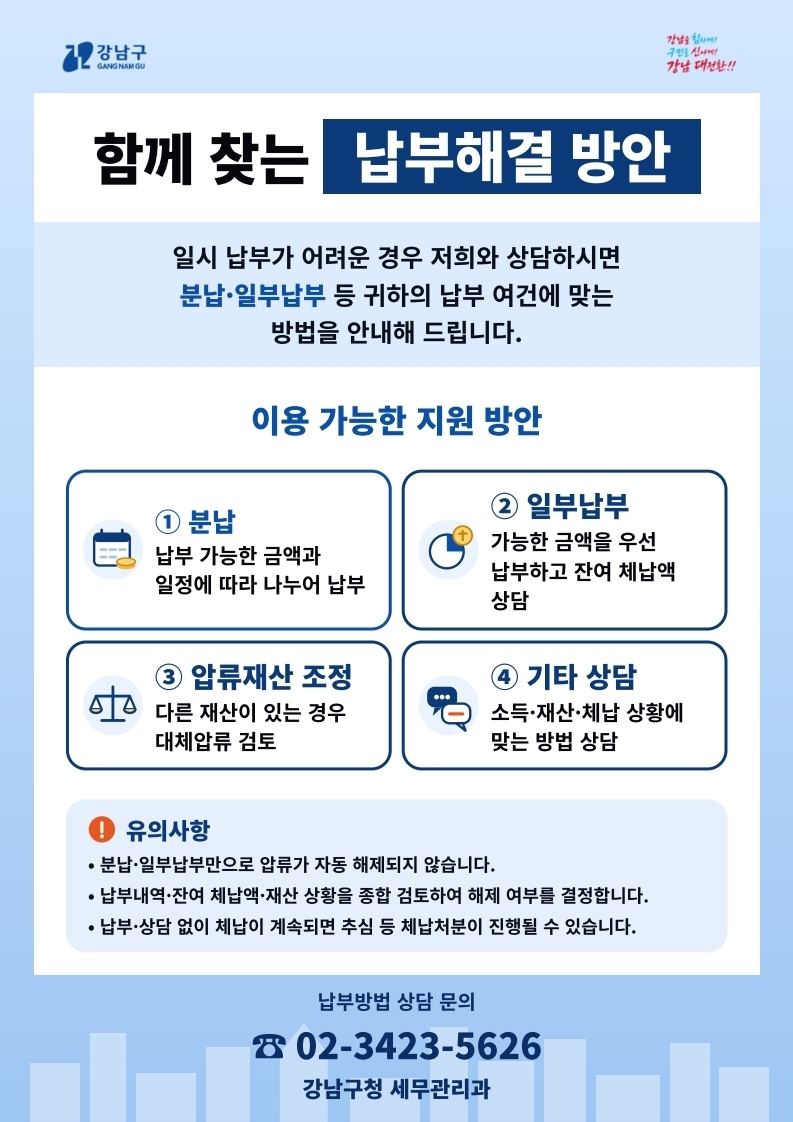
However, delinquent taxpayers facing temporary financial hardship are offered options such as installment payments.
Gangnam-gu is using AI to reduce repetitive administrative tasks in tax collection and tailor its enforcement approach to each taxpayer's circumstances. High-income or willful delinquents are tracked precisely down to their financial assets and wages, while those experiencing temporary cash shortfalls are offered installment payment plans and other accommodations.
Behind this tailored approach is an AI-assisted tax delinquency management program the district developed in-house, called Chenabneum. The program streamlines repetitive tasks — searching and reviewing delinquency records, organizing data, and managing investigation histories and follow-up actions — freeing staff to spend more time examining delinquents' financial assets and income sources.
Until now, asset seizures had focused mainly on deposits held at major commercial banks. Drawing on the administrative capacity freed up by the program, the district has expanded its reach to secondary financial institutions — including savings banks, community credit cooperatives and regional agricultural cooperatives — as well as securities accounts and wage claims. Staff cross-reference financial and income data against existing seizures and prior-ranking claims to identify assets most likely to yield actual collection, while also reducing cases of excessive seizure.
As a result, the total amount seized from financial accounts and wages in the first nine months of this year reached 84 billion won ($62.9 million), 18.3 times the figure for the same period last year. Actual collections came to 3.27 billion won, a 15.3-fold increase year on year. The district said its focus has been on tracing the actual flow of funds to achieve real collection, rather than simply increasing the number of seizures.
Enforcement methods also vary by asset type and the taxpayer's situation. Deposits and securities holdings are seized without prior notice — given the risk that funds could be withdrawn — and then collected. Wages, being directly tied to livelihoods, are handled differently: the district first issues a warning and offers payment counseling, giving taxpayers the chance to pay voluntarily or in installments. Seizure proceeds only if payment is still not made, and only within the limits set by law.
The program has been copyright-registered and is now in use across 20 of Seoul's autonomous districts. Its application in Gangnam-gu has been recognized as a best-practice case in tax delinquency collection by the Seoul Metropolitan Government.
"We are using AI to cut repetitive work and redirect the administrative capacity gained toward a closer look at each delinquent taxpayer's situation," Gangnam-gu District Mayor Kim Hyun-ki said. "We will continue to pursue those who are capable of paying but refuse to do so, while guiding those facing genuine temporary hardship toward flexible options such as installment payments — ensuring fair tax administration."
seouldream01@heraldcorp.com




